 Filipino Girl Name Generator
Discover beautiful Filipino names blending East and West
Guides & Articles
Filipino Girl Names: A Complete Guide to Stylish, Beautiful and Meaningful Choices
Explore the most popular, unique, modern, and culturally rich Filipino baby girl names for 2026
Introduction: The Enchanting World of Filipino Girl Names
Choosing a name for your baby girl is one of the most deeply personal and meaningful decisions a parent can ever make. In the Philippines, this decision is shaped by a beautiful and complex blend of cultural traditions, religious devotion, colonial history, family pride, and the ever-evolving tastes of a modern and outward-looking nation. Filipino girl names stand among the most musically beautiful, emotionally resonant, and culturally layered names in all of Asia, reflecting a people whose identity has been forged across centuries of rich indigenous heritage, Spanish colonial influence, American cultural connection, and a uniquely Filipino spirit that belongs entirely to itself.
The Philippines is an archipelago of more than seven thousand islands and more than a hundred distinct ethnolinguistic groups, which means that Filipino naming traditions are extraordinarily diverse. A name chosen by a family in Manila may carry different cultural echoes than one chosen in Cebu, Davao, or the Ilocos region. Yet across this beautiful diversity, certain threads run consistently through Filipino naming culture: a love of soft, musical sounds; a deep reverence for faith and family; a pride in cultural identity; and an openness to global influences that gives Filipino names a wonderfully cosmopolitan quality.
In 2026, Filipino parents are navigating an exciting new era of baby naming. Traditional Spanish-influenced names like Maria, Rosario, and Concepcion remain deeply beloved. Modern and unique names inspired by nature, English words, Korean pop culture, and creative Filipino innovation are rapidly gaining ground. Classic indigenous names rooted in Tagalog, Visayan, Ilocano, and other Philippine languages are experiencing a passionate revival. And beautiful pan-Asian and internationally influenced names are finding enthusiastic audiences among Filipino families who see naming as a bridge between heritage and the world.
Whether you are a Filipino parent searching for the perfect name for your daughter, someone of Filipino heritage looking to connect with your roots, or simply a lover of beautiful names from around the world, this complete guide covers every dimension of Filipino girl names in depth. You will find popular names and their meanings, modern and trending choices, rare and distinctive picks, culturally significant indigenous names, the influence of faith and family on naming, expert tips for choosing the right name, and a comprehensive FAQ section answering the questions Filipino parents ask most.
Popular Filipino Girl Names with Beautiful Meanings
Certain names have stood at the heart of Filipino naming culture for generations, consistently chosen by families across all regions of the Philippines because of their beautiful sounds, their deep meanings, and their connections to faith, family, and Filipino identity. These are the names that grandmothers and granddaughters share, that echo through family gatherings, and that carry a warmth recognized across every corner of the archipelago.
|
Name |
Origin / Meaning |
Why It Stands Out |
|
Maria |
Hebrew, beloved, wished-for child |
Most historically common name in the Philippines |
|
Ana |
Hebrew, grace, God has favored me |
Simple, timeless, beloved across all regions |
|
Sofia |
Greek, wisdom, knowledge |
Elegant, internationally loved, widely chosen |
|
Isabella |
Hebrew via Spanish, devoted to God |
Romantic, beautiful, deeply traditional |
|
Andrea |
Greek, strong and courageous |
Popular across generations, strong and musical |
|
Angela |
Greek, messenger of God, angelic |
Faith-rooted, beautifully familiar |
|
Camille |
Latin, noble attendant, young ceremonial attendant |
Modern classic, flowing and lovely |
|
Gabrielle |
Hebrew, God is my strength |
Strong meaning, musical French form |
|
Patricia |
Latin, noble, of noble birth |
Classic dignity, widely beloved in the Philippines |
|
Marisol |
Spanish blend, Mary of the sun, sea and sun |
Uniquely Filipino-Spanish, poetic and bright |
|
Theresa |
Greek, to harvest, summer |
Saint-rooted, deeply devotional |
|
Lourdes |
French shrine name, pilgrimage of faith |
Deeply Catholic, uniquely Filipino |
Maria holds a position in Filipino naming history that is almost impossible to overstate. For centuries, the name Maria has been the most common given name among Filipino women, reflecting the overwhelming importance of devotion to the Virgin Mary in a country that is home to one of the largest and most passionate Catholic communities in all of Asia. Maria is rarely used alone in traditional Filipino naming practice. Instead, it is combined with other names to create beautifully layered compound names like Maria Sofia, Maria Isabella, Maria Theresa, and Maria Lourdes, a tradition that allows families to honor the Virgin while still giving their daughter a distinctive and personal identity.
Sofia and Isabella have made the journey from their Spanish and Greek origins into the very heart of mainstream Filipino naming culture, loved today by Filipino parents of every background and region. These names carry an international elegance that resonates with Filipino families who are deeply connected to the global community through the Philippines diaspora, through media and popular culture, and through the country's long history of openness to outside influences.
Modern and Trending Filipino Girl Names in 2026
Filipino parents in 2026 are among the most creative and globally aware baby namers in all of Southeast Asia. Modern trending Filipino girl names reflect a dynamic cultural conversation happening at the intersection of traditional Filipino values, global pop culture, Korean Wave influence, social media aesthetics, and a growing pride in indigenous Filipino heritage. The result is an exciting and diverse landscape of modern names that feel both fresh and deeply meaningful.
|
Name |
Meaning / Inspiration |
Why It Is Trending |
|
Althea |
Greek, healing, wholesome |
Soft and elegant, rising fast among modern Filipinos |
|
Zoe |
Greek, life, full of vitality |
Short, energetic, widely fashionable |
|
Eliana |
Hebrew, my God has answered |
Musical, modern, beautiful and meaningful |
|
Aurora |
Latin, goddess of dawn, morning light |
Celestial and romantic, hugely popular |
|
Mia |
Scandinavian, beloved, mine |
Short, stylish, modern and widely loved |
|
Leah |
Hebrew, delicate, weary, gentle |
Biblical simplicity, very currently popular |
|
Hana |
Japanese-Filipino, flower, happiness |
Cross-cultural beauty, widely embraced |
|
Chloe |
Greek, blooming, young green shoot |
Fresh, modern, fashionable across Asia |
|
Anya |
Russian-Filipino, grace, inexhaustible |
Soft and beautiful, gaining rapidly |
|
Luna |
Latin, the moon |
Celestial romance, hugely trending |
|
Skye |
English, sky, limitless freedom |
Open and aspirational, very fashionable |
|
Ren |
Japanese, lotus, love, water lily |
Minimalist, cross-cultural, beautifully simple |
The Korean Wave, known in the Philippines as Hallyu, has had a visible and fascinating impact on modern Filipino baby naming trends. The Philippines has one of the most passionate K-pop and K-drama fan communities anywhere in the world, and names like Hana, Ren, and other Korean-influenced options have found genuine appreciation among young Filipino parents who grew up watching Korean dramas and listening to K-pop groups. This is not mere imitation but a genuine cultural conversation between two Asian nations with deep mutual appreciation.
Aurora has become one of the most fashionable Filipino girl names of the current era, beloved for its celestial beauty, its connection to the natural phenomenon of the aurora borealis, and its role as the name of Sleeping Beauty in the beloved Disney animated classic. For Filipino parents who want a name that is both internationally recognized and aesthetically beautiful, Aurora hits every mark perfectly. Luna follows a remarkably similar trajectory, having crossed from a name that once seemed unusual or exotic into one of the most widely embraced modern names across the entire Philippine archipelago.
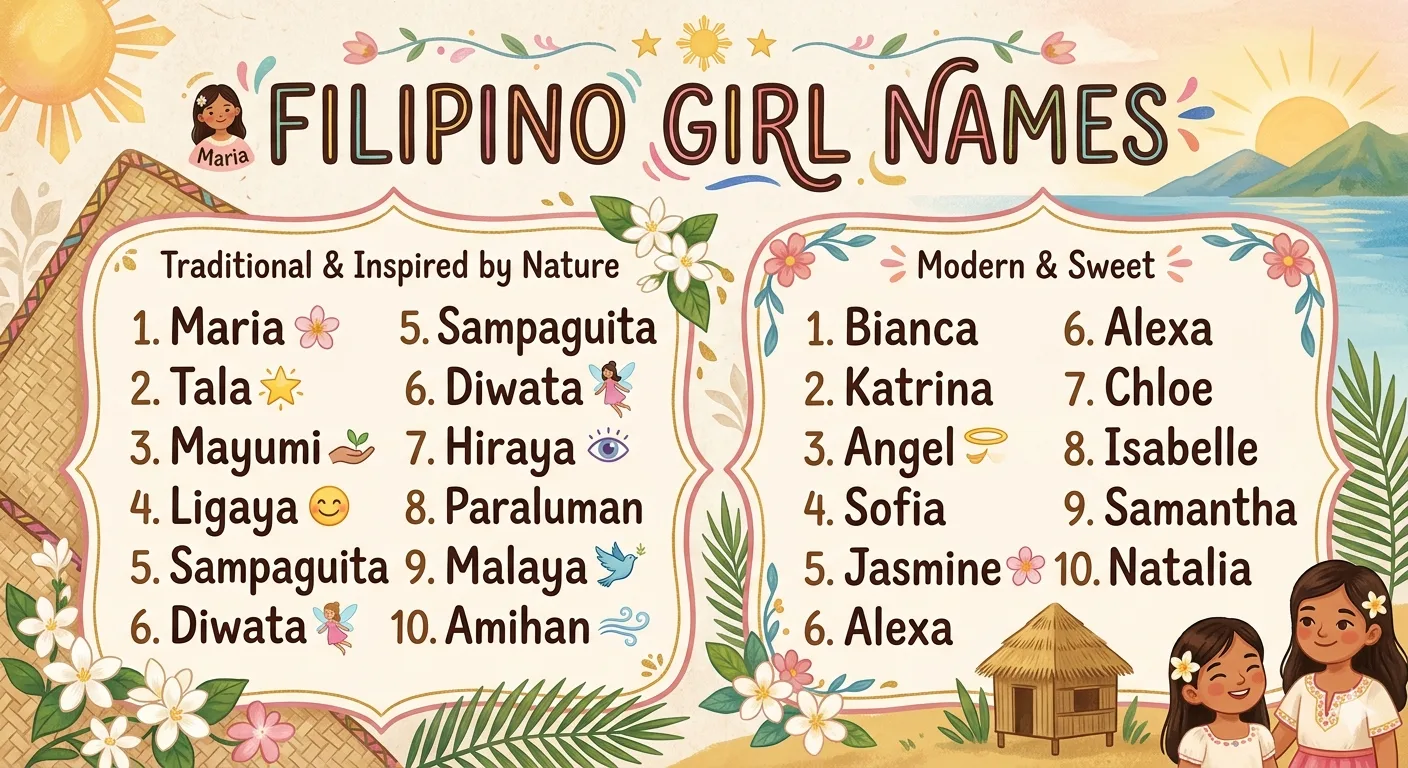
Traditional Filipino Girl Names Rooted in Culture and Heritage
Traditional Filipino girl names carry the beauty of history, the depth of cultural heritage, and the warmth of generations of family love. These are the names that appear in handwritten family bibles, that are whispered in prayers, that link living Filipinos to their grandparents and great-grandparents. They range from deeply Spanish-influenced names that reflect the country's colonial heritage to names from indigenous Philippine languages that are experiencing a passionate contemporary revival.
|
Name |
Origin / Meaning |
Why It Endures |
|
Rosario |
Spanish, rosary, string of prayers |
Deeply Catholic, timelessly Filipino |
|
Concepcion |
Spanish, Immaculate Conception |
Profoundly devotional, classically Filipino |
|
Dolores |
Spanish, sorrows, Our Lady of Sorrows |
Traditional faith name, historically significant |
|
Pilar |
Spanish, pillar, Our Lady of the Pillar |
Strong Marian devotion, quietly enduring |
|
Carmen |
Latin via Spanish, garden, song |
Musical and warm, classically beloved |
|
Remedios |
Spanish, Our Lady of Remedies |
Distinctly Filipino-Spanish, healing meaning |
|
Estrella |
Spanish, star, guiding light |
Poetically beautiful, traditionally Filipino |
|
Soledad |
Spanish, solitude, Our Lady of Solitude |
Deeply contemplative, traditionally honored |
|
Corazon |
Spanish, heart, sacred heart |
Famously Filipino, deeply meaningful |
|
Ligaya |
Filipino-Tagalog, happiness, joy |
Beautifully indigenous, warmly cherished |
|
Dalisay |
Filipino-Tagalog, pure, clean, sincere |
Indigenous beauty, culturally significant |
|
Nena |
Spanish-Filipino, little girl, beloved |
Affectionate, warm, timelessly Filipino |
Corazon carries perhaps the most powerful political and cultural resonance of any Filipino girl name in the modern era. Made globally famous by former President Corazon Cory Aquino, who led the peaceful People Power Revolution of 1986 that restored democracy to the Philippines, this name meaning heart has become a symbol of courage, integrity, and the Filipino people's deep capacity for nonviolent change. Naming a daughter Corazon today is both a beautiful aesthetic choice and a tribute to one of the most remarkable women in Philippine and Asian history.
Ligaya and Dalisay represent the indigenous Tagalog naming tradition that is currently experiencing a heartfelt revival among Filipino parents who want names that are authentically rooted in Philippine language and culture rather than in the Spanish colonial heritage. Ligaya, meaning happiness, is a name of extraordinary warmth and beauty, carrying in its four syllables the entire aspiration of Filipino parents for their daughters. Dalisay, meaning pure, offers a name that sounds distinctly Filipino while carrying a timeless virtue meaning that transcends cultural boundaries.
You can also use our Name Generator Tool to create unique names instantly. Colombian Girl Names
Beautiful Indigenous Filipino Girl Names from Philippine Languages
The Philippines is home to more than a hundred distinct indigenous languages and dialects, each with its own rich vocabulary of names drawn from the natural world, from traditional values, from spiritual beliefs, and from the history and culture of individual communities. Indigenous Filipino baby girl names are among the most beautiful and distinctive in Asia, and a growing movement of cultural pride is bringing them back into mainstream Filipino naming culture.
|
Name |
Language / Origin |
Meaning |
|
Amihan |
Tagalog |
Northeast wind, cool breeze, a mythical bird |
|
Bathala |
Tagalog |
Supreme deity, divine power (fem. form used) |
|
Mayari |
Tagalog |
Goddess of the moon, beauty and war |
|
Diwata |
Tagalog-Visayan |
Fairy, nature spirit, enchanted being |
|
Tala |
Tagalog |
Star, the goddess of stars |
|
Sinag |
Tagalog |
Ray of light, beam of sunshine |
|
Laya |
Filipino-Tagalog |
Freedom, liberation, the free one |
|
Mutya |
Tagalog |
Pearl, precious jewel, amulet |
|
Liwayway |
Tagalog |
Dawn, the breaking of light |
|
Dalanghita |
Tagalog |
Mandarin orange, the sweet citrus fruit |
|
Bulalacao |
Tagalog |
Falling star, meteor shower |
|
Lupeng |
Tagalog diminutive |
Beloved, a tender traditional nickname name |
Mayari is one of the most beautiful and culturally powerful names from the ancient Philippine mythological tradition. In the Tagalog creation story, Mayari is the goddess of the moon and one of the most important figures in the pre-colonial Filipino spiritual world. She is described as extraordinarily beautiful, courageous, and powerful, making her name an ideal choice for parents who want to honor the pre-colonial heritage of the Philippines while giving their daughter a name with genuine mythological gravitas. Mayari is currently one of the most beloved indigenous revival names among young Filipino parents.
Tala, the Tagalog word for star and also the name of the goddess of stars in the pre-colonial Filipino pantheon, has become one of the most fashionable indigenous Filipino girl names of the current era. It is short, easy to pronounce in any language, musically beautiful, and deeply rooted in Philippine cultural heritage. The growing international profile of Filipino culture through music, film, and the global Filipino diaspora has introduced Tala to audiences far beyond the Philippines, and it is a name increasingly appreciated by people of diverse backgrounds who are drawn to its simple celestial beauty.
Rare and Unique Filipino Girl Names That Truly Stand Out
For Filipino parents who want a name that is genuinely distinctive, the Philippine naming tradition offers a wealth of rare and uncommon choices. These unique Filipino girl names are perfect for families who want their daughter to have a name that is memorable, deeply meaningful, and unlikely to be shared with many classmates. The Philippines is rich enough in cultural and linguistic diversity to offer countless rare and beautiful options.
|
Name |
Origin / Meaning |
Why It Stands Out |
|
Apolonia |
Greek-Filipino, sun, destroyer |
Rare saint name, distinctly Filipino feel |
|
Malinao |
Tagalog, calm, serene, clear water |
Nature-rooted, beautifully rare |
|
Sampaguita |
Filipino, the national flower of the Philippines |
Fragrant, poetic, uniquely Filipino |
|
Hiraya |
Tagalog, the fruit of your dreams and hopes |
Aspirational, deeply beautiful, very rare |
|
Paraluman |
Tagalog, guiding star, muse, inspiration |
Poetic and powerful, exquisitely rare |
|
Umaga |
Tagalog, morning, the start of a new day |
Rare and fresh, full of light and hope |
|
Alamid |
Filipino, civet cat, associated with special coffee |
Unusual, earthy, distinctly Philippine |
|
Salome |
Hebrew via Filipino tradition, peace |
Biblical rarity, quietly beautiful |
|
Yolanda |
Greek-Filipino, violet flower |
Saint name, traditional yet unusual |
|
Coralinda |
Spanish-Filipino blend, coral, beautiful |
Poetic compound, distinctly Filipino sound |
Hiraya is perhaps the most aspirational name in the entire Tagalog language. Derived from the phrase Hiraya Manawari, which carries the meaning of may the wishes of your heart be granted, this name has been elevated into wide cultural awareness through a beloved Filipino children's television series that used it as its title. For Filipino parents, choosing Hiraya for a daughter is a profound wish for her future, a name that is literally a blessing and an aspiration wrapped into five beautiful syllables.
Paraluman, meaning guiding star or muse in Tagalog, represents the most poetic and romantic tradition in Filipino naming. This name, rarely given today, was more common in the early twentieth century among families who wanted to express the idea that their daughter would be a source of inspiration and light. The great Tagalog poet Francisco Balagtas wrote of Paraluman as the embodiment of pure and selfless love, giving the name a literary depth that makes it one of the most beautifully meaningful choices in the entire Philippine naming tradition.
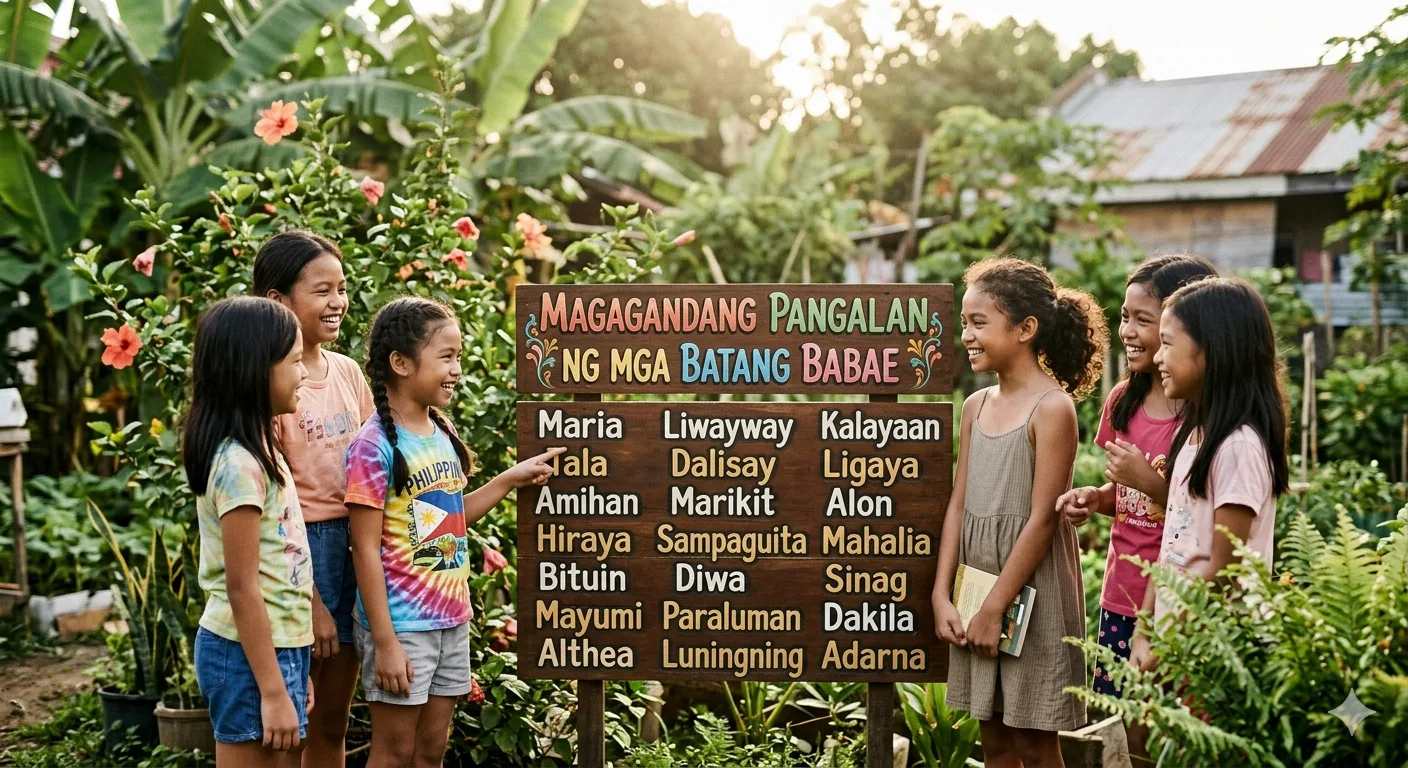
Nature-Inspired Filipino Girl Names Blooming with Beauty
The Philippines is blessed with some of the most extraordinary natural beauty anywhere on earth, from the volcanic peaks of Luzon and the chocolate hills of Bohol to the crystal-clear waters of Palawan and the rice terraces of the Ifugao mountains. This profound connection to the natural world has always inspired Filipino parents to choose names that honor the living landscape, the seasons, the sea, and the sky.
|
Name |
Natural Connection |
Why It Is Beautiful |
|
Amihan |
The cool northeast wind, seasonal breeze |
Mythological and natural, deeply Filipino |
|
Tala |
Stars, the goddess of stars |
Celestial and simple, widely beloved |
|
Sampaguita |
The white jasmine national flower |
Fragrant, poetic, uniquely Philippine |
|
Perlas |
Pearl, the ocean's precious gem |
Sea-inspired, beautiful and rare |
|
Bituin |
Star in Tagalog, shining light |
Melodic, distinctly Filipino, beautiful |
|
Uhaw |
Rain cloud (poetic usage) |
Rare and poetic, earthy and pure |
|
Dalisay |
Pure as clear water, clean |
Natural purity, Filipino through and through |
|
Rosal |
Rose bush, flowering plant |
Gentle, floral, classically lovely |
|
Sinag |
Ray of sunlight, beam of light |
Bright and warm, soft Filipino beauty |
|
Malinao |
Clear and calm water, serene |
Peace-filled, nature-rooted, rare |
Sampaguita, the small white jasmine flower that is the national flower of the Philippines, represents one of the most distinctly and beautifully Filipino name choices a parent can make. The sampaguita is deeply embedded in Filipino culture and identity. Its fragrant white blossoms are used in religious offerings, woven into garlands for honored guests, and sold by children at traffic intersections across the country. It is the scent of home for millions of Filipinos living abroad, a fragrant symbol of everything warm and beautiful about Philippine culture. Choosing Sampaguita as a name is an act of profound cultural pride.
Bituin, the Tagalog word for star, offers a distinctly Filipino alternative to international star names like Stella or Luna, with a melody and character that is completely and beautifully its own. The name was made famous internationally by the iconic song Bituin Walang Ningning, a beloved Filipino ballad about a rising star, and it carries with it the warmth of Filipino musical culture, the brightness of celestial imagery, and the pride of a name that is unmistakably rooted in the language and heart of the Philippines.
You can also use our Name Generator Tool to create unique names instantly. Comoros Girl Names
Filipino Girl Names Rooted in Catholic Faith and Devotion
The Philippines is the only predominantly Christian nation in Southeast Asia and home to one of the most deeply devoted Catholic communities anywhere in the world. The Catholic faith has been at the center of Filipino life, culture, and identity for nearly five centuries, and its influence on Filipino naming traditions is profound, pervasive, and beautiful. Faith-rooted names remain among the most consistently popular and deeply loved choices for Filipino girls across all generations.
|
Name |
Faith Connection |
Cultural Significance |
|
Maria |
Blessed Virgin Mary, mother of Jesus |
Most historically beloved Filipino name |
|
Grace |
Divine grace, God's unmerited favor |
Virtue name, widely loved in the Philippines |
|
Faith |
Belief and trust in God |
English virtue name embraced by Filipino families |
|
Lourdes |
Our Lady of Lourdes shrine in France |
Pilgrimage devotion, classically Filipino |
|
Fatima |
Our Lady of Fatima apparition |
Marian apparition, deeply devotional |
|
Milagros |
Spanish, miracles, divine wonders |
Miracle-rooted, timelessly devotional |
|
Immaculada |
Spanish, Immaculate Conception |
Deeply Marian, traditional Filipino name |
|
Asuncion |
Spanish, Assumption of Mary |
Traditional feast day name, historic |
|
Salvacion |
Spanish, salvation, divine saving |
Profoundly faithful, traditionally Filipino |
|
Esperanza |
Spanish, hope, theological virtue |
Meaningful and warm, traditionally beloved |
The tradition of naming Filipino daughters after Marian apparitions, feast days, mysteries of the rosary, and titles of the Virgin Mary is one of the most distinctly Filipino expressions of Catholic faith anywhere in the world. Names like Lourdes, Fatima, Milagros, Asuncion, and Salvacion are not simply names in the Filipino Catholic tradition. They are prayers, expressions of devotion, and declarations of faith that connect the bearer to the great mysteries of the Catholic spiritual life. Choosing one of these names for a daughter is, for many Filipino families, an act of consecrating their child to the care of the Blessed Mother.
The name Grace has crossed cultural and linguistic boundaries to become one of the most warmly beloved names among Filipino families of all social backgrounds. In the Philippines, Grace carries the full weight of its theological meaning, the unmerited favor and love of God, while also functioning beautifully as a modern, internationally recognized name that works equally well in Filipino and English contexts. This quality of being simultaneously deeply faithful and practically international is precisely what makes Grace so enduringly popular among Filipino parents.
Latest Filipino Baby Girl Naming Trends in 2026
Filipino naming culture in 2026 is undergoing one of its most exciting and dynamic transformations in modern history. Several major trend currents are shaping the names Filipino parents choose for their daughters today, reflecting the complex and beautiful ways that Filipino identity is evolving in a globally connected world.
The Indigenous Name Revival
One of the most significant and heartening trends in contemporary Filipino naming is the passionate revival of indigenous Philippine names. Driven by a growing movement of cultural pride and decolonization, many Filipino parents are choosing names rooted in Tagalog, Visayan, Ilocano, Kapampangan, and other Philippine languages as a way of honoring their pre-colonial heritage and resisting the long dominance of Spanish naming conventions. Names like Mayari, Tala, Amihan, Hiraya, and Mutya are being given to new generations of Filipino girls as declarations of cultural identity and pride.
Korean Wave Influence
The extraordinary popularity of Korean pop music, Korean drama series, and Korean beauty culture in the Philippines has had a measurable influence on baby naming trends. Filipino parents with strong K-pop and K-drama connections are increasingly drawn to names like Hana, Soo, Jia, and other Korean-influenced options. This trend is particularly strong among millennial Filipino parents who grew up during the first wave of Korean cultural exports and who now have children of their own to name.
Short and Elegant Name Preference
Filipino parents in 2026 show a clear preference for short, elegant names of two to three syllables that are easy to pronounce across languages. Names like Mia, Zoe, Anya, Leah, and Tala all fit this pattern. This preference reflects the practical reality that many Filipinos live and work internationally or in multicultural environments where a name that works equally well in Filipino, English, and other languages is a genuine advantage.
Nature and Celestial Names
The global trend toward nature-inspired and celestial names is playing out strongly in the Philippines. Names connected to stars, the moon, the dawn, flowers, and the sea are gaining rapidly. Aurora, Luna, Tala, Bituin, Amihan, and Sampaguita all reflect this desire to connect Filipino daughters to the beauty of the natural world and the cosmic order.
Creative Nickname Culture
The beloved Filipino tradition of giving children distinctive and affectionate nicknames continues to be one of the most charming aspects of Filipino naming culture. Filipino families have always been creative and playful with nicknames, and in 2026 this tradition is as strong as ever. Parents may choose a formal given name and an entirely different, lovingly created nickname. The result is that Filipino naming culture operates simultaneously on two levels: the formal name for official purposes and the beloved nickname for everyday life and family use.
You can also use our Name Generator Tool to create unique names instantly. Polish Girl Names
How Filipino Families Choose Names and What Shapes Their Decisions
The Role of Catholic Faith
For the majority of Filipino families, Catholic faith remains the single most important influence on baby naming decisions. Many families follow the traditional practice of choosing names from the Catholic calendar of saints, ensuring that the child has a patron saint whose feast day corresponds to the date of birth or baptism. Others choose names with Marian significance as a form of consecration and protection. The baptismal ceremony, which typically happens within days or weeks of birth, is a central event in Filipino family life, and the name given at baptism carries enormous spiritual weight.
Family and Ancestral Naming Patterns
Filipino families have strong traditions of naming children to honor grandparents, parents, and respected relatives. It is common for a Filipino child to carry the name of a grandparent or great-grandparent as either a given name or a middle name, creating naming patterns that run across generations and create deep connections between living children and their ancestors. This practice of intergenerational naming reflects the central importance of family, known in Filipino as pamilya, in Filipino cultural values.
Media and Celebrity Influence
Filipino popular culture, including television drama series known as teleseryes, Filipino film, and local and international music, has always had a strong influence on baby naming trends. When a popular teleserye features a beloved character with a beautiful name, that name often experiences a surge in popularity across the country. International celebrities and the characters they portray have a similarly powerful effect on Filipino naming choices, particularly among younger parents who are deeply connected to global popular culture.
The Global Filipino Diaspora
With millions of Filipinos living and working in the United States, the Middle East, Europe, and across Asia, the naming choices of the global Filipino diaspora have a meaningful influence on naming trends back home. Overseas Filipino workers and their families bring naming ideas from their countries of residence back to the Philippines, contributing to the beautiful cosmopolitan quality of modern Filipino naming culture. This global perspective is one of the reasons Filipino names in 2026 are so remarkably diverse and internationally aware.
Expert Tips for Choosing the Perfect Filipino Girl Name
Choosing a name for your Filipino daughter is a beautiful and important responsibility. Here are some thoughtful and practical tips to help guide your decision.
• Consider how the name sounds in both Filipino and English, since most Filipino children will use their name in both language contexts throughout their lives.
• Think about the full name as a whole, including the combination of given name, middle name, and family name, since Filipino names are typically used in their full form on official documents.
• Explore your family heritage and consider whether there are meaningful ancestral names worth honoring across generations.
• Look into the meaning of the name you are considering, since Filipino naming culture places great value on names with beautiful and auspicious meanings.
• Consider whether the name works well as a basis for the affectionate Filipino nickname culture, since your child will likely receive a beloved everyday nickname alongside her formal name.
• Research the saint's day or feast day associated with the name if your family follows the Catholic calendar tradition, since this can add meaningful spiritual significance to the choice.
• Trust your instinct and your heart, since Filipino naming culture ultimately values the love and intention behind a name above all other considerations.
Generate More Names: Girl Names Generator
Conclusion: The Living Beauty of Filipino Girl Names
Filipino girl names are among the most beautiful, diverse, and culturally rich in all of Asia and indeed in all of the world. They carry within them the full sweep of Philippine history, from the ancient indigenous naming traditions of the pre-colonial archipelago to the deeply devotional Catholic heritage of five centuries of faith, from the musical legacy of Spanish colonial culture to the modern cosmopolitan openness of a nation deeply connected to the global community. Every Filipino girl name is a story, a prayer, a celebration, and a gift.
Whether you choose a classic name rooted in Marian devotion, a rare indigenous name that honors the deep roots of Philippine language and culture, a modern name reflecting contemporary Filipino taste, or a nature-inspired name that connects your daughter to the extraordinary beauty of the Philippine natural world, you are participating in one of the oldest and most beautiful human traditions: the act of naming a beloved child.
In 2026, Filipino parents have more extraordinary options than ever before, from timeless traditions to exciting modern innovations. Whatever name you choose for your daughter, may it carry all the love, hope, faith, and beauty that Filipino naming culture has always expressed at its finest.