 Chinese Girl Name Generator
Discover beautiful Chinese names with rich cultural heritage
Guides & Articles
Chinese Girl Names: A Complete Guide to Stylish, Popular and Meaningful Choices
Explore the most beautiful, trending, unique and culturally rich Chinese girl names for 2026
Introduction: The Timeless Beauty of Chinese Girl Names
Choosing a name for your baby girl is one of the most profound and joyful decisions a parent can make. In Chinese culture, this decision carries even greater weight because a name is believed to shape a person's destiny, reflect the family's deepest hopes, and carry the weight of ancestral love and wisdom across generations. Chinese girl names are among the most poetic, meaningful, and culturally layered names in the entire world, drawing on thousands of years of philosophy, literature, nature worship, and artistic tradition.
In China and among Chinese communities around the world, the naming of a child is taken with extraordinary seriousness. Parents, grandparents, and sometimes even specialized naming experts are consulted. The Chinese characters chosen for a name must not only look beautiful and sound harmonious but must also carry auspicious meanings, balance the five elements in the child's birth chart, and reflect the family's values and aspirations for their daughter's future. This is a naming tradition unlike any other on earth, and the names it produces are genuinely extraordinary.
In 2026, Chinese girl names are evolving in fascinating ways. Traditional names rooted in classical poetry and ancient philosophy continue to be deeply honored, while modern Chinese parents are also embracing fresher, lighter names that sound elegant in today's world. Across China, Taiwan, Singapore, Malaysia, and Chinese diaspora communities worldwide, there is a rich and living conversation about what it means to give a Chinese girl a name that is both beautifully traditional and confidently contemporary. This complete guide explores popular Chinese girl names, modern and trending choices, traditional and classical names, rare and unique picks, and the deep cultural traditions that make Chinese naming one of the most meaningful practices in human civilization.
Popular Chinese Girl Names with Beautiful Meanings
Some Chinese girl names have risen to widespread popularity because they combine beautiful sounds with deeply auspicious meanings. These popular Chinese baby girl names are beloved by families across mainland China, Taiwan, Hong Kong, and overseas Chinese communities alike. They represent the heart of what Chinese parents look for in a name for their daughter.
|
Chinese Name |
Pinyin |
Meaning |
Why It Is Beloved |
|
芳 / 芳芳 |
Fang |
Fragrant, virtue, flowering |
Classic floral name, symbol of feminine grace |
|
玲 |
Ling |
Tinkling jade, clever, delicate |
Musical quality, widely used for generations |
|
雪 |
Xue |
Snow, pure, clean beauty |
Symbolizes purity and quiet strength |
|
晨 |
Chen |
Morning light, dawn |
Associated with new beginnings and hope |
|
娜 |
Na |
Graceful, elegant, refined |
Extremely popular across all Chinese communities |
|
美 |
Mei |
Beautiful, lovely, good |
Most universally beloved meaning in Chinese culture |
|
佳 |
Jia |
Excellent, beautiful, fine |
Joyful and positive, widely favored by parents |
|
婷 |
Ting |
Graceful, slim, upright |
Delicate feminine quality, beautiful resonance |
|
丽 |
Li |
Beautiful, lovely, elegant |
Enduring popularity across all generations |
|
慧 |
Hui |
Intelligent, wise, bright |
Parents aspire for daughters to be learned and wise |
|
静 |
Jing |
Quiet, serene, calm |
Values of peace and inner composure |
|
思 |
Si |
Thoughtful, contemplative |
Associated with wisdom and deep feeling |
Names like Mei and Li have been among the most frequently chosen Chinese girl names for well over a century because they capture something essential about the qualities Chinese culture has traditionally valued in women. Mei, meaning beautiful and good, is arguably the single most beloved syllable in Chinese female naming, appearing alone or in combination in countless names across all regions and dialects. Li, meaning beautiful and elegant, carries a similarly universal appeal.
Hui and Jing represent another equally important strand in Chinese girl naming. Chinese parents have always placed the highest value on wisdom, learning, and quiet inner strength, and names that carry these meanings are consistently among the most popular choices for daughters. A name like Jing, meaning serene and calm, expresses the wish that a daughter will grow up with a composed and peaceful spirit, able to navigate life's challenges with grace and equanimity. This reflects the deep Confucian and Buddhist values that run through Chinese naming culture.
Modern and Trending Chinese Girl Names in 2026
Chinese baby girl naming trends in 2026 reflect a fascinating interplay between deep tradition and fresh contemporary energy. Modern Chinese parents are gravitating toward names that feel poetic and light while still carrying meaningful characters. The heaviest, most formal classical names are giving way to choices that sound elegant in both Mandarin and on the international stage, as Chinese families increasingly think about their daughters growing up in a globally connected world.
|
Name |
Pinyin |
Meaning |
Why Trending in 2026 |
|
晓彤 |
Xiao Tong |
Dawn light, red sky at sunrise |
Celestial beauty, poetic and fresh |
|
悦 |
Yue |
Joyful, delighted, pleased |
Single character, light and happy feel |
|
梦琪 |
Meng Qi |
Dream of jade beauty |
Dreamy and precious, widely loved |
|
诗涵 |
Shi Han |
Poetry and grace contained within |
Literary and elegant, hugely fashionable |
|
语嫣 |
Yu Yan |
Words like blooming flowers |
Literary association, exquisitely beautiful |
|
奕辰 |
Yi Chen |
Brilliant morning star |
Modern celestial feel, gaining fast |
|
芊芊 |
Qian Qian |
Lush, verdant, flourishing |
Nature-inspired, soft and lovely |
|
乐瑶 |
Le Yao |
Joyful jade beauty |
Happy and precious combined, very popular |
|
可心 |
Ke Xin |
Pleasing to the heart |
Simple, warm, deeply endearing |
|
欣然 |
Xin Ran |
Joyful and natural, free-spirited |
Fresh and positive, trending strongly |
|
依依 |
Yi Yi |
Gentle clinging affection |
Tender and loving, beautiful repetition |
|
涵 |
Han |
To contain, to nurture, depth |
Single character trend, minimalist and deep |
One of the clearest patterns defining modern Chinese girl names in 2026 is the strong preference for names that evoke nature, light, and poetry. Names that reference dawn light, celestial bodies, jade, and flowering plants are enormously popular because they connect a child to the natural world while also carrying the aesthetic beauty that Chinese naming culture prizes above almost all else. Yu Yan, meaning words like blooming flowers, perfectly captures this fusion of literary elegance and natural imagery that contemporary Chinese parents adore.
The trend toward single-character names like Yue and Han is also significant and growing. While two-character given names have been the norm in China for most of the modern era, a new wave of parents is returning to the older tradition of single-character names, valuing their clean simplicity and the depth of meaning that a single perfectly chosen character can carry. This minimalist approach to naming feels both ancient and completely contemporary, which is exactly the aesthetic that resonates with modern Chinese families.
Traditional and Classical Chinese Girl Names That Never Fade
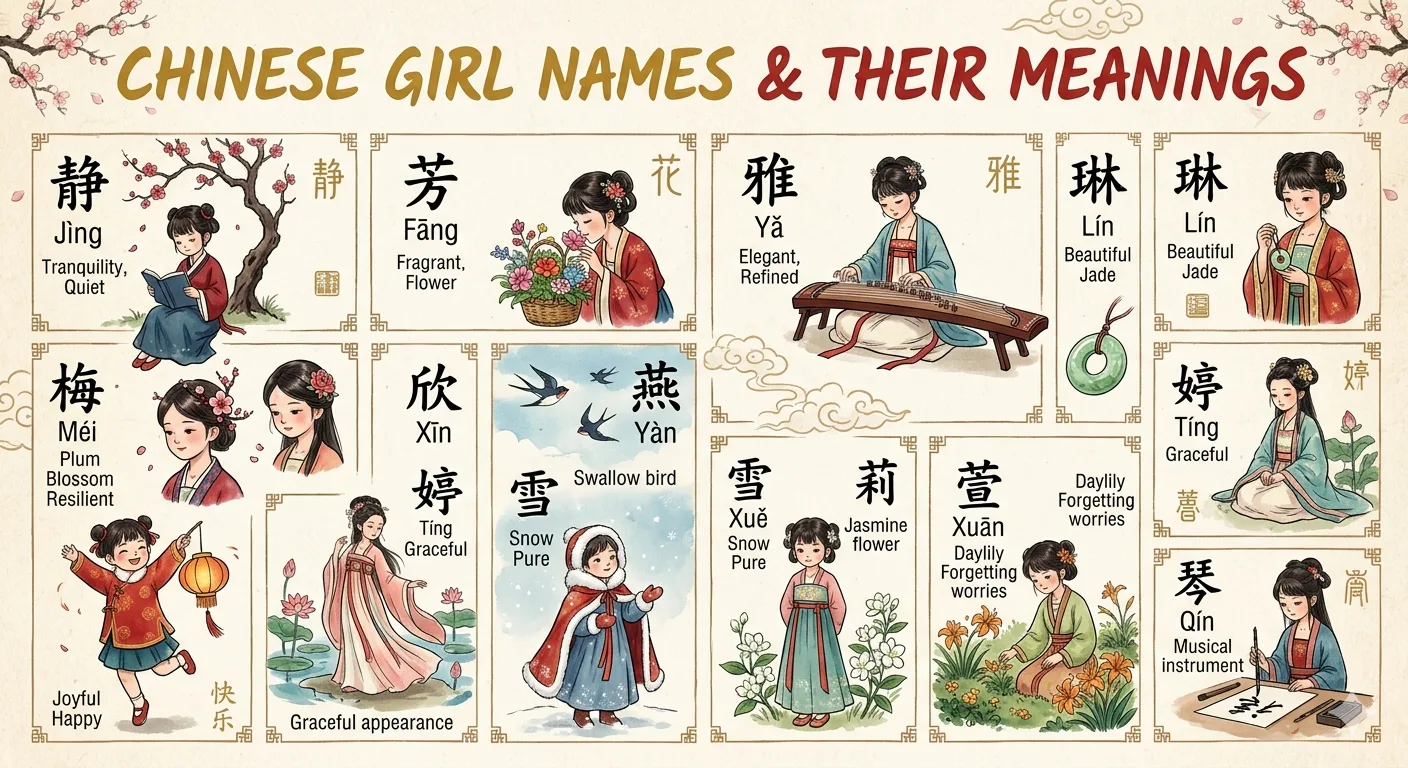
Traditional Chinese girl names draw from a treasury of classical literature, ancient philosophy, historical figures, and thousands of years of poetic and artistic heritage. These classical names carry enormous cultural prestige and deep meaning. Many of them come directly from the verses of the Tang and Song dynasty poets, from classical Confucian texts, or from the great novels and plays of Chinese literary history.
|
Name |
Pinyin |
Classical Origin |
Enduring Beauty |
|
兰 |
Lan |
Orchid, classical symbol of virtue |
Ancient symbol of noble character and refinement |
|
菊 |
Ju |
Chrysanthemum, autumn beauty |
One of the four noble plants, deeply classical |
|
梅 |
Mei |
Plum blossom, resilience in cold |
Symbol of strength through hardship, beloved |
|
荷 |
He |
Lotus flower, purity from mud |
Buddhist symbolism, supremely classical |
|
凤 |
Feng |
Phoenix, the divine feminine bird |
Imperial and mythological, grandly traditional |
|
婉儿 |
Wan Er |
Graceful, accomplished woman |
Literary association with Tang dynasty poetess |
|
昭君 |
Zhao Jun |
Bright and noble |
Famous historical beauty, classical reference |
|
贞 |
Zhen |
Chaste, virtuous, upright |
Classical virtue name, deeply honorable |
|
淑 |
Shu |
Gentle, pure, virtuous woman |
Traditional feminine virtue, widely cherished |
|
雅 |
Ya |
Elegant, refined, classical |
Confucian ideal of refinement and cultivation |
|
素 |
Su |
Simple, plain, unadorned beauty |
Daoist aesthetic of natural simplicity |
|
琴 |
Qin |
The guqin zither, music |
Classical musical instrument, artistic heritage |
The four noble plants of Chinese tradition, plum blossom, orchid, chrysanthemum, and bamboo, have long been rich sources of girl names precisely because each carries profound symbolic meaning. Mei, the plum blossom, represents resilience and the ability to flower even through hardship and cold, making it an inspiring name for a daughter whom parents hope will face life's difficulties with beauty and grace. Lan, the orchid, represents refinement, gentleness, and noble character, qualities that Chinese culture has always deeply admired in women of learning and virtue.
Feng, the phoenix, is one of the most powerful and culturally significant names in the entire Chinese tradition. In Chinese mythology, the phoenix is the supreme female bird, counterpart to the male dragon, and a symbol of divine feminine power, grace, and renewal. Giving a daughter the name Feng or a name incorporating the phoenix character is an act of enormous cultural aspiration, expressing the hope that she will rise to become someone of exceptional power and beauty. Names with deep mythological roots like this connect a child to thousands of years of cultural imagination in a way that feels genuinely magnificent.
You can also use our Name Generator Tool to create unique names instantly. Cyprus Girl Names
Rare and Unique Chinese Girl Names That Truly Shine
For families seeking something genuinely unusual and distinctive, Chinese naming tradition offers a wealth of rare and exquisite choices. These unique Chinese girl names draw on less commonly used characters, classical literary references, and poetic imagery that sets them apart from the most frequently chosen names while still carrying deep cultural meaning and beautiful sound.
|
Name |
Pinyin |
Meaning |
What Makes It Special |
|
璇玑 |
Xuan Ji |
Jade armillary sphere, celestial navigation |
Ancient astronomical instrument, rare and majestic |
|
沁芳 |
Qin Fang |
Fragrance seeping into everything |
From Dream of Red Mansions, exquisitely literary |
|
芷若 |
Zhi Ruo |
Angelica herb and gentleness |
From the Wuxia classic, rare and feminine |
|
莺歌 |
Ying Ge |
Oriole's song, musical beauty |
Bird-inspired, rare and melodious |
|
霓裳 |
Ni Shang |
Rainbow skirt, celestial garment |
Classical dance reference, ethereally beautiful |
|
嫣然 |
Yan Ran |
A bewitching smile, radiant |
Describes the most beautiful smile, poetic |
|
素心 |
Su Xin |
Simple and pure heart |
Daoist ideal, deeply meaningful and rare |
|
灵犀 |
Ling Xi |
Magical rhinoceros horn, telepathy |
From classical poetry, rare and evocative |
|
汀兰 |
Ting Lan |
Orchid growing on the waterside |
Nature poetry imagery, delicate and rare |
|
晴岚 |
Qing Lan |
Clear mountain mist after rain |
Landscape painting imagery, ethereal |
|
蕙质 |
Hui Zhi |
Orchid nature, fragrant soul |
Classical feminine ideal, refined and rare |
|
婉妍 |
Wan Yan |
Gentle and beautiful |
Quietly beautiful, uncommon combination |
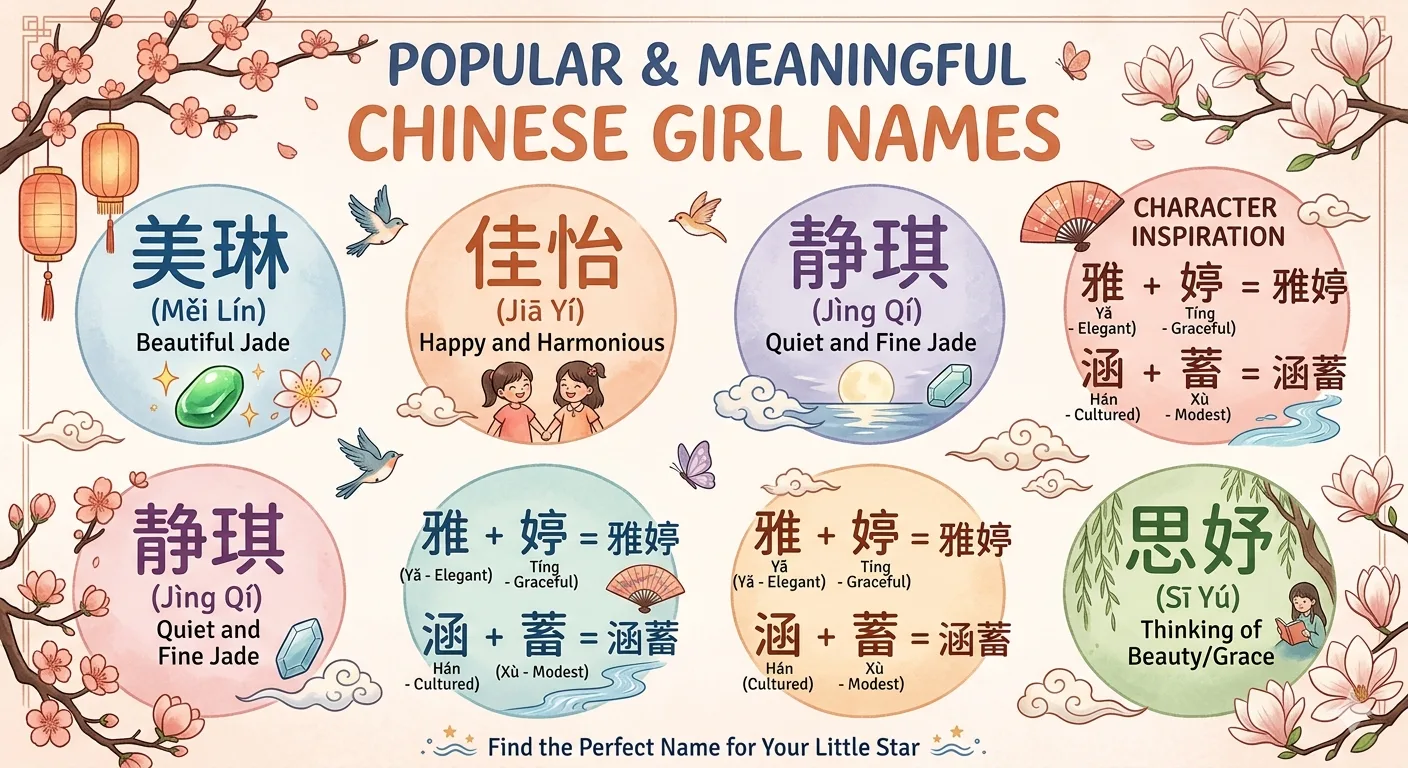
Qin Fang, meaning fragrance that seeps into everything, comes directly from the Dream of Red Mansions, China's greatest novel and one of the supreme masterpieces of world literature. The poem pavilion in the novel's famous garden was called Qin Fang Pavilion, a name given by the brilliant Jia Baoyu to honor the beauty of fallen petals and the way fragrance lingers in the air. Choosing this name for a daughter is both an act of great literary appreciation and a genuinely beautiful aesthetic choice that most people will recognize as deeply cultured and refined.
Ni Shang, referring to the legendary Rainbow Skirt dance of the Tang dynasty court, is one of those names that carries an entire world of cultural imagery within two simple characters. The Rainbow Skirt and Feather Garment melody was said to have been the most beautiful music ever composed in Chinese history, brought by the Emperor Xuanzong from a dream of the moon palace. A daughter named Ni Shang carries that entire story of celestial beauty and imperial artistry within her name, which is a remarkably powerful thing for a name to hold.
Chinese Girl Names Inspired by Nature and the Natural World
Nature has always been one of the most fertile and beloved sources of Chinese girl names. Chinese culture places an extraordinarily high value on the natural world, seeing in mountains, rivers, flowers, birds, seasons, and celestial bodies a reflection of the deepest truths about human life and virtue. Names inspired by nature give a daughter a connection to something vast and beautiful that transcends human society.
|
Name |
Pinyin |
Natural Inspiration |
Symbolic Meaning |
|
晓露 |
Xiao Lu |
Morning dew |
Fresh and pure, symbolizes a new beginning |
|
秋水 |
Qiu Shui |
Autumn waters |
Classical beauty, clear and serene |
|
云霞 |
Yun Xia |
Clouds and rosy mist |
Celestial beauty, free and luminous |
|
碧波 |
Bi Bo |
Green rippling waves |
Vivid and alive, water energy |
|
芙蓉 |
Fu Rong |
Hibiscus or lotus face |
Supreme feminine beauty, classical |
|
山月 |
Shan Yue |
Mountain and moon |
Majestic and serene, nature poetry |
|
溪桐 |
Xi Tong |
Stream and phoenix tree |
Flowing and strong, classical imagery |
|
翠微 |
Cui Wei |
Verdant mountain mist |
Mountain landscape, misty and beautiful |
|
彩云 |
Cai Yun |
Colorful clouds |
Joyful and beautiful, auspicious sky imagery |
|
霜叶 |
Shuang Ye |
Frost-touched leaves |
Autumn poetry, beauty in change |
|
竹韵 |
Zhu Yun |
Rhythm of bamboo |
Bamboo elegance, noble and flexible |
|
蓝天 |
Lan Tian |
Blue sky |
Open and limitless, pure and free |
Chinese landscape painting and poetry have always drawn an inseparable connection between feminine beauty and natural scenery. The great Tang dynasty poets compared their beloved to autumn waters, to moonlight on a jade palace, and to hibiscus flowers emerging from clear streams. When Chinese parents choose nature-inspired names for their daughters today, they are participating in a tradition of poetic imagery that goes back over a thousand years. A name like Qiu Shui, autumn waters, carries the entire weight of that poetic tradition in just two simple characters.
Bamboo names like Zhu Yun carry a particularly layered meaning in Chinese culture because bamboo itself is one of the most symbolically rich plants in the entire Chinese tradition. Bamboo is celebrated for its upright growth, its flexibility in the wind, its persistence through all four seasons, and its hollow interior that is said to represent an open mind and humble heart. Giving a daughter a name associated with bamboo expresses the wish that she will embody all of these qualities throughout her life.
You can also use our Name Generator Tool to create unique names instantly. Czech Girl Names
Chinese Girl Names Rooted in Literature and Classical Arts
Chinese literary tradition offers some of the most exquisite and culturally rich sources for girl names in the world. The great classical novels, the Tang and Song poetry traditions, the ancient Book of Songs, and the rich world of Chinese opera and drama have all contributed beautiful names that carry literary prestige along with genuine aesthetic beauty.
|
Name |
Pinyin |
Literary Source |
Cultural Significance |
|
黛玉 |
Dai Yu |
Dream of Red Mansions |
Iconic literary character, supreme poetic beauty |
|
宝钗 |
Bao Chai |
Dream of Red Mansions |
Classic feminine virtue and practical wisdom |
|
小乔 |
Xiao Qiao |
Three Kingdoms, famous beauty |
Historical beauty, enormously culturally known |
|
西施 |
Xi Shi |
Ancient Four Great Beauties |
Symbol of supreme feminine beauty in China |
|
绿珠 |
Lu Zhu |
Jin dynasty romantic heroine |
Loyal and beautiful, rare and literary |
|
素素 |
Su Su |
Classical romantic literature |
Gentle and pure, beloved literary feeling |
|
诗情 |
Shi Qing |
Poetic emotions |
Created from classical concept, deeply cultural |
|
书颜 |
Shu Yan |
Literary grace on her face |
Book-inspired, refined and scholarly |
|
墨涵 |
Mo Han |
Containing the ink of learning |
Scholarly beauty, deep cultural resonance |
|
文心 |
Wen Xin |
Literary heart and mind |
From classical literary theory, profound |
|
韵华 |
Yun Hua |
Rhyme and flowered splendor |
Poetry and beauty combined, elegant |
|
芸香 |
Yun Xiang |
Fragrance of bookworms herb |
Plant used to preserve books, scholarly |
The Dream of Red Mansions has exerted an extraordinary influence on Chinese girl naming over centuries and continues to do so today. Dai Yu and Bao Chai, the two central female figures of this great novel, represent two contrasting ideals of Chinese womanhood and femininity. Lin Dai Yu is the passionate, sensitive, artistically gifted poet who loves with her whole heart. Xue Bao Chai is the composed, virtuous, practically wise woman who manages her world with grace and intelligence. Parents who name their daughters after these characters are aligning them with one of these two great female archetypes from the heart of Chinese literary culture.
The concept of wen, meaning literature, culture, and refinement, is central to Chinese intellectual identity and appears in many beautiful girl names. A name like Wen Xin, meaning literary heart or the heart of literature, draws directly from the Wenxin Diaolong, one of the greatest works of classical Chinese literary criticism, which means the Literary Mind Carving Dragons. Naming a daughter with characters from this tradition expresses an aspiration that she will grow up with a deep love of learning, writing, and the cultural heritage that makes Chinese civilization so extraordinary.
How Names Are Chosen in Chinese Culture and Society
The Role of Chinese Characters and Stroke Count
In Chinese naming culture, the visual appearance of the characters chosen for a name matters as much as their sound and meaning. Each Chinese character is formed from a specific number of strokes, and many families consult numerological systems that assign auspicious or inauspicious meanings to different stroke counts. The visual balance and aesthetic beauty of the characters when written together is also an important consideration. A Chinese girl's name is not only heard but seen, and it must look beautiful on paper, on official documents, and carved in stone.
Five Elements Balance and Destiny Charts
Traditional Chinese naming often involves consulting a ba zi or four pillars destiny chart, which analyzes the year, month, day, and hour of a child's birth in terms of the five elements of wood, fire, earth, metal, and water. If a child's chart shows an excess or deficiency of a particular element, parents may choose characters for the name that carry the energy of the lacking element. This practice reflects the deep integration of Daoist cosmological thinking into everyday Chinese family life and shows how seriously Chinese culture takes the idea that a name can genuinely shape a person's destiny.
Generational Naming Traditions
Many Chinese families follow a tradition of generational naming in which all children of the same generation within a family share one character of their given name. This shared character, called the pai hang or generation character, is often drawn from a generation poem composed generations earlier by an ancestor. The practice creates a beautiful thread of connection running through family history, allowing the name of a child to situate her immediately within her family's story across time. This tradition has been in practice in China for over a thousand years and remains meaningful for many families today.
Regional and Dialectal Naming Differences
China is an enormous country with vast regional diversity, and naming preferences vary significantly across different regions and dialect groups. Cantonese-speaking families in Guangdong and Hong Kong have naming conventions and character preferences that differ from those of Mandarin-speaking families in Beijing or Shanghai. Hokkien families in Fujian and across Southeast Asia have their own distinct naming traditions. Families from Sichuan, Hunan, Yunnan, and other regions each bring their own local poetic and cultural influences to the naming of their daughters. This regional richness makes the landscape of Chinese girl names even wider and more varied than any single list can fully capture.
You can also use our Name Generator Tool to create unique names instantly. Colombian Girl Names
Latest Naming Trends Shaping Chinese Girl Names in 2026
Chinese baby girl naming in 2026 is being shaped by a fascinating set of cultural forces that reflect broader changes in Chinese society, values, and global awareness. Understanding these trends helps illuminate what makes Chinese naming culture so alive and dynamic even today.
The revival of classical and literary names is one of the most significant trends of recent years. Driven partly by the enormous popularity of period dramas, historical fantasy series, and Wuxia fiction on streaming platforms, Chinese parents are increasingly drawn to names that feel like they could have come from the pages of a classical novel or a Tang dynasty poem. Names like Yu Yan, Zi Xuan, Wan Er, and Ruo Xi all carry this air of classical literary beauty and are enormously popular among younger Chinese parents who have grown up with a deep love of historical drama.
The nature and celestial name trend is accelerating strongly in 2026. Names referencing stars, moon, dawn, mountain mist, lotus, and bamboo are among the fastest-growing choices for baby girls across China. This reflects a broader cultural moment of reconnection with natural beauty and traditional Chinese landscape aesthetics in a society that has experienced rapid urbanization over the past few decades.
Shorter, lighter names are becoming more fashionable. The trend toward single-character names and two-character names with a light, airy sound reflects a modern aesthetic preference for simplicity and elegance. Names that feel heavy, overly formal, or difficult to say in daily life are becoming less fashionable, replaced by choices that feel easy, beautiful, and confident. This mirrors similar trends in naming cultures worldwide, where parents are moving toward names that feel clean and contemporary without losing depth of meaning.
Global and cross-cultural influences are playing a small but growing role in Chinese girl naming. Chinese families with international experience or aspirations for their daughters to thrive on the world stage sometimes choose names that work gracefully in multiple languages or that carry meanings that translate beautifully across cultures. This is a subtle but real shift that reflects China's increasingly prominent role in the global community.
Gender-neutral character choices are a quietly growing trend. Some Chinese parents are choosing characters for their daughters' names that traditionally carried masculine associations, such as characters meaning strong, heroic, or brilliant, as an expression of their hopes that their daughter will grow up without limitations. This reflects broader changes in Chinese attitudes toward gender roles and women's place in society.
Tips for Choosing the Perfect Stylish Chinese Girl Name
Consider the meaning above all else. In Chinese naming culture, meaning is everything. The characters you choose for your daughter's name will carry their meanings with her throughout her entire life. Choose characters whose meanings genuinely move you, that express something you truly hope for your daughter, rather than simply following fashion trends.
Think about how the name sounds in both Mandarin and any other languages your family speaks. If your family is bilingual or multilingual, consider whether the name works gracefully in all the languages your daughter will use. Some Chinese names translate beautifully into English by sound or meaning. Others may be difficult for non-Chinese speakers to pronounce. There is no single right answer, but it is worth thinking about the full linguistic environment in which your daughter will live.
Look at the characters visually. Place the characters of the candidate name side by side and look at how they appear together on paper. Do they balance each other visually? Do they look beautiful when written? Chinese names are seen as well as heard, and the visual harmony of the chosen characters matters deeply in Chinese aesthetic culture.
Consult your family's generation poem if your family follows this tradition. Using the generation character that belongs to your family's current generation is a way of honoring a tradition that may go back many centuries and of connecting your daughter to the full story of your family across time.
Seek meaningful connections to your family's heritage and values. The most powerful Chinese girl names are those that carry something genuinely meaningful to the specific family that chooses them. A name connected to a beloved ancestor, to a classical text that has shaped your family's values, to a natural scene that holds special meaning in your family's history, will always feel more alive and resonant than a name chosen only for its current popularity.
Trust the beauty of the language. Chinese is one of the most tonal, poetic, and musically beautiful languages in the world. When a Chinese name sounds right, when its tones flow naturally, when its sounds create a melody in the mouth, that is a genuine sign of a good name. Listen to the sound of the name said aloud many times in different contexts. A name that sounds beautiful in conversation, when called across a room, when announced at a graduation, and when whispered tenderly, is a name that will serve your daughter well throughout her life.
Generate More Names: Girl Names Generator
Conclusion: Honoring the Poetry of Chinese Girl Names
Chinese girl names are among the most beautiful, meaningful, and culturally layered names anywhere in the world. They carry thousands of years of poetic tradition, philosophical wisdom, natural beauty, and literary heritage in every carefully chosen character. Whether you are drawn to the timeless elegance of classical floral names like Lan and Mei, the dreamy literary beauty of names like Yu Yan and Qin Fang, the celestial freshness of modern choices like Xiao Tong and Xuan Ji, or the rare poetic power of names like Ni Shang and Ling Xi, the Chinese naming tradition offers an extraordinary gift to every daughter born into it.
Naming a Chinese girl is an act of profound cultural love. It is the first poem her parents write for her, the first wish they offer on her behalf, and the first story they begin to tell about who she might become. The name she carries will travel with her through every stage of her life, shaping how others see her and how she sees herself, connecting her to her ancestors and to the vast river of Chinese civilization that flows through her family's history.
In 2026 and beyond, Chinese girl names continue to evolve while staying rooted in this extraordinary tradition. Modern parents are finding beautiful ways to honor the past while looking confidently toward the future, choosing names that carry classical depth with fresh contemporary energy. May this guide help you discover the perfect name for your daughter, a name she will carry with pride, beauty, and joy throughout her remarkable life.