Queen Names Generator
Type your name & get 100+ stylish royal queen name variations
Guides & Articles
The Ultimate Guide to Queen Names: Royal Heritage Across Cultures and Time
Throughout history, queens have embodied power, grace, and enduring legacies. Their names resonate through the ages, inspiring parents, writers, and anyone fascinated by royal heritage. Whether you're searching for egypt queen names that echo ancient grandeur, exploring other names for queen in various languages, or discovering queen names in india from the subcontinent's rich royal history, this comprehensive guide illuminates the captivating world of royal nomenclature.
Understanding the Power and Significance of Royal Names
Royal names carry profound historical weight and cultural meaning. When parents select regal names for their children, they often seek to instill qualities of strength, dignity, and leadership. The fascination with queenly appellations transcends mere aesthetics—these names embody stories of powerful women who shaped nations and influenced civilizations.
The practice of bestowing royal names has evolved across different cultures and time periods. Ancient civilizations selected names reflecting divine connections, political alliances, or desired virtues. Modern usage adapts these traditions, with people drawn to names that combine historical significance with contemporary appeal.
Egypt Queen Names Ancient Majesty from the Nile
Ancient Egypt produced some of history's most iconic female rulers, and egypt queen names continue to captivate modern imagination. The civilization along the Nile River gave the world queens whose names still resonate with mystery and power thousands of years after their reigns ended.
Legendary Egyptian Royal Women
Cleopatra represents perhaps the most famous among egypt queen names. The name, meaning "glory of the father" in Greek, belonged to several rulers of the Ptolemaic dynasty. Cleopatra VII, the most renowned, demonstrated exceptional intelligence and diplomatic skill. Her legacy has made this one of the most enduring egypt queen names in popular culture, appearing in countless books, films, and artistic works.
Nefertiti, whose name translates to "the beautiful one has come," ruled during Egypt's 18th Dynasty alongside Pharaoh Akhenaten. Her famous limestone bust, discovered in 1912, has become one of the most recognizable artifacts from ancient Egypt. Among egypt queen names, Nefertiti symbolizes timeless beauty and royal elegance.
Hatshepsut stands out among egypt queen names as a remarkable woman who ruled as pharaoh rather than queen consort. For over twenty years, she governed Egypt successfully, overseeing prosperous trade expeditions and impressive architectural projects. Her name, meaning "foremost of noble ladies," perfectly captured her groundbreaking role in ancient history.
Nefertari, the beloved wife of Ramesses II, bore a name meaning "beautiful companion." Her elaborately decorated tomb in the Valley of the Queens showcases the devotion her husband held for her. This remains one of the most romantic egypt queen names, representing ideal queenship and devoted partnership.
Additional notable egypt queen names include Ankhesenamun, Ahmose-Nefertari, and Tiye. Each carries stories of political intrigue, cultural advancement, and feminine power in one of civilization's greatest ancient societies.
The enduring popularity of egypt queen names reflects modern fascination with ancient civilizations. Parents choosing these names often appreciate their historical depth and exotic appeal, qualities that make egypt queen names continuously relevant across generations.
Queen Names in India A Rich Tapestry of Regional Royalty
The Indian subcontinent boasts an incredibly diverse royal heritage spanning thousands of years. Queen names in india reflect the region's multitude of cultures, languages, and dynasties that flourished across this vast territory. From Rajput queens of Rajasthan to royal women of the Vijayanagara Empire, queen names in india offer fascinating glimpses into the subcontinent's regal past.
Northern Indian Royal Heritage
In North India, particularly among Rajput royal families, names often incorporated Sanskrit elements reflecting virtues, beauty, or divine connections. Rani Padmini (also known as Padmavati) of Chittor remains among the most legendary figures in Indian history. Her story of beauty, honor, and sacrifice has inspired countless artistic works across centuries.
Rani Durgavati, whose name honors the goddess Durga, ruled the Gondwana kingdom with exceptional military acumen. Her name reflects the warrior spirit and devotion to Hindu deities common in medieval Indian royal nomenclature, making it a powerful example of queen names in india.
Maharani Ahilyabai Holkar of the Maratha Empire ruled Indore with wisdom and justice. Her administrative skills and temple-building activities made her reign legendary. She represents the administrative excellence found in historical queen names in india.
Southern Indian Royal Women
Queen names in india from southern regions drew from Tamil, Telugu, Kannada, and Malayalam linguistic traditions. Rudrama Devi, one of the rare female rulers of the Kakatiya dynasty, bore a name combining "Rudra" (a form of Shiva) with "devi" (goddess). Her successful reign demonstrated that women could effectively govern medieval Indian kingdoms.
Abbakka Rani, the fearless queen of Ullal in coastal Karnataka, fought Portuguese colonizers with remarkable courage. Her resistance against European colonial forces has made her name synonymous with patriotic valor in the history of queen names in india.
The diversity of queen names in india reflects the subcontinent's rich cultural tapestry. Each region contributed unique naming traditions, creating a vast collection of beautiful and meaningful royal appellations.
Queen Names in Tamil Tradition
Exploring queen names in tamil specifically reveals distinctive southern traditions. Queen names in tamil often incorporate elements like "Nachiyar" (lady or queen) and "Rani" (queen), combined with other meaningful terms. Velu Nachiyar, who fought against British colonial forces in the 18th century, represents a powerful example of queen names in tamil heritage.
Alli Rani, another historical figure from Tamil literature and history, exemplifies the poetic beauty characteristic of queen names in tamil. These names reflect both indigenous Dravidian naming conventions and cultural synthesis over millennia, making queen names in tamil particularly distinctive within the broader landscape of Indian royal nomenclature.
Other Names for Queen Across Languages and Cultures
Understanding other names for queen enriches our appreciation of how different societies conceptualized female monarchy. Various languages developed unique terms for female rulers, consorts, and regents, each reflecting specific cultural contexts and linguistic traditions.
European languages offer several other names for queen including "Regina" (Latin and Italian), "Reine" (French), "Reina" (Spanish), and "Königin" (German). These other names for queen represent the same concept while demonstrating the phonetic and grammatical diversity of Romance and Germanic language families.
Asian cultures provide other names for queen such as "Maharani" in Sanskrit-derived languages, "Huang Hou" in Chinese, and "Sultana" in Islamic contexts. These other names for queen frequently incorporate additional honorifics denoting specific rank, virtue, or divine favor.
African kingdoms developed their own other names for queen including "Kandake" in ancient Nubia, "Iyoba" in the Benin Kingdom, and various indigenous terms across the continent. Understanding these other names for queen helps appreciate the universal yet culturally specific nature of female royal authority.
Specific terms like "Queen Consort" (a reigning monarch's wife) versus "Queen Regnant" (a ruler in her own right) represent important other names for queen that clarify political authority. Similarly, "Queen Mother," "Queen Dowager," and "Queen Regent" denote specific familial or political relationships to the throne, adding nuance to other names for queen in historical contexts.
Professional titles sometimes incorporate queenly references too. In business settings, terms like "industry queen" or "queen of [field]" represent modern other names for queen that acknowledge female excellence and leadership in various domains.
Queen Names England and British Royal Heritage
The British monarchy has produced numerous iconic queens whose names remain globally recognized. Queen names england encompasses centuries of royal tradition, from medieval queens through modern monarchs. This heritage has profoundly influenced naming conventions worldwide.
Elizabeth stands as perhaps the most significant among queen names england. Elizabeth I, the "Virgin Queen," ruled during England's golden age in the 16th century. Her reign saw unprecedented cultural flowering and naval supremacy. Elizabeth II, who reigned for over 70 years in the 20th and 21st centuries, became one of history's most recognized monarchs. The name's prominence makes it central to queen names england.
Victoria represents another cornerstone of queen names england. Queen Victoria's 63-year reign defined an entire era—the Victorian Age—characterized by industrial expansion, cultural achievement, and imperial growth. Her name became synonymous with propriety, progress, and British imperial power.
Mary, Anne, and Margaret comprise additional classical queen names england. Each has been borne by significant monarchs or royal consorts who shaped British history. Mary I and Mary II both ruled as queens regnant, while numerous queens consort bore this name through different dynasties.
The influence of queen names england extends far beyond Britain's borders. Commonwealth nations, former colonies, and countries with historical British connections all show naming patterns influenced by queen names england. Parents worldwide choose these names for their historical gravitas and cultural significance.
Queen Names UK Scotland, Wales, and Ireland
Expanding beyond England alone, queen names uk encompasses the broader United Kingdom's royal heritage. Scottish queens like Mary, Queen of Scots, and Margaret, Queen of Scotland, contributed significantly to the rich tapestry of queen names uk.
Welsh heritage within queen names uk includes medieval queens from Welsh kingdoms before English annexation. While less prominent in popular consciousness than English or Scottish queens, Welsh royal women contributed unique names to the queen names uk catalog.
Irish royal history adds another dimension to queen names uk, though Ireland's monarchy ended earlier than other British Isles kingdoms. Medieval Irish queens and later noble women connected to British nobility expanded the diversity of queen names uk.
The consolidation of the United Kingdom brought these traditions together, creating the comprehensive collection we recognize as queen names uk. Modern British royalty draws from all these traditions, making queen names uk truly representative of the islands' diverse heritage.
Contemporary queen names uk continue evolving. The current British Royal Family maintains connections to historical naming patterns while occasionally introducing variations, ensuring queen names uk remains relevant to modern sensibilities.
Queen Names List Comprehensive Collection
Creating a comprehensive queen names list helps identify patterns, preferences, and the sheer diversity of royal nomenclature across cultures. A well-organized queen names list serves various purposes—from baby naming to creative writing to historical research.
A European-focused queen names list might include Elizabeth, Victoria, Catherine, Mary, Anne, Margaret, Isabella, Sophia, and Alexandra. These appear repeatedly across different European monarchies, reflecting dynastic marriages and naming traditions that crossed borders.
An Asian queen names list would feature completely different names Padmini, Wu Zetian, Himiko, Jodha Bai, Nur Jahan, and others reflecting the continent's diverse cultures and languages. This demonstrates how a truly comprehensive queen names list must account for global royal traditions.
African royal heritage contributes unique entries to a queen names list. Nzinga, Amina, Makeda, Yennenga, and Taytu Betul, among others. These names carry stories of powerful leadership often overlooked in Eurocentric historical narratives.
Middle Eastern history adds names like Zenobia, Sheba, Esther, and Tomyris to a complete queen names list. Ancient Mesopotamian, Persian, and later Islamic royal women all contributed distinctive appellations.
When compiling a queen names list for practical use, organization by region, time period, or cultural tradition helps users find appropriate options for their specific needs, whether naming a child, developing fictional characters, or conducting historical research.
Russian Queen Names Imperial Grandeur from the Tsars
Russia's imperial history offers distinctive russian queen names blending Slavic, Byzantine, and European influences. The Russian Empire's queens and empresses left powerful legacies reflected in their regal appellations.
Catherine (Yekaterina in Russian) represents the most significant among russian queen names. Catherine the Great, who ruled from 1762 to 1796, expanded the Russian Empire dramatically and brought enlightenment ideas to her realm. Her political acumen and cultural patronage made her one of history's most accomplished monarchs. This makes Catherine the most influential of russian queen names.
Elizabeth (Yelizaveta) provides another important example of russian queen names. Elizabeth of Russia, who ruled from 1741 to 1762, oversaw a period of cultural flourishing and military success. Her reign strengthened Russia's position as a European power.
Alexandra, the last Empress of Russia, bore one of the most tragic russian queen names. Her devotion to her family, particularly her hemophiliac son, and her controversial association with Rasputin contributed to the Romanov dynasty's downfall in 1917. This russian queen names carries historical weight as the last of Russia's imperial line.
Queen Victoria Names Legacy and Influence
Among all royal appellations, queen victoria names holds special significance due to the monarch's extraordinary impact on history and culture. Queen Victoria's 63-year reign (1837-1901) profoundly influenced naming conventions, social norms, and imperial expansion.
The Victorian era saw deliberate adoption of the name Victoria itself as parents honored their queen. Previously uncommon in English-speaking countries, it became extremely popular, demonstrating how queen victoria names could shift cultural patterns. This trend exemplifies the broader influence of queen victoria names on society.
Victoria's own children received names that became fashionable Alexandra, Alice, Louise, Helena, and Beatrice for her daughters. These choices, all part of queen victoria names influence, spread through European royal families as Victoria's children married into other dynasties.
The enduring popularity of queen victoria names extends to modern times. Parents still choose Victoria and its variants (Tori, Vicky, Vita) for their daughters, drawn by the historical grandeur and strength the name conveys. Queen victoria names remains synonymous with propriety, strength, and refined elegance in contemporary naming discussions.
Queen Elizabeth Names Regal Tradition Across Centuries
Queen elizabeth names encompasses one of history's most significant royal appellations, borne by two of England's most influential monarchs. The name's Hebrew origin means "God is my oath," but its royal associations have made it eternally popular.
Elizabeth I (1533-1603) ruled during England's golden age, defeating the Spanish Armada and presiding over a cultural renaissance that produced Shakespeare and other literary giants. Her strength and political acumen made queen elizabeth names synonymous with powerful female leadership. The "Elizabethan Era" itself demonstrates the impact of queen elizabeth names on cultural memory.
Elizabeth II (1926-2022) reigned for over 70 years, making her the longest-serving British monarch. Her dedication to duty and adaptation to changing times while maintaining traditional values gave queen elizabeth names continued relevance through the modern era. She witnessed and shaped enormous social, political, and technological changes, cementing queen elizabeth names as representing steadfast leadership.
Variations of queen elizabeth names appear globally Elisabeth, Elisabet, Elżbieta, and others in different languages. Nicknames like Liz, Beth, Eliza, and Bess offer flexibility while maintaining connection to queen elizabeth names heritage. This adaptability contributes to the name's enduring popularity across cultures and generations.
Queen Names for Instagram Digital Age Royalty
Modern social media has created new contexts for royal appellations. Queen names for instagram represents this digital evolution, where users select regal handles to convey confidence and authority online. Choosing appropriate queen names for instagram involves balancing historical reference with personal brand identity.
Popular approaches to queen names for instagram include combining actual royal names with creative elements "ModernCleopatra," "QueenVictoriaVibes," or "NefertitiRising." These queen names for instagram blend historical grandeur with contemporary personality, creating memorable digital identities.
Some users prefer elegant variations for their queen names for instagram, using names like "IsabellaReigns," "AlexandraTheGreat," or "CatherineOfCouture." This approach to queen names for instagram maintains sophistication while clearly communicating the user's desired image.
Influencers and content creators often select queen names for instagram that establish authority in their niches. Fashion influencers might use "StyleQueenElizabeth" or "VictoriaVogue," while wellness creators could choose "QueenOfWellness" or "AhilyabaiHealth," making queen names for instagram relevant across industries.
The creativity behind queen names for instagram demonstrates how ancient royal traditions adapt to digital platforms. Users draw inspiration from historical queens worldwide, creating unique handles that stand out in crowded social media landscapes. This modern application shows the continuing cultural relevance of queen names for instagram in expressing personal empowerment and confidence.
Queen Names for Cats and Dogs Royal Pets
Queen Names for Cats Feline Majesty
Cats possess naturally regal bearing, making them perfect recipients of queen names for cats. Their independent, dignified demeanor aligns perfectly with royal nomenclature. Selecting queen names for cats often involves matching the feline's personality or appearance with appropriate historical or fictional royalty.
Classic queen names for cats include Cleopatra (often shortened to Cleo), Victoria, Nefertiti, and Elizabeth. These timeless choices suit cats of various breeds and temperaments. A white Persian might embody the name Marie Antoinette, while a sleek black cat perfectly captures Nefertiti's elegant mystique.
More exotic queen names for cats can reference lesser-known historical figures Hatshepsut, Zenobia, or Tomyris for cats with particularly commanding presences. These distinctive choices demonstrate owner creativity while maintaining regal associations inherent in queen names for cats.
Queen Names for Dogs Canine Royalty
While dogs might seem less naturally regal than cats, many breeds possess aristocratic associations that make queen names for dogs entirely appropriate. Breeds historically favored by royalty—Corgis, Cavalier King Charles Spaniels, Afghan Hounds—particularly suit these appellations.
Popular queen names for dogs include Victoria, Charlotte, Eleanor, and Alexandra. These can be shortened to cute nicknames (Vicky, Lottie, Ellie, Alex) while maintaining the regal reference, making queen names for dogs both dignified and practical for training.
Larger, more imposing breeds might suit dramatic queen names for dogs like Boudicca, Zenobia, or Artemisia, celebrating warrior queens of antiquity. Smaller breeds can create charming contrast with grand names, making queen names for dogs work across all sizes and temperaments.
Queen Names of England Historical Progression
Examining queen names of england chronologically reveals evolving trends and political influences. Medieval queen names of england reflected Norman French influence Eleanor, Matilda, Berengaria, and Isabella dominated early periods after 1066.
The Tudor dynasty produced the most famous queen names of england. Henry VIII's six wives—Catherine (twice), Anne (twice), Jane, and Catherine again—demonstrate how certain appellations repeated across the era. Elizabeth I's reign made that particular name central to queen names of england heritage.
Stuart queen names of england included Anne and Mary (who ruled jointly with William III). The Hanoverian dynasty largely maintained traditional English naming patterns despite Germanic origins, keeping queen names of england recognizably English for public relations purposes.
Fantasy Queen Names and Creative Applications
Queen Names Fantasy Fiction and Gaming
Writers and game developers constantly seek queen names fantasy that evoke otherworldly elegance. Creating compelling queen names fantasy involves blending familiar patterns with unusual elements that transport audiences to imaginary realms.
Literary examples of queen names fantasy include Galadriel (Tolkien), Daenerys (Martin), and Titania (Shakespeare). These demonstrate how effective queen names fantasy balance pronounceability with exotic appeal. Writers creating original queen names fantasy can follow these patterns while developing unique appellations.
Soft consonants (L, M, N, R) combined with vowel-rich structures often create beautiful queen names fantasy. Examples include Aeloria, Celestria, Lunara, and Seraphina—names that work well for elven queens, sorceress rulers, or celestial monarchs.
Fairy Queen Names Enchanted Royalty
Folklore and fantasy overflow with fairy queen names representing supernatural feminine power. Fairy queen names like Titania from Shakespeare's "A Midsummer Night's Dream" have become archetypal examples of how enchanted royalty should sound.
Celtic mythology provides numerous fairy queen names Áine, Clíodhna, and Rhiannon connect to ancient beliefs about supernatural forces governing nature. These fairy queen names often associate with specific seasons, natural phenomena, or magical abilities.
Modern fantasy continues creating fairy queen names Maeve, Orianna, Lysandra, and Faylinn exemplify contemporary approaches. These fairy queen names incorporate nature elements and ethereal qualities that distinguish them from mortal royal appellations.
Queen Vampire Names Gothic Elegance
Gothic fiction has popularized queen vampire names blending aristocratic elegance with dark allure. Queen vampire names like Akasha (Anne Rice) set standards for ancient, powerful vampire queens who combine beauty with menace.
Creating compelling queen vampire names involves balancing sophistication and darkness. Historical names with tragic or sinister associations work well Lilith, Lamia, or Bathory. These queen vampire names carry pre-existing connections to death, blood, or supernatural evil.
Queen Elf Names Ethereal Royalty
Fantasy settings frequently feature elven royalty requiring appropriate queen elf names. These typically emphasize elegance, ancient lineage, and magical connections. Galadriel represents perhaps the most famous queen elf names example from Tolkien's works.
Creating original queen elf names involves combining natural elements (star, moon, tree) with elegant suffixes (-iel, -wen, -riel). Examples include Stariel, Moonwyn, or Silverleaf—instantly communicating magical nature and noble heritage characteristic of effective queen elf names.
Meaningful Royal Names
Names Meaning Queen or Goddess
Parents often seek names meaning queen or goddess to bestow powerful significance upon children. These names meaning queen or goddess derive from various languages and mythological traditions, offering rich symbolic weight.
Regina (Latin), Malika (Arabic), Rani (Sanskrit), and Reina (Spanish) all directly translate to "queen." Names meaning queen or goddess with divine connections include Juno (Roman queen of gods), Hera (Greek queen of gods), and Frigg (Norse goddess and Odin's wife).
Other names meaning queen or goddess include Sarah (meaning princess/lady in Hebrew), Rhiannon (Welsh goddess of sovereignty), and Lakshmi (Hindu goddess associated with queenly attributes). These names meaning queen or goddess combine royal and divine elements.
Names Meaning Princess or Queen
While related, names meaning princess or queen represent different hierarchical levels. Names meaning princess or queen interest parents wanting flexibility in regal associations. Sarah works as both, while Amira (Arabic for princess) carries queenly connotations.
Adeline (Germanic, meaning noble) has been used for both titles, as has Eulalia (Greek, meaning well-spoken). These names meaning princess or queen suggest royalty without being overly literal.
Japanese Names Meaning Queen
Japanese naming conventions approach royalty differently than Western traditions. Japanese names meaning queen typically use kanji representing nobility, grace, or leadership rather than directly translating "queen." The Japanese word for queen, "joō," doesn't commonly appear in given names.
However, japanese names meaning queen can be constructed using appropriate kanji. Names like Kimi (using the character for "noble") create japanese names meaning queen associations. Historical empresses bore names like Suiko and Jingū, representing the complex interplay between titles and personal names in japanese names meaning queen contexts.
Specialized Queen Name Categories
Queen Goddess Names Divine and Royal Combined
Many cultures conceived deities as royal courts, creating numerous queen goddess names blending divine and regal attributes. Greek mythology offers queen goddess names like Hera (queen of gods) and Persephone (queen of the underworld).
Egyptian queen goddess names include Isis (queen of heaven) and Hathor (goddess of love and joy). Norse traditions provide Frigg (queen of Asgard) as prominent examples of queen goddess names combining spiritual and royal significance.
Queen Different Names Alternative Royal Titles
Exploring queen different names reveals how various cultures and contexts created alternative royal titles. Queen different names might include "Empress," "Czarina," "Sultana," or "Rani"—each representing slight variations in political structure or cultural tradition.
Understanding queen different names helps appreciate the nuanced ways societies organized female royal authority. Some queen different names denote consorts specifically, while others indicate ruling monarchs, adding layers of meaning to royal nomenclature.
Queen Bee Names Insect Royalty
An entirely different context for queen bee names involves actual honeybee colonies, where queens serve critical reproductive roles. Beekeepers sometimes assign queen bee names for identification and recordkeeping purposes.
While typically less elaborate than human royal names, some beekeepers enjoy giving their queen bee names that reflect humor or personality. This playful approach to queen bee names demonstrates how royal terminology extends even to insect nomenclature.
Queen Names in Bible Sacred Royalty
The biblical tradition includes several notable queen names in bible texts. Esther, perhaps the most famous queen names in bible, saved her people from destruction through courage and wisdom. Her story has made this among the most beloved queen names in bible heritage.
Bathsheba, though controversial, appears prominently in biblical narratives as King David's wife and Solomon's mother. Jezebel represents another significant, though negative, example of queen names in bible, becoming synonymous with corrupt female influence.
The Queen of Sheba, possibly named Makeda in Ethiopian tradition, visited Solomon and appears in multiple religious texts. These queen names in bible carry both historical and spiritual significance, making them meaningful choices for religiously observant families.
Creative and Modern Applications
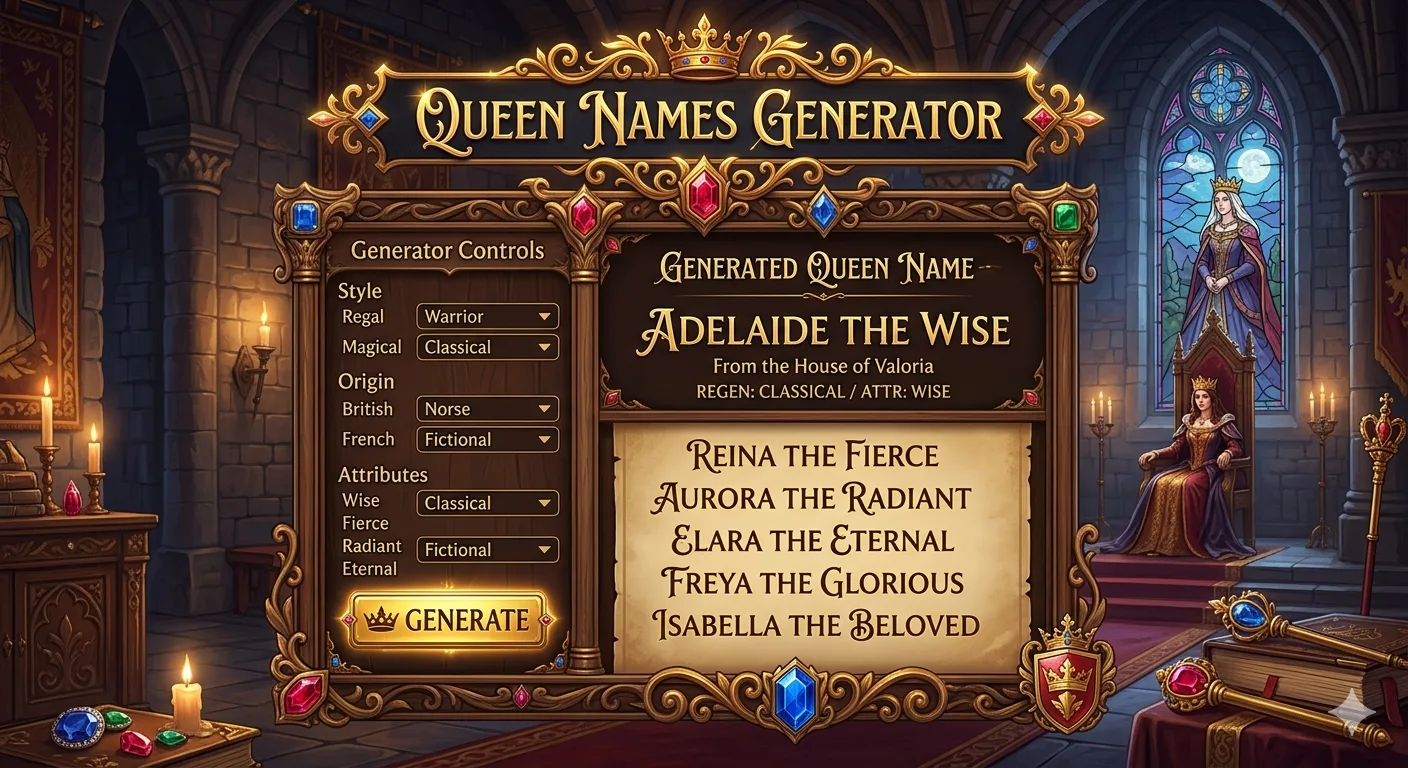
Queen Names Generator Creating Custom Royalty
While comprehensive historical queen names generator resources exist, understanding the principles helps in creating custom appellations. A conceptual queen names generator combines historical elements, meaningful translations, and creative variations to produce original names.
When manually acting as a queen names generator, consider these techniques combine two historical queens' names (Victoria + Elizabeth = Victorabeth), translate "queen" into different languages and modify spelling (Reina → Rayna), or blend names with fantasy suffixes.
Queen Album Names Rock Music Royalty
The legendary rock band Queen created iconic queen album names that influenced music culture. While queen album names like "A Night at the Opera" and "The Game" don't literally reference royalty, they carry the band's signature theatrical grandeur.
Fans discussing the band often reference these queen album names when analyzing musical evolution and legacy. The band name "Queen" itself represented a bold choice that matched their dramatic musical style perfectly.
Queen Names Band Musical Heritage
Beyond specific albums, discussing queen names band references acknowledges how the band name "Queen" projected confidence and theatrical flair. The queen names band selection influenced their public image and musical presentation, becoming inseparable from their legendary status.
Queen Team Names Competitive Excellence
Sports teams and organizational groups often adopt queen team names conveying strength and unity. Effective queen team names include "The Regal Rivals," "Crown Crushers," or "Sovereign Squad."
Creating memorable queen team names involves incorporating specific historical queens (The Cleopatras) or royal terminology (The Coronation Crew). These queen team names establish immediate identity while celebrating powerful imagery.
Queen Group Names Collective Identity
Beyond sports, queen group names serve social and professional contexts. Friend groups, business networks, and online communities use queen group names to establish collective identity. Some well-liked choices are "The Royal Court," "Queens of [Location]," or "Crown Collective."
Professional queen group names might emphasize achievement "The Executive Queens" or "Boss Queens Network." Online communities use queen group names combining royal concepts with specific interests "Crafting Queens" or "Fitness Royalty."
Queen Names Ideas Inspiration and Creativity
Generating queen names ideas requires considering specific contexts and purposes. For babies, queen names ideas might focus on age-appropriate options with good nicknames Alexandra (Alex), Victoria (Tori), Catherine (Cate), Eleanor (Ellie).
For fictional characters, queen names ideas can be more dramatic Arabella, Octavia, Serafina, or Valentina for historical fiction. Fantasy queen names ideas might include Evelina, Celestine, or Luminara.
Business and brand queen names ideas should project authority Regency, Sovereign, Majesty, or Crown. These queen names ideas work for luxury brands or premium services.
Queen Like Names Regal Without Literal Meaning
For those who love royal associations but prefer less literal options, queen like names offer similar elegance without explicit references. Queen like names include Adelaide (noble), Arabella (beautiful altar), Beatrix (bringer of joy), and Cordelia (heart).
More queen like names with regal feels include Freya, Genevieve, Helena, Imogen, and Juliana. These queen like names carry sophisticated sounds and historical associations without literally meaning "queen."
Queen Related Names Connections and Associations
Queen related names encompass broader royal terminology and associated concepts. For boys, queen related names might reference kings or princes Rex (king), Basil (royal), Malik (king in Arabic).
Queen related names can also include surnames with royal associations Tudor, Stuart, Plantagenet, or descriptive surnames like King, Queen, or Noble. These queen related names work creatively as first names too.
Queen Last Names Surnames and Dynasty
Some surnames directly reference queens or royal dynasties, creating interesting queen last names options. Historical queen last names include Tudor, Stuart, Bourbon, Habsburg, and Romanov—all famous royal families.
Descriptive queen last names related to royalty include King, Queen, Regal, and Royal. Some cultures have surnames meaning "descendant of royalty" that function as creative queen last names.
Queen Names Style Aesthetic Considerations
Choosing appropriate queen names style depends on aesthetic preferences and context. Victorian queen names style includes Adelaide, Beatrice, Charlotte, emphasizing formality and multiple syllables.
Medieval queen names style tends toward simpler structures Eleanor, Matilda, Blanche. Modern queen names style adapts traditions for contemporary sensibilities Ava, Ella, Mia.
Exotic queen names style draws from non-Western traditions Amina, Nur, Lakshmi, celebrating global heritage beyond European names.
Queen Names Starting with D
Exploring queen names starting with d reveals numerous elegant options. Historical examples include Diana, Dorothy, and Désirée (Napoleon's first fiancée, later Queen of Sweden).
Creative queen names starting with d include Delilah, Drusilla, Dahlia, and Desdemona. International options like Devika (Indian) or Dalia (Hebrew/Arabic) add diversity to queen names starting with d.
African Royal Heritage
Nubian Queen Names Ancient Kush
African royal traditions offer unique perspectives on queenship. Nubian queen names from ancient Kush include Amanirenas, Amanishakheto, and Nawidemak. These nubian queen names belonged to the Kandakes, powerful warrior queens who defended their kingdom against Roman expansion.
Zulu Queen Names Southern African Royalty
Moving to southern Africa, zulu queen names represent a different cultural context. While Zulu society traditionally centered on kings, queen mothers and principal wives held significant influence. Zulu queen names like Nandi (mother of legendary Shaka Zulu) carry immense cultural resonance.
Other zulu queen names include Monase and Langazana, each associated with important periods in Zulu history. These zulu queen names reflect the formation of the Zulu nation and showcase powerful women who influenced one of Africa's most famous kingdoms.
Drag Queen Names UK Performance Royalty
A completely different context emerges with drag queen names uk, referring to performance artists in British drag culture. While not literal royalty, drag queen names uk often incorporate regal references and wordplay, celebrating theatrical personas through creative naming.
Drag queen names uk frequently blend humor with elegance, creating memorable stage identities. This modern subculture demonstrates how royal nomenclature continues inspiring creative expression in unexpected contexts, showing the versatility of queenly references.
Generate More: Boy Name Generator
Conclusion The Enduring Power of Royal Names
Queen names represent far more than mere nomenclature—they embody centuries of history, cultural heritage, and powerful feminine identity. From ancient egypt queen names like Cleopatra and Nefertiti that still captivate imaginations, to queen names in india celebrating the subcontinent's rich royal traditions, to modern uses in social media and creative works, these regal appellations continue evolving while maintaining timeless appeal.
Whether seeking names for a newborn child, fictional character, social media presence, or simply appreciating historical and cultural significance, the vast world of royal nomenclature offers endless inspiration. Understanding other names for queen across languages and cultures enriches this exploration, while recognizing specialized categories demonstrates versatility and enduring fascination with queenly identities.
The comprehensive resources compiled in this article, spanning continents and centuries, provide valuable tools for anyone interested in royal naming traditions. From queen names england and queen names uk documenting British heritage, to russian queen names, nubian queen names, and zulu queen names representing global traditions, the diversity reflects humanity's universal acknowledgment of powerful female leadership.
As naming trends continue evolving, royal appellations adapt while retaining essential regal character. Modern parents appreciate names meaning queen or goddess for empowerment associations, while creative industries explore fantasy variations for otherworldly elegance. Whether choosing traditional options like Elizabeth and Victoria, exploring unique historical choices like Zenobia and Tomyris, or crafting original variations for specific purposes, the legacy of queens continues inspiring new generations.
The stories behind these names tales of courage, intelligence, political acumen, and cultural advancement—remind us that names carry weight beyond sound and spelling. They connect us to human experiences across time and space, to women who shaped history and influenced civilizations. In choosing, appreciating, or learning about royal names, we participate in an ongoing cultural conversation about power, femininity, heritage, and identity that spans millennia and shows no signs of diminishing.