 Uzbek Girl Name Generator
Discover beautiful Uzbek girl names from the heart of the Silk Road
Guides & Articles
Uzbekistan Girl Names: A Complete Guide to Stylish, Popular and Meaningful Choices
A Complete Guide to Stylish, Popular, Traditional and Unique Uzbek Girl Names for 2026
Introduction: The Timeless World of Uzbekistan Girl Names
Choosing a name for your baby girl is one of the most deeply personal and meaningful decisions you will ever make as a parent. In Uzbekistan, this decision carries an especially rich cultural weight, rooted in thousands of years of civilization, Islamic tradition, Silk Road heritage, and a language that is as musical and poetic as the names it produces. Uzbekistan girl names are among the most beautiful and meaningful in Central Asia, offering parents a stunning variety of stylish, unique, and culturally significant choices.
Uzbekistan sits at the ancient crossroads of civilizations, a land shaped by Persian empires, Turkic migrations, the golden age of Islamic scholarship, Mongol dynasties, and Soviet transformation. This extraordinary history has given Uzbek naming culture a depth and diversity that few other countries can match. You will find names that trace their roots to Arabic Quranic tradition, names derived from the Persian poetic classics, names rooted in ancient Turkic heritage, and names that carry the influence of Russian and Soviet culture alongside timeless local traditions.
In 2026, Uzbekistan baby girl names are experiencing a beautiful moment of renewal. Modern Uzbek parents are reconnecting with their pre-Soviet cultural heritage, rediscovering rare and traditional names that were suppressed during the Soviet era, while also embracing the global world their daughters will grow up in. The result is a naming landscape that balances deep cultural pride with contemporary sophistication, offering parents a truly inspiring range of stylish and meaningful choices for their daughters.
This complete guide explores the most popular Uzbekistan girl names with beautiful meanings, modern and trending choices, traditional and cultural names, rare and unique picks, and the deep cultural forces shaping Uzbek naming traditions today. You will also discover expert insights into how names are chosen in Uzbekistan, the role of Islam and Persian poetry in shaping Uzbek girl names, current naming trends across the country, and a comprehensive FAQ section answering the most searched questions about Uzbek baby girl names.
Popular Uzbekistan Girl Names with Beautiful Meanings
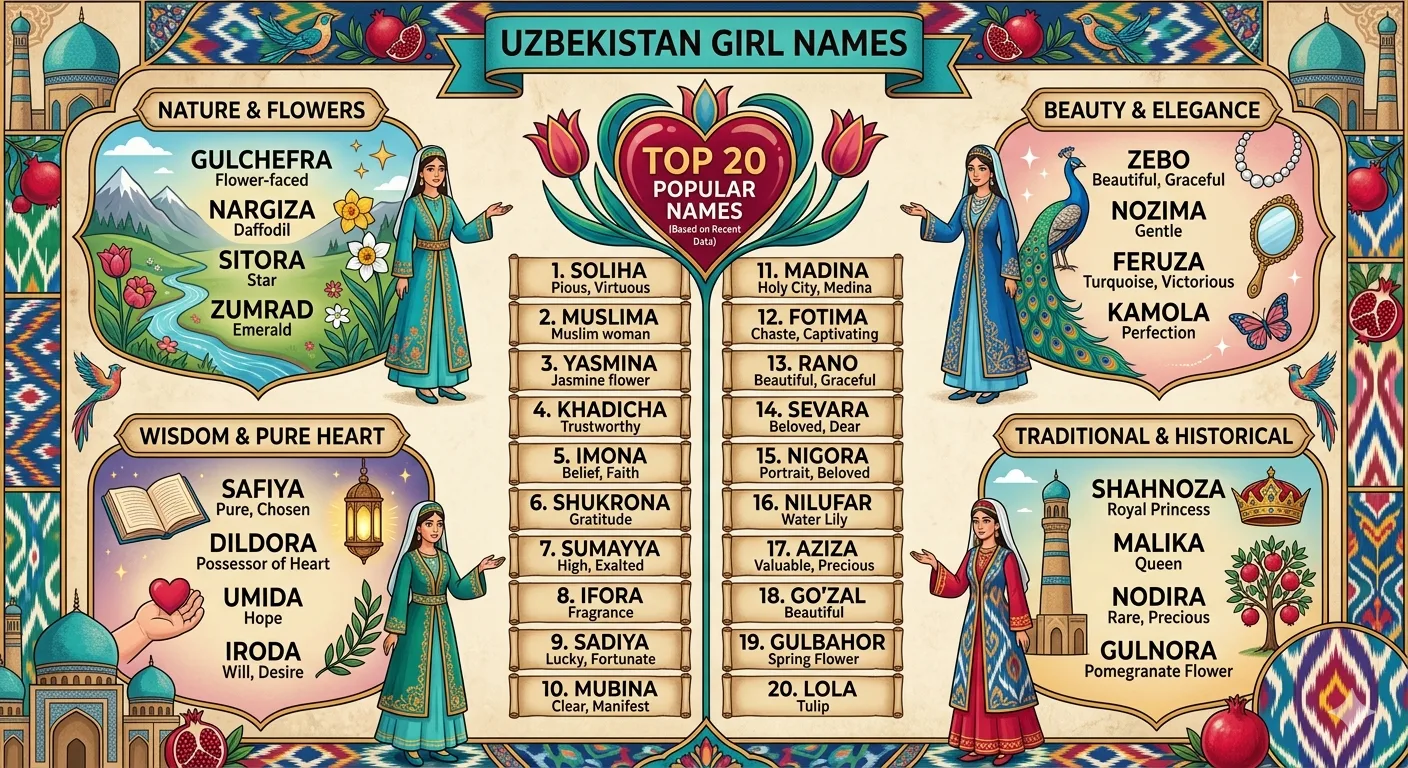
Certain names have remained consistently beloved across generations of Uzbek families, chosen again and again because they combine exquisite sounds with profound meanings and strong cultural resonance. These popular Uzbek girl names represent the heart of the Uzbekistan naming tradition, names that feel both warmly familiar and timelessly beautiful.
|
Name |
Origin / Meaning |
Why It Stands Out |
|
Malika |
Arabic, queen, angel |
Beloved classic, widely popular across Uzbekistan |
|
Dilnoza |
Persian-Uzbek, one who refreshes the heart |
Uniquely Uzbek, deeply romantic and melodious |
|
Zulfiya |
Arabic-Persian, she with beautiful curly hair |
Literary name, honored by famous Uzbek poet |
|
Nodira |
Arabic, rare, unique, priceless |
Royal heritage, carried by beloved Uzbek queen |
|
Feruza |
Persian, turquoise gemstone |
Gemstone name, widely loved across Central Asia |
|
Gulnora |
Persian-Uzbek, pomegranate flower |
Floral beauty, deeply rooted in Uzbek culture |
|
Mohira |
Arabic, skilled, dexterous, clever |
Graceful and strong, very commonly used |
|
Shahnoza |
Persian, royal fragrance |
Regal meaning, beautiful and fashionable |
|
Barno |
Uzbek-Tajik, beautiful young woman |
Authentically Central Asian, charming and rare |
|
Nargiza |
Persian, narcissus flower |
Floral name, poetic and widely admired |
|
Hulkar |
Uzbek, star cluster, Pleiades |
Celestial beauty, distinctively Uzbek |
|
Dilorom |
Persian, one who soothes the heart |
Deeply poetic, beloved across generations |
Names like Malika and Dilnoza hold a special place in the hearts of Uzbek families because they capture the dual soul of Uzbek naming culture: the Arabic Islamic tradition of meaningful, spiritually resonant names and the Persian poetic tradition of romantic, nature-inspired, heart-centered imagery. Malika, meaning queen or angel, is chosen by parents who want their daughter's very name to announce her worth and dignity. Dilnoza, which translates beautifully as one who refreshes or delights the heart, represents the deep Uzbek appreciation for poetry, emotion, and the interior life.
Feruza is one of the most beloved gemstone names in the Uzbek tradition, taking its root from the Persian word for turquoise. This choice reflects the deep cultural significance of turquoise in Central Asian art, architecture, and spiritual life, most famously embodied by the breathtaking turquoise domes of Samarkand and Bukhara. When an Uzbek family names their daughter Feruza, they connect her to this ancient and luminous visual heritage.
Modern and Trending Uzbekistan Girl Names in 2026
Uzbek parents in 2026 are drawn to girl names that feel contemporary and stylish while still honoring the cultural depth and linguistic beauty of their heritage. Modern trending Uzbek girl names strike a balance between global appeal and distinctively Central Asian identity, giving daughters names that work beautifully in both Tashkent and the wider world.
|
Name |
Meaning |
Why Trending |
|
Lola |
Arabic-Uzbek, tulip flower, ruby |
Short, elegant, beloved by modern Uzbek families |
|
Kamola |
Arabic, perfection, completeness |
Timeless yet fresh, widely fashionable today |
|
Aziza |
Arabic, precious, dearly loved, powerful |
Short and strong, popular across Central Asia |
|
Sarvinoz |
Persian-Uzbek, cypress tree fragrance |
Nature-inspired poetry, beautifully fashionable |
|
Munira |
Arabic, shining, radiant, luminous |
Light-themed name, rising rapidly in popularity |
|
Zilola |
Arabic-Uzbek, clear flowing water |
Nature connection, modern and musical sound |
|
Nилуфар (Nilufar) |
Persian, lotus flower, water lily |
Floral elegance, one of Uzbekistan's top names |
|
Ozoda |
Uzbek, clean, pure, neat, well-groomed |
Virtue name, uniquely Uzbek, freshly fashionable |
|
Shaklo |
Uzbek-Tajik, beautiful appearance |
Authentically Central Asian, gaining wider use |
|
Umida |
Uzbek, hope, one who brings hope |
Meaningful virtue name, modern and hopeful |
|
Sevinch |
Uzbek, joy, happiness, delight |
Joyful meaning, distinctively Uzbek sound |
|
Maftuna |
Arabic-Uzbek, enchanted, fascinated |
Romantic meaning, modern and flowing beautifully |
One of the most significant trends in modern Uzbek girl naming is the powerful return to authentically Uzbek names that have no direct Arabic or Persian equivalent. Names like Sevinch meaning joy, Ozoda meaning pure and well-kept, and Umida meaning hope are being chosen with increasing frequency by parents who want to celebrate the Uzbek language itself rather than reaching exclusively toward Arabic or Persian roots. This reflects a broader cultural movement of Uzbek national identity renewal that has been gathering strength since independence in 1991.
Lola deserves special mention as perhaps the most fashionable and widely recognized Uzbek girl name in the contemporary era. Meaning tulip or ruby in the Uzbek and Arabic traditions, Lola has a warm, musical quality that works beautifully in Uzbek, Russian, and international contexts alike. The tulip itself holds deep symbolic significance in Uzbek culture, and a name that connects a girl to this beloved flower while sounding elegant and modern in any language is a natural choice for today's Uzbek parents.
Traditional and Cultural Uzbekistan Girl Names That Carry Deep Heritage
Traditional Uzbek girl names carry the weight of centuries of civilization, poetry, scholarship, and faith. These are the names that have been passed down through Uzbek families for generations, names that connect daughters to the golden age of Islamic learning in Bukhara and Samarkand, to the courts of Timurid queens and poets, and to the deep well of Central Asian cultural memory.
|
Name |
Origin / Meaning |
Why It Endures |
|
Zuhra |
Arabic, the planet Venus, brilliance |
Celestial and classical, deeply traditional |
|
Robiya |
Arabic, springtime, fourth |
Ancient Uzbek-Islamic heritage, warmly enduring |
|
Maryam |
Hebrew via Arabic, beloved, grace |
Most sacred Islamic name, deeply revered |
|
Fotima |
Arabic, one who abstains |
Prophet's daughter, most honored name in Islam |
|
Xurmo |
Persian-Uzbek, date palm fruit |
Ancient Central Asian name, deeply rooted |
|
Soliha |
Arabic, righteous, virtuous woman |
Islamic virtue name, widely traditional |
|
Nasiba |
Arabic, noble, of good standing |
Dignified classic, beloved across generations |
|
Maftuna |
Arabic, captivated by beauty |
Romantic classic, cherished for centuries |
|
Qunduz |
Uzbek, otter, river creature |
Ancient Turkic name, rare and historically deep |
|
Sabohat |
Arabic, beauty at dawn, morning loveliness |
Poetic sunrise name, deeply traditional |
|
Muazzam |
Arabic, great, mighty, revered |
Classical Islamic dignity, traditionally honored |
|
Yulduz |
Uzbek, star |
Most beloved Uzbek celestial name, timeless |
Fotima and Maryam occupy the highest positions in the traditional Uzbek naming hierarchy because of their profound Islamic significance. Fotima honors the daughter of the Prophet Muhammad, one of the most revered figures in Islamic tradition, and choosing this name for a daughter is understood as a prayer for her virtue, spiritual depth, and blessed life. Maryam, the Islamic form of Mary, is equally honored as the name of the blessed mother of the Prophet Isa (Jesus) in Islamic theology, making it a name of extraordinary spiritual weight across the Muslim world.
Yulduz, meaning star in Uzbek, represents the distinctly Turkic-Uzbek contribution to the naming tradition, a name rooted not in Arabic or Persian but in the ancient Turkic languages that are the foundation of modern Uzbek. It is one of the most beloved names in Uzbekistan because it captures something essential about the Uzbek landscape and imagination, the vast open skies of Central Asia blazing with stars, and the deep human impulse to name a beloved daughter after something luminous and eternal.
You can also use our Name Generator Tool to create unique names instantly. Libya Girl Names
Uzbekistan Girl Names with Royal and Historical Heritage
Uzbekistan has a remarkable history of queens, court poets, noblewomen, and cultural heroines whose names have become aspirational choices for parents who want to connect their daughters to this extraordinary legacy of feminine achievement and dignity.
|
Name |
Historical Figure or Connection |
Cultural Significance |
|
Nodira |
Queen and poet Nodira of Kokand Khanate |
One of the greatest Uzbek poet-queens in history |
|
Zulfiya |
Zulfiya Isroilova, national poet of Uzbekistan |
National poetic legacy, honored on banknotes |
|
Gavhar |
Persian, jewel, gem |
Regal gemstone name, associated with court culture |
|
Shahlo |
Persian, she with blue-grey eyes |
Aristocratic beauty name, historically beloved |
|
Hamida |
Arabic, praiseworthy, one who praises God |
Classical dignity, associated with noble families |
|
Nilufaroy |
Persian-Uzbek, like the lotus flower |
Extended lotus name, associated with Timurid courts |
|
Zebunniso |
Persian-Uzbek, ornament of women |
Historical Mughal princess and poet name |
|
Oyjamol |
Uzbek, beautiful as the moon |
Moon beauty name, poetically regal |
Nodira stands as perhaps the most powerful name in the entire Uzbek female naming tradition because of its extraordinary historical bearer. Nodira was a queen of the Kokand Khanate in the nineteenth century and one of the finest poets in the Uzbek language, a woman who ruled a kingdom and wrote verse of piercing beauty during a period of political turmoil. Her name, meaning rare and priceless, is a perfect reflection of her singular place in Uzbek cultural memory. Choosing Nodira for a daughter today is an act of deep cultural reverence and an expression of hope that she too will be rare, precious, and extraordinary.
Zulfiya carries the legacy of Zulfiya Isroilova, the most celebrated Uzbek female poet of the Soviet era and one of the most important voices in twentieth-century Uzbek literature. So honored is her legacy that her portrait appeared on Uzbek currency for many years. When Uzbek parents name their daughter Zulfiya, they invoke not just the beautiful Arabic-Persian meaning of the name but also this luminous literary tradition.
Rare and Unique Uzbekistan Girl Names That Truly Stand Out
For parents who want something genuinely one of a kind, the Uzbek naming tradition offers a treasure of rare and uncommon choices. These unique Uzbek girl names come from the deepest wells of Persian poetry, ancient Turkic heritage, and rare Arabic roots, offering daughters names that are both distinctive and deeply meaningful.
|
Name |
Origin / Meaning |
Why It Is Special |
|
Mohlaroyim |
Uzbek, cheeks like the moon |
Extremely rare, poetically beautiful, deeply Uzbek |
|
Sarvar |
Persian-Uzbek, leader, chief, master |
Strong and rare, historically significant |
|
Parizod |
Persian, born of fairies, fairy-born |
Magical meaning, rare and enchantingly beautiful |
|
Dildora |
Persian-Uzbek, holder of hearts |
Profoundly romantic, rare and deeply poetic |
|
Xilola |
Arabic, dew drop, morning dew |
Nature poetry, rare and exquisitely delicate |
|
Surayyo |
Arabic, the Pleiades star cluster |
Celestial rarity, beautifully astronomical |
|
Oydin |
Uzbek, moonlit, bright as moon |
Distinctively Uzbek, luminous and rare |
|
Gulbahor |
Persian-Uzbek, spring flower |
Seasonal nature name, rare and lovely |
|
Mahfuza |
Arabic, protected, preserved by God |
Spiritual rarity, deeply meaningful |
|
Zarnigor |
Persian-Uzbek, she who embroiders gold |
Artisan heritage name, extraordinarily rare |
Parizod, meaning born of fairies or fairy-born, captures the magical and poetic imagination that runs through Central Asian naming traditions. In Persian and Uzbek folklore, fairies called pari are creatures of extraordinary beauty and otherworldly grace, and naming a daughter Parizod expresses the hope that she will carry something of that magical, luminous quality throughout her life. It is a name almost never encountered outside of Central Asia and is therefore both deeply authentic and genuinely rare even within Uzbekistan itself.
Zarnigor is one of the most culturally specific and historically evocative of all rare Uzbek girl names. Meaning she who embroiders in gold, it honors the extraordinary tradition of Uzbek gold embroidery known as zardozi, one of the most highly prized textile arts in the Islamic world. For centuries, the gold embroiderers of Bukhara and Shakhrisabz were celebrated throughout Asia and Europe, and a name that connects a girl to this heritage of artisanal mastery and artistic excellence carries a unique and beautiful cultural weight.
Nature-Inspired Uzbekistan Girl Names Blooming in 2026
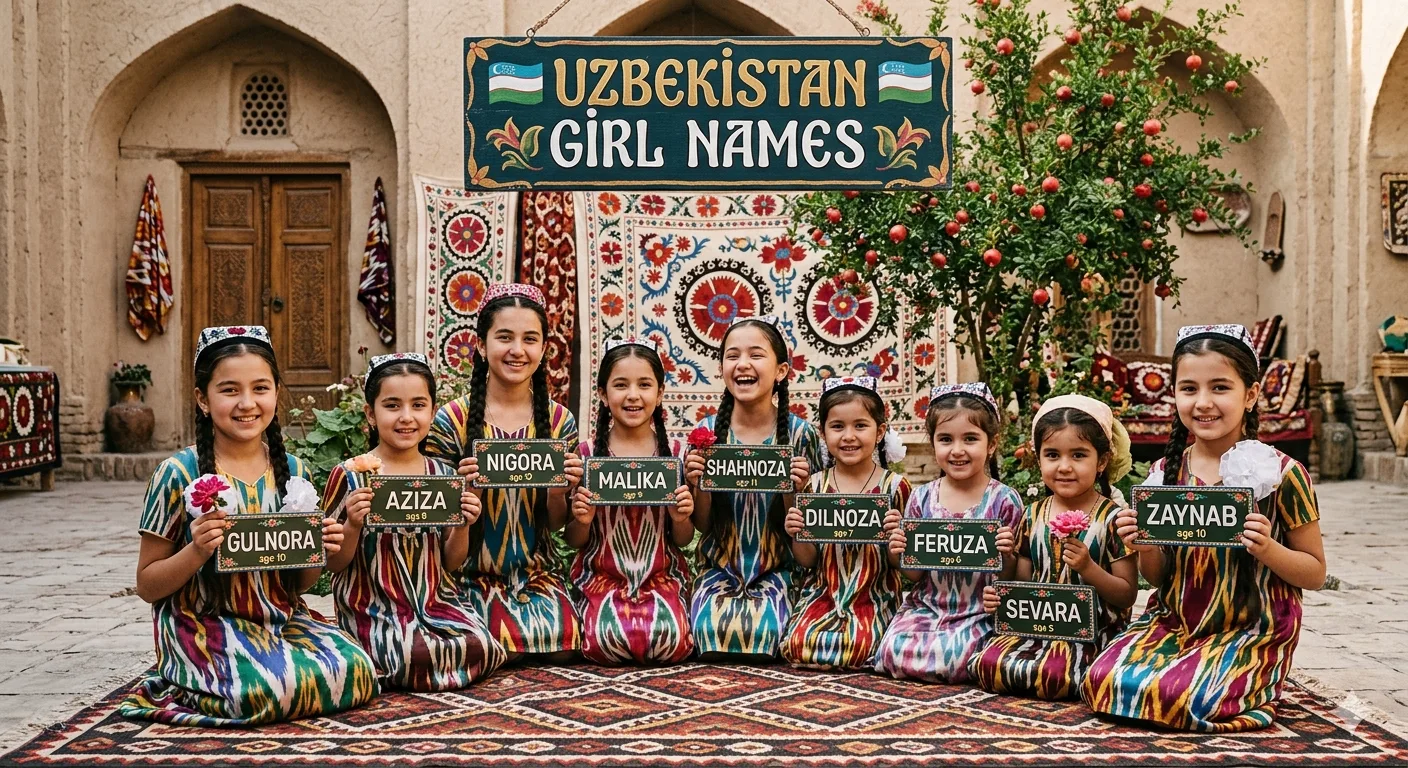
Uzbekistan's landscape ranges from the Tian Shan mountains and Fergana Valley orchards to the Kyzylkum Desert and the dying shores of the Aral Sea. This dramatic and diverse natural world has long inspired Uzbek parents to choose names drawn from the flowers, stars, seasons, gems, and elements that define Central Asian life.
|
Name |
Natural Connection |
Why It Is Beloved |
|
Nilufar |
Lotus flower, water lily |
Most beloved floral name in Uzbekistan |
|
Gulsanam |
Persian-Uzbek, a flower among flowers |
Layered floral beauty, deeply poetic |
|
Bahor |
Persian-Uzbek, springtime |
Seasonal freshness, simple and beautiful |
|
Yulduz |
Uzbek, star |
Celestial classic, timeless in Uzbek culture |
|
Sumalak |
Uzbek, wheat sprout dish of Nowruz |
Cultural harvest name, distinctively Uzbek |
|
Kumush |
Uzbek, silver |
Precious metal name, simple and luminous |
|
Lola |
Uzbek, tulip, ruby |
Flower and gem combined, hugely popular |
|
Chamanzor |
Persian-Uzbek, meadow, green garden |
Pastoral beauty, rare nature name |
|
Sarvinoz |
Persian, cypress fragrance |
Tree-inspired, elegant and aromatic |
|
Zangori |
Uzbek, sky blue color |
Color name, unique and visually poetic |
|
Toshbibi |
Uzbek, stone woman, enduring as rock |
Strength through nature, traditional |
|
Gulsara |
Persian-Uzbek, rose-faced, rosy-cheeked |
Floral beauty, warmly beloved |
Nilufar holds a place of extraordinary honor among Uzbek nature names. The lotus or water lily is a flower of profound spiritual and aesthetic significance across Persian and Central Asian culture, associated with purity, spiritual awakening, and the capacity to rise from muddy waters into perfect beauty. Nilufar is consistently one of the top names chosen for Uzbek baby girls and has the additional appeal of sounding beautiful in Uzbek, Russian, Persian, and international contexts alike, making it a truly versatile and wonderful choice.
Bahor, simply meaning springtime in Uzbek and Persian, represents the deep Central Asian love for the season of Nowruz, the Persian and Uzbek new year celebrated at the spring equinox. Spring in the Fergana Valley and around Samarkand is a time of extraordinary natural beauty, with apricot and almond orchards bursting into blossom across the landscape. Naming a daughter Bahor connects her to this annual miracle of renewal and the deep cultural celebration that surrounds it.
You can also use our Name Generator Tool to create unique names instantly. Liechtenstein Girl Names
Uzbekistan Girl Names Shaped by Islamic Faith and Quranic Tradition
Islam is the defining spiritual force in Uzbek culture and has shaped Uzbek girl naming traditions for over a thousand years. Names with clear Quranic and Islamic significance are consistently among the most popular and respected choices in Uzbekistan, carrying the dual beauty of Arabic linguistic elegance and deep spiritual meaning.
|
Name |
Islamic Significance / Meaning |
Spiritual Value |
|
Fotima |
Daughter of Prophet Muhammad |
Most honored female name in Islam |
|
Maryam |
Mother of Prophet Isa, purity |
Sacred in both Islam and Christianity |
|
Zainab |
Wife of Prophet, fragrant plant |
Family of the Prophet, deeply revered |
|
Rohila |
Arabic, spiritual, of the soul |
Profoundly spiritual Islamic name |
|
Saodат |
Arabic, happiness, blessedness |
Virtue name, connected to paradise |
|
Rayhona |
Arabic, sweet basil, fragrant herb |
Plant of paradise, deeply loved |
|
Mukhabbat |
Arabic, love, affection, devotion |
Love as a divine attribute |
|
Hafiza |
Arabic, one who memorizes the Quran |
Quranic honor, deeply revered |
|
Shoira |
Arabic, poetess |
Literary-Islamic combination, widely loved |
|
Muslima |
Arabic, she who submits to God |
Core Islamic virtue and identity |
Rayhona, meaning sweet basil or fragrant herb in Arabic, holds a special place among Islamic girl names because the sweet basil plant is described in Quranic tradition as one of the plants of paradise, the eternal garden promised to the faithful. When Uzbek parents choose Rayhona for their daughter, they are connecting her name to the divine fragrance of paradise itself, a profound and beautiful spiritual gesture. The name is also simply gorgeous to hear and say, with a flowing musicality that makes it one of the most beautiful names in the Uzbek tradition.
Hafiza, meaning one who has memorized the Quran, carries perhaps the highest possible spiritual honor in the Islamic naming tradition. A hafiz or hafiza is someone who has committed the entire holy Quran to memory, an achievement of tremendous dedication and spiritual discipline. Naming a daughter Hafiza expresses the hope and prayer that she will be a person of deep faith, remarkable memory, and unwavering commitment to her spiritual heritage. It is a name that places enormous and beautiful expectations on the child who carries it.
How Names Are Chosen in Uzbekistan: Cultural Traditions and Modern Practices
Understanding how Uzbek families approach the sacred task of naming their daughters reveals the rich and layered cultural logic that makes Uzbek girl names so distinctive and meaningful.
The Role of the Mullah and Religious Blessing
In traditional Uzbek communities, the naming of a child is a religious act as much as a personal one. On the seventh day after a child's birth, a ceremony called the Yetti Oshilik or Aqiqa is often held, during which a mullah or respected Islamic scholar may be invited to suggest or approve the name given to a child. The chosen name is whispered into the newborn's ear by the mullah as part of the Islamic Adhan, the call to prayer, making the very first words the child hears a sacred declaration of faith. This practice means that names with clear Islamic significance have historically been favored because they carry divine blessing from the first moment of life.
Family Naming Traditions and Ancestral Honor
Uzbek families have strong traditions of naming children in honor of grandparents, great-grandparents, and other respected elders who have passed away. This practice, which has parallels in Jewish naming tradition, ensures that beloved names are kept alive across generations and that children grow up feeling a living connection to their family's past. A grandmother named Zulfiya may find her granddaughter given the same name decades later as a tribute to her memory and legacy. This tradition gives Uzbek girl names a deeply personal dimension that goes beyond fashion or trend.
The Influence of Persian Poetry and Classical Literature
Persian classical poetry, particularly the works of Rumi, Hafiz, Nizami, and Alisher Navoi, has profoundly shaped Uzbek girl naming traditions. Alisher Navoi, the greatest poet in the Uzbek language and one of the towering figures of fifteenth-century Islamic civilization, wrote extensively about beauty, love, spirituality, and the natural world in ways that directly influenced what Uzbek parents consider beautiful in a name. Names that evoke roses, nightingales, moonlight, garden fragrances, and the beloved in classical Persian poetry have been consistently fashionable in Uzbek naming culture for centuries.
Soviet Influence and the Return to Heritage
The Soviet period from 1924 to 1991 had a complex effect on Uzbek naming traditions. While many families maintained their traditional Islamic and Uzbek names, there was also a significant adoption of Russian names like Natalya, Olga, Elena, and Valentina among urban and educated Uzbek families seeking social mobility within the Soviet system. Since independence in 1991, there has been a powerful and sustained movement to return to traditional Uzbek and Islamic names as an expression of national and cultural identity. Many parents today are specifically seeking out names that were suppressed or discouraged during the Soviet era, reclaiming them as acts of cultural pride and historical reconnection.
You can also use our Name Generator Tool to create unique names instantly. Vanuatu Girl Names
Latest Uzbekistan Girl Name Trends Shaping 2026
Uzbekistan baby girl naming trends in 2026 reflect a fascinating and sometimes surprising intersection of cultural revival, global awareness, Islamic renaissance, and national identity. Several clear patterns are defining the naming landscape across the country right now.
The return to authentically Uzbek-language names is perhaps the most significant trend of this decade. Names that use Uzbek root words rather than Arabic or Persian borrowings, names like Sevinch meaning joy, Oydin meaning moonlit, Bahor meaning springtime, and Kumush meaning silver, are being chosen with increasing frequency by parents who want to celebrate the Uzbek language and Uzbek identity. This trend is particularly strong among educated urban families in Tashkent and Samarkand.
Short, punchy names are trending strongly across Uzbekistan in 2026. Names of just two or three syllables like Lola, Aziza, Barno, and Zebo are appealing to modern Uzbek parents who want names that are easy to use in daily life while still carrying beautiful meanings. This preference for simplicity and directness is a notable shift from the longer compound names that were once fashionable in previous generations.
Celestial and nature-themed names continue their powerful surge across Uzbekistan. Yulduz, Hulkar, Surayyo, Nilufar, and Bahor are all consistently high in popularity rankings, reflecting the universal human desire to connect children to the beauty of the natural and cosmic world. The open skies of Central Asia, blazing with stars over the ancient Silk Road cities, seem to inspire an especially strong pull toward celestial naming in Uzbek culture.
Names associated with the concept of light, radiance, and illumination are experiencing a particularly strong moment in Uzbek naming culture right now. Munira meaning luminous, Nura meaning light, Rohila meaning spiritual light, and Oydin meaning moonlit all share this quality of inner and outer radiance that Uzbek parents find deeply appealing for their daughters. This trend connects to both Islamic concepts of divine light and the Central Asian love of luminous visual beauty.
There is also a growing interest among some Uzbek families in rediscovering very old and pre-Islamic Turkic names that represent the deepest layer of Uzbek cultural heritage before the arrival of Islam in the region. Names like Qunduz meaning otter and ancient Turkic virtue names are being explored by parents seeking the most authentic possible connection to their Central Asian roots.
Expert Tips for Choosing the Perfect Uzbek Girl Name
Begin with meaning and spiritual resonance. In Uzbek culture, a name is understood as a kind of prayer for the life the child will live. Choosing a name whose meaning aligns with your deepest hopes for your daughter is the most important first step in the entire process. Whether you want her to be strong like Aziza, luminous like Munira, rare like Nodira, or joyful like Sevinch, let meaning guide your heart.
Consider the musicality of the full name. Uzbek is a beautifully rhythmic and vowel-rich language, and Uzbek girl names have a natural musicality that should be honored when combining first name with family name. Say the full combination out loud many times, in Uzbek, in Russian, and if your family has international connections, in other languages as well, to ensure the name sounds beautiful and workable in all the contexts your daughter will encounter.
Honor your family heritage thoughtfully. If you have grandmothers or great-grandmothers whose names you admire and want to preserve, consider using those names or finding beautiful modern variations of them. The Uzbek tradition of generational name-keeping is a beautiful one that keeps family stories alive across time.
Seek a name that works in multiple cultural contexts. Uzbekistan is a country where Uzbek, Russian, and increasingly English are all parts of daily life for urban families. A name that sounds beautiful and is pronounceable in all these contexts gives your daughter a practical as well as aesthetic gift. Names like Lola, Aziza, Malika, and Nilufar work particularly well across language boundaries.
Consult with elders and respected community members. In Uzbek culture, the naming decision is rarely made in complete isolation from the wider family. Grandparents, respected aunts and uncles, and community elders often have deeply meaningful input and may suggest names from family history that you might not have considered. This consultation process is not just a cultural formality but a genuine source of wisdom and connection.
Generate More Names: Girl Names Generator
Conclusion: Celebrating the Extraordinary World of Uzbekistan Girl Names
Uzbekistan girl names are among the most beautiful, meaningful, and culturally rich in the entire world. They carry within them thousands of years of civilization, the golden legacy of Islamic scholarship in Bukhara and Samarkand, the flowing beauty of the Persian poetic tradition, the deep roots of ancient Turkic culture, and the modern spirit of a proud, independent nation reclaiming and celebrating its heritage in the twenty-first century.
Whether you choose a beloved classic like Malika or Feruza, a modern trending name like Lola or Kamola, a rare poetic gem like Parizod or Zarnigor, an authentically Uzbek choice like Sevinch or Oydin, or a name of deep Islamic significance like Fotima or Nilufar, you are giving your daughter a name with genuine depth, beauty, and meaning that will serve her throughout her entire life.
The most important thing about choosing a name in the Uzbek tradition is choosing one that carries your love, your hopes, and your family's story within it. In the rich and endlessly inspiring world of Uzbekistan girl names, there is a perfect name waiting for every baby girl born into this remarkable culture. May your daughter grow up proud of her name, connected to her extraordinary heritage, and ready to write her own luminous chapter in the long and beautiful story of Uzbek civilization.