 Singaporean Girl Name Generator
Discover multicultural Singaporean girl names with Chinese, Malay and Indian heritage
Guides & Articles
Singapore Girl Names: A Complete Guide to Stylish, Popular and Meaningful Choices
Discover the most beautiful, trending, unique and culturally rich Singapore girl names for 2026
Introduction: The Enchanting World of Singapore Girl Names
Choosing a name for your baby girl is one of the most profound and lasting decisions any parent will make. In Singapore, this deeply personal choice is woven into a rich tapestry of cultures, languages, and centuries-old traditions that make naming one of the most meaningful acts a family can undertake. Singapore girl names are uniquely beautiful precisely because they emerge from a society where Chinese, Malay, Indian, and Eurasian communities have lived side by side for generations, creating a naming culture that is simultaneously ancient and thoroughly modern.
Singapore stands as one of the most diverse and cosmopolitan cities in Asia, and this extraordinary diversity is reflected directly in the names its parents give their daughters. You will find names rooted in Mandarin Chinese heritage sitting alongside names drawn from Tamil and Sanskrit tradition, names shaped by Malay and Islamic culture, names borrowed from English and Western influence, and names that blend multiple languages into entirely new and beautiful creations. This cultural richness makes Singapore girl names some of the most varied and fascinating in the entire world.
In 2026, Singapore baby girl naming trends are evolving rapidly. Modern Singaporean parents are navigating between the desire to honor their ethnic and cultural heritage and the pull of contemporary global naming fashions. They seek names that sound beautiful in multiple languages, that work in both professional and personal settings, that carry meaningful symbolism aligned with values like wisdom, strength, and good fortune, and that give their daughters a sense of individual identity in a tightly connected society. Whether you are drawn to popular Chinese names, elegant Malay choices, beautiful Tamil names, rare and unique picks, or modern cross-cultural creations, this comprehensive guide covers the full spectrum of stylish Singapore girl names for today's parents.
Popular Singapore Girl Names with Beautiful Meanings
Certain names have held a cherished place in Singapore families for decades, consistently appearing among the most loved choices for baby girls across all communities. These popular Singapore girl names combine beautiful sounds, powerful meanings, and strong cultural resonance. Whether rooted in Chinese, Malay, Tamil, or English tradition, these names have proven their timeless appeal across generations.
|
Name |
Origin and Meaning |
Why It Stands Out |
|
Mei Lin |
Chinese, beautiful jade or beautiful forest |
Classic Chinese beauty name, elegantly timeless |
|
Aisha |
Arabic-Malay, alive and prosperous, thriving |
Most beloved name in the Malay Muslim community |
|
Priya |
Sanskrit, beloved, dear one |
Top choice in Tamil and Indian Singaporean families |
|
Sophie |
Greek via English, wisdom and knowledge |
Modern global name embraced across all communities |
|
Hui Ying |
Chinese, bright and shining, lustrous |
Popular Mandarin name reflecting parental hopes |
|
Nur |
Arabic-Malay, light, divine illumination |
Spiritual and beautiful, widely loved in Singapore |
|
Kavya |
Sanskrit, poetry, literary brilliance |
Rising Tamil name with artistic meaning |
|
Chloe |
Greek, blooming and verdant |
Among the top English names in Singapore today |
|
Xin Yi |
Chinese, heart of righteousness, moral beauty |
Meaningful and melodic, consistently popular |
|
Siti |
Arabic-Malay, noble lady, lady of dignity |
A beloved traditional name in Malay culture |
|
Divya |
Sanskrit, divine, heavenly radiance |
Deeply meaningful in Singapore Indian families |
|
Emma |
Germanic via English, whole and universal |
Globally popular, widely used by all communities |
Names like Mei Lin and Hui Ying represent the enduring strength of Chinese naming traditions in Singapore, where the majority ethnic community has maintained deep connections to Mandarin naming practices even as English has become the dominant language of public life. These names are typically chosen for their positive meanings, their pleasant sounds in Mandarin, and their ability to convey the qualities parents most hope to see in their daughters. Mei Lin, combining the characters for beautiful and either jade or forest depending on the character used, captures the Chinese aesthetic ideal of natural beauty and quiet elegance.
Aisha and Nur represent the beautiful tradition of Malay Muslim naming in Singapore, where names drawn from Arabic have become central to cultural identity. Aisha, the name of the wife of the Prophet Muhammad, carries deep Islamic significance alongside its beautiful meaning of one who is alive and thriving. Nur, meaning light, is one of the most widely used names in the Malay community and is often combined with other words to create compound names like Nur Aisyah or Nur Hidayah that carry layered spiritual meaning.
Modern and Trending Singapore Girl Names in 2026
Singaporean parents in 2026 are drawn to girl names that feel contemporary, globally stylish, and forward-looking while still carrying genuine meaning and connection to cultural roots. Modern trending names in Singapore often bridge Eastern and Western aesthetic sensibilities, reflecting the city-state's unique position as a global hub where Asian and international cultures meet and blend. Here are the names gaining the most momentum across Singapore right now.
|
Name |
Meaning |
Why Trending |
|
Ariel |
Hebrew-English, lion of God, noble |
Western-Asian crossover appeal, stylish sound |
|
Xuan |
Chinese, snow, mysterious and elegant |
Short, modern, phonetically beautiful in Mandarin |
|
Alesha |
Greek-English, noble and truthful |
Modern global feel, popular across communities |
|
Naomi |
Hebrew, pleasant and delightful |
Biblical revival gaining ground across Singapore |
|
Zi Xuan |
Chinese, purple and brilliant |
Fashionable two-character name, poetic imagery |
|
Jasmine |
Persian-English, the jasmine flower |
Singapore's national flower connection, timeless |
|
Rania |
Arabic, queen, delightful and contented |
Elegant Malay-origin name rising in popularity |
|
Amelia |
Germanic-English, industrious and hardworking |
Globally fashionable, embraced by all communities |
|
Kai Ting |
Chinese, victory and elegance together |
Modern pairing of auspicious characters |
|
Samara |
Arabic-Hebrew, guarded by God |
Multicultural appeal, soft and beautiful sound |
|
Luna |
Latin, the moon |
Global celestial trend reaching Singapore strongly |
|
Hui Xin |
Chinese, wisdom of the heart |
Meaningful compound name, consistently modern |
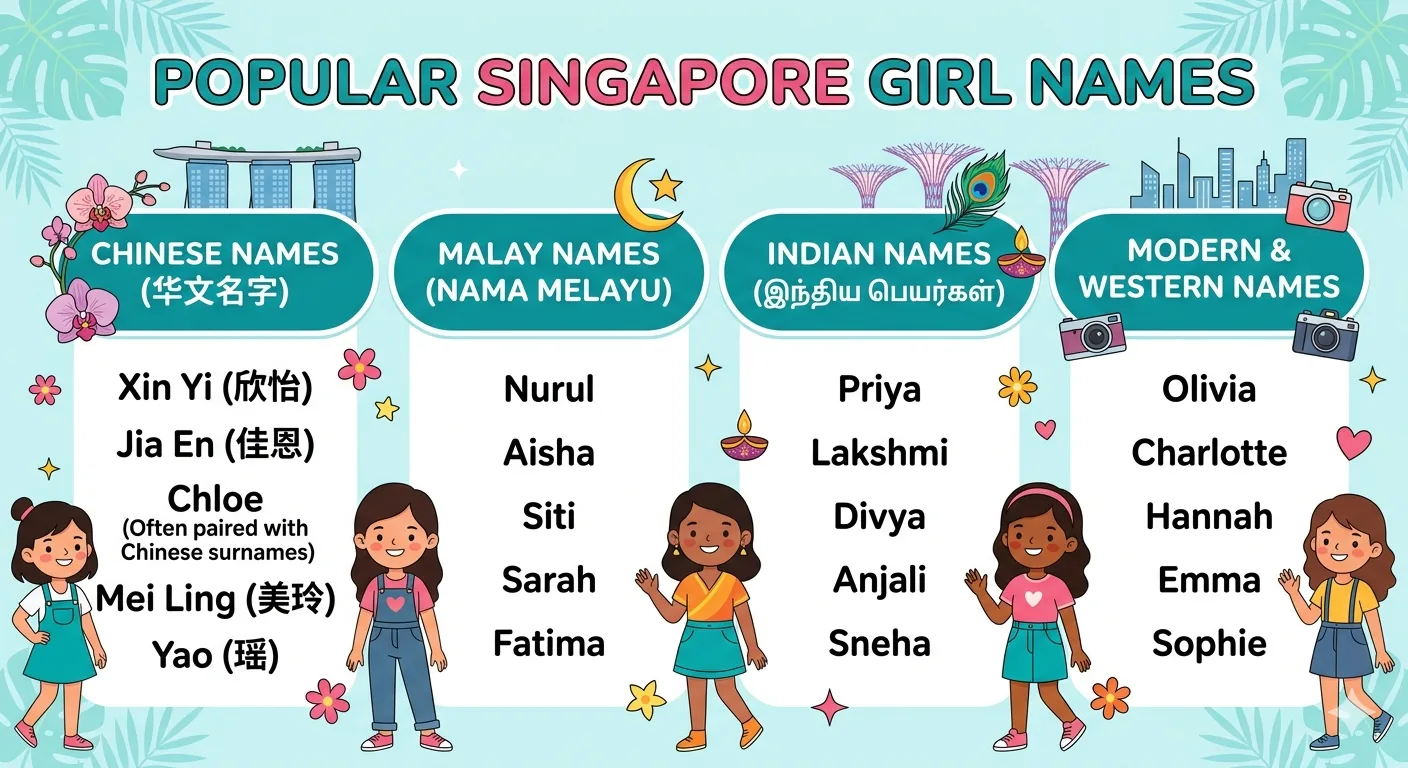
One of the clearest patterns defining modern Singapore girl names in 2026 is the growing preference for names that work beautifully in both English and Chinese or Malay contexts. Many Singaporean families today choose a name that functions well in the child's mother tongue while also sounding natural in English, reflecting Singapore's official policy of bilingualism and the practical reality of navigating a multilingual society every day. Names like Jasmine carry this dual appeal naturally, sounding distinctly beautiful in English while also connecting to Singapore's most iconic symbol, the fragrant jasmine that serves as the national flower.
The celestial naming trend that has swept the Western world is also making significant inroads in Singapore. Luna, Nova, Aurora, and Stella are all appearing with increasing frequency among English-educated Singaporean families. At the same time, Chinese families are reaching for celestial names within their own tradition, with names like Xing meaning star and Yue meaning moon appearing on more birth certificates than in previous generations.
Traditional and Cultural Singapore Girl Names That Carry Deep Heritage
Traditional Singapore girl names carry the weight of generations, the beauty of cultural continuity, and the comfort of deep-rooted meaning. These classic names have been cherished by Singapore families for many decades and continue to be chosen with pride by parents who want to honor their heritage and connect their daughters to the long history of their communities.
|
Name |
Origin and Meaning |
Why It Endures |
|
Li Hua |
Chinese, beautiful like the pear blossom |
Classically elegant, beloved across generations |
|
Fatimah |
Arabic-Malay, one who abstains, daughter of the Prophet |
Most sacred name in Malay Muslim tradition |
|
Meenakshi |
Sanskrit, fish-eyed goddess, Parvati |
Ancient Tamil Hindu name of great significance |
|
Siew Lan |
Hokkien Chinese, small and graceful orchid |
Traditional dialect name with floral beauty |
|
Rohani |
Malay-Arabic, spiritual, pertaining to the soul |
Deeply spiritual traditional Malay name |
|
Saraswathi |
Sanskrit, goddess of learning and arts |
Highest honor in Tamil Hindu tradition |
|
Ah Kow |
Hokkien, traditional auspicious dialect name |
Old-fashioned charm, rare today but historically rich |
|
Zubaidah |
Arabic-Malay, cream of the crop, elite |
Classical Islamic name with historical dignity |
|
Kamala |
Sanskrit, lotus flower, the goddess Lakshmi |
Sacred lotus symbolism, deeply Tamil and meaningful |
|
Bee Choo |
Hokkien Chinese, pearl and autumn |
Traditional Hokkien naming at its most poetic |
|
Maimunah |
Arabic-Malay, blessed and auspicious |
Classically beloved in the Malay Muslim community |
|
Lakshmi |
Sanskrit, goddess of prosperity and fortune |
Most auspicious name in Singapore Hindu tradition |
Fatimah stands in a category all by itself within Singapore's Malay Muslim naming tradition. As the name of the beloved daughter of the Prophet Muhammad, Fatimah carries spiritual significance that transcends its historical roots. Choosing Fatimah for a daughter in the Malay community is simultaneously a religious act, a cultural statement, and an expression of deep love and hope. While its use has become somewhat less universal as modern parents explore a wider variety of Arabic names, Fatimah remains one of the most respected and recognized names in Singapore's Malay heritage.
Meenakshi and Saraswathi represent the profound influence of Tamil Hindu tradition on Singapore's Indian community naming practices. Meenakshi refers to the fish-eyed goddess, a manifestation of Parvati worshipped at the famous Meenakshi temple in Madurai, and choosing this name for a daughter is an act of deep devotion. Saraswathi, goddess of learning, music, and wisdom, is especially popular among Singapore Tamil families who place great emphasis on education and intellectual achievement, qualities that align perfectly with Singapore's broader cultural values.
You can also use our Name Generator Tool to create unique names instantly. Micronesia Girl Names
Beautiful Chinese Singapore Girl Names with Auspicious Meanings
Chinese girl names form the largest single category of names in Singapore given that Chinese Singaporeans make up approximately seventy-five percent of the population. Chinese naming in Singapore draws on both Mandarin and various Chinese dialects including Hokkien, Teochew, Cantonese, and Hakka, creating a rich and varied landscape of naming traditions. The selection of Chinese characters for a girl's name is taken extremely seriously, with parents often consulting fortune tellers or family elders to choose characters with the best possible auspicious meaning and favorable stroke count.
|
Name |
Characters and Meaning |
Cultural Significance |
|
Xin Hui |
Heart and wisdom, brilliant kindness |
Combines moral virtue with intellectual beauty |
|
Mei Ling |
Beautiful and exquisite, jade-like beauty |
Classic Chinese beauty ideal, timeless elegance |
|
Jia Yi |
Home and righteousness, household virtue |
Family-centered values reflected in naming |
|
Zi Ying |
Purple and intelligent, flourishing brightness |
Purple symbolizes nobility in Chinese culture |
|
Li Xuan |
Beautiful and mysterious, lovely brilliance |
Poetic and modern, gaining popularity rapidly |
|
Ying Xue |
Flourishing and snow-white, brilliant purity |
Nature imagery combined with positive character |
|
Shu Hua |
Graceful and magnificent, cultured beauty |
Refinement and culture deeply valued in naming |
|
Qing Yun |
Clear sky and soaring clouds, reaching high |
Aspirational name suggesting unlimited potential |
|
Zhen Ni |
Precious and graceful, treasured elegance |
Modern Mandarin name with warmth and beauty |
|
Yan Ling |
Swallow and exquisite, graceful as a swallow |
Bird imagery beloved in Chinese naming tradition |
The practice of choosing Chinese characters for a daughter's name in Singapore involves careful consideration of multiple factors that go far beyond simple aesthetics. The meaning of each character must be positive, aspirational, and appropriate for a girl. The combination of characters must sound harmonious together in Mandarin pronunciation. Many families also consider the total number of brush strokes in the written name, as certain stroke counts are believed to bring better fortune than others according to Chinese numerological traditions. Some families consult a traditional fortune teller or bazi calculator who analyzes the child's birth date and time to recommend characters that will complement her elemental chart.
Chinese Singaporean naming traditions have also been shaped by the shift from dialect communities to a predominantly Mandarin-speaking Chinese population. Names that were originally given in Hokkien, Teochew, or Cantonese pronunciation are increasingly being rendered in Mandarin even within families from those dialect backgrounds. This shift reflects Singapore's national Speak Mandarin Campaign and the growing reality that Mandarin has become the primary Chinese language of the younger generation, even as older dialect names remain cherished within family memory.
Elegant Malay Singapore Girl Names Rooted in Islamic Tradition
Malay girl names in Singapore draw primarily from Arabic roots, reflecting the central place of Islam in Malay cultural identity. The naming of a Malay child in Singapore is a sacred act, with names typically chosen from the Quran, from the names of respected Islamic figures, or from Arabic words with beautiful and spiritually significant meanings. At the same time, modern Malay parents are increasingly choosing names that feel fresh and contemporary while remaining rooted in Islamic values.
|
Name |
Meaning |
Why It Is Beloved |
|
Nur Aisyah |
Light of the living one, luminous and alive |
Most popular compound name in Malay tradition |
|
Sofea |
Malay form of Sophia, wise and pure |
Modern Malay spelling with timeless meaning |
|
Hana |
Arabic, happiness and bliss, contentment |
Short, sweet, universally appealing |
|
Irdina |
Malay-Arabic, beautiful religion, faith's radiance |
Modern Malay original name, widely fashionable |
|
Alya |
Arabic, heavenly, exalted, sublime |
Beautiful and spiritual, rising strongly |
|
Insyirah |
Arabic, happy, comforted, open-hearted |
Quranic reference, deeply meaningful |
|
Batrisyia |
Arabic-Malay, noble and distinguished |
Unique Malay form of an Arabic classic |
|
Qistina |
Arabic-Malay, just and fair, equitable |
Modern Malay name with justice as its meaning |
|
Nurfaizah |
Arabic-Malay, light of success, victorious glow |
Compound name combining spirituality and ambition |
|
Hafeeza |
Arabic, guardian, one who preserves |
Protective meaning, deeply valued in tradition |
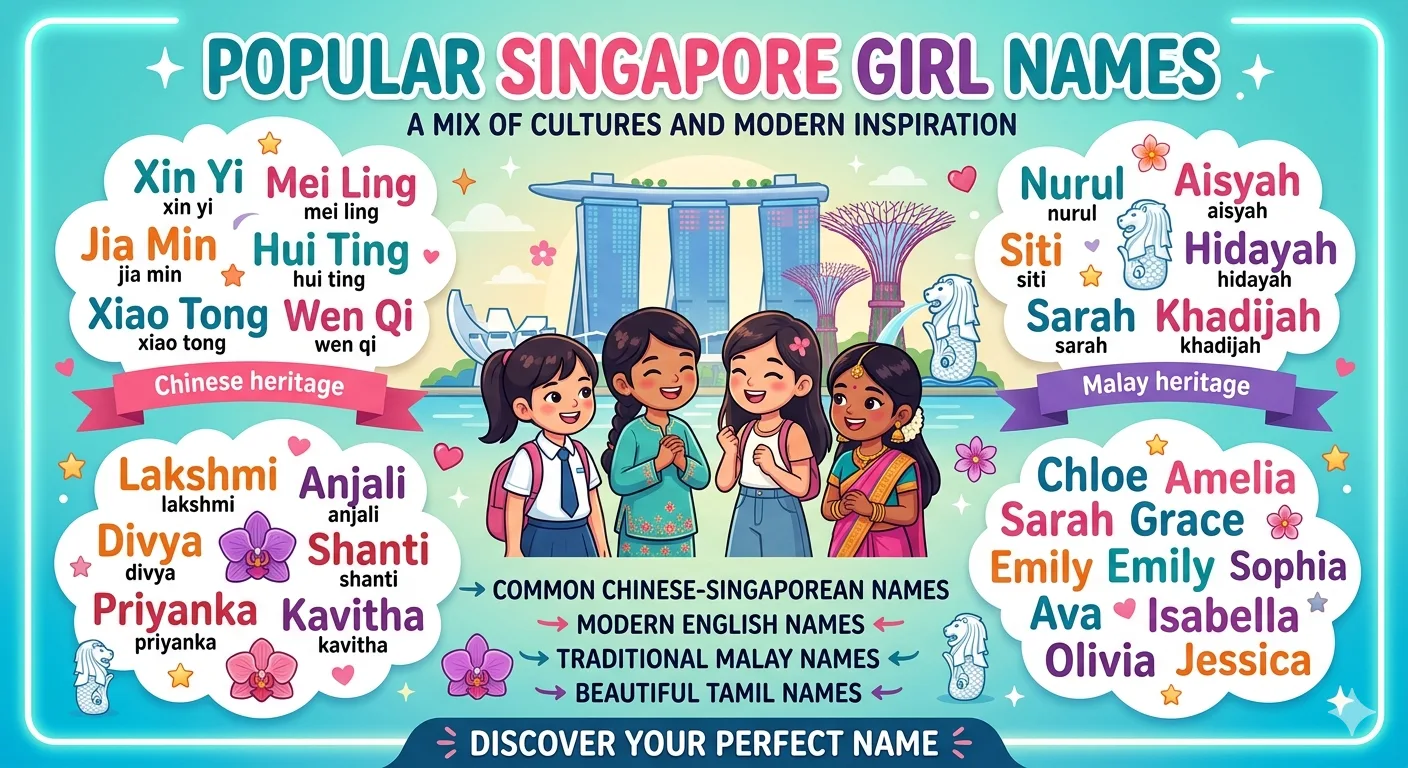
Nur Aisyah represents the most beloved naming pattern in Singapore's Malay Muslim community, combining the word Nur meaning light with the name Aisyah, which honors the most revered wife of the Prophet Muhammad. This practice of prefixing names with Nur to create compound names is one of the most distinctive features of Malay naming culture. Other popular Nur combinations include Nur Hidayah meaning light of guidance, Nur Syahirah meaning light of the illustrious one, and Nur Amira meaning light of the princess, creating a rich family of names that all share the fundamental symbolism of divine illumination.
Irdina is a fascinating example of how Malay naming culture creates new names by blending Arabic roots with Malay phonetic preferences to produce sounds that feel distinctively Malay rather than directly Arabic. This practice of adapting Arabic names to fit Malay phonology and aesthetic sensibility has been going on for centuries and continues to produce new names in the present day. Qistina similarly represents a Malay adaptation of an Arabic concept, taking the word for justice and fairness and giving it a phonetic form that sounds natural and beautiful in the Malay language.
Radiant Tamil and Indian Singapore Girl Names with Divine Meanings
Singapore's Indian community, though smaller in number than the Chinese and Malay communities, maintains a vibrant and deeply rich naming tradition drawn primarily from Tamil, Sanskrit, and other South Asian linguistic and religious sources. Tamil Hindu names in Singapore carry connections to ancient literature, divine mythology, and a philosophical tradition that values beauty, learning, devotion, and virtue as the highest qualities a daughter can embody.
|
Name |
Meaning |
Cultural Significance |
|
Ananya |
Sanskrit, unique, without equal, peerless |
Celebrates the daughter as one of a kind |
|
Kavitha |
Tamil-Sanskrit, poetry, poetic brilliance |
Literature and artistry deeply honored |
|
Dharshini |
Tamil, she who has been granted a vision |
Spiritual seeing, divine insight celebrated |
|
Nithya |
Sanskrit, eternal, everlasting, always present |
Timeless quality wished for the child |
|
Varsha |
Sanskrit, rain, blessings like monsoon showers |
Abundance and blessing through nature imagery |
|
Ishwarya |
Sanskrit, goddess-like prosperity, divine wealth |
Tamil form celebrating Lakshmi the goddess |
|
Priyadharshini |
Sanskrit-Tamil, beautiful to behold, dear sight |
Long name honoring beauty and divine vision |
|
Kiruthika |
Tamil, star cluster Krittika, bright star |
Celestial name connecting to Murugan the god |
|
Sangeetha |
Sanskrit, musical, full of melody |
Music as divine gift celebrated in the name |
|
Thevika |
Tamil, divine, godly and sacred |
Directly connecting the child to the divine |
Tamil Hindu naming in Singapore follows traditions that go back thousands of years to the ancient Sangam literary period of South India. Names are often chosen from the vast treasury of Sanskrit and Tamil words associated with the Hindu deities, with natural phenomena interpreted as divine gifts, with desirable qualities of character and intellect, or with auspicious astrological symbols. Many Singapore Tamil families consult a jothidar or astrologer when naming a child, who will calculate the appropriate starting syllable for the name based on the baby's birth star, ensuring that the name carries the maximum possible auspicious energy for the child's life ahead.
Ananya has become one of the most popular girl names in Singapore's Indian community in recent years, loved for its beautiful Sanskrit meaning of one who is without equal and for its pleasant sound that works well in both Tamil and English contexts. Priyadharshini represents the older Tamil tradition of giving daughters longer, more elaborate names that combine multiple meaningful elements into a single poetic whole, a tradition that coexists today with the modern preference for shorter and simpler names.
You can also use our Name Generator Tool to create unique names instantly. Moldova Girl Names
Rare and Unique Singapore Girl Names That Truly Stand Out
For parents who want something genuinely distinctive, Singapore's multicultural naming landscape offers a wealth of rare and uncommon choices. These unique Singapore girl names are perfect for families who want their daughter to have a name that is memorable, deeply meaningful, and unlikely to be shared with many others. Singapore's cultural richness is deep enough to offer countless rare gems across all its major naming traditions.
|
Name |
Origin and Meaning |
Why It Stands Out |
|
Yuzhen |
Chinese, jade treasure, rarest precious gem |
Extremely rare combination, hauntingly beautiful |
|
Asyura |
Arabic-Malay, tenth day of Muharram, sacred |
Rare Islamic calendar name with deep meaning |
|
Amirtham |
Tamil, nectar of immortality, divine elixir |
Ancient Tamil divine concept, beautifully rare |
|
Seraphina |
Hebrew-English, fiery and angelic, burning one |
Rare globally, increasingly fashionable in Singapore |
|
Raudhah |
Arabic, garden of paradise, heavenly garden |
Deeply spiritual rare Malay name of great beauty |
|
Ziyun |
Chinese, purple cloud, symbol of good fortune |
Rare celestial imagery, deeply auspicious |
|
Indrani |
Sanskrit, queen of heaven, wife of Indra |
Rare Tamil mythological name of great grandeur |
|
Cerise |
French-English, cherry red, bright and vivid |
Rare color name gaining attention in Singapore |
|
Shuying |
Chinese, graceful and brilliant, cultured radiance |
Rare literary name combining beauty and wisdom |
|
Thilaga |
Tamil, a mark of beauty, the beautiful one |
Rare classic Tamil name of intimate beauty |
Yuzhen represents the most prized category of rare Chinese girl names in Singapore, combining two of the most auspicious characters in the Chinese naming tradition. Yu, meaning jade, is one of the most beautiful and symbolically loaded characters in Chinese culture, representing purity, nobility, and the highest quality of character. Zhen, meaning precious or treasure, amplifies this meaning to create a name that essentially means the most precious jade of all. Despite its beautiful meaning and elegant sound, this name remains relatively rare in Singapore, making it a wonderful discovery for parents seeking something genuinely distinctive.
Raudhah, meaning garden of paradise in Arabic, is a beautiful and deeply spiritual rare name in Singapore's Malay Muslim community. In Islamic tradition, Raudhah refers specifically to the area between the Prophet Muhammad's mosque and his grave in Medina, making it one of the most sacred names in the Islamic naming tradition. The combination of its spiritual significance, its beautiful meaning, and its relative rarity in Singapore makes Raudhah a name of extraordinary distinctiveness and depth.
Nature-Inspired Singapore Girl Names Blooming with Beauty
Singapore's remarkable natural environment, from the lush tropical rainforests and Gardens by the Bay to the vibrant coral reefs, fragrant botanical gardens, and dramatic monsoon skies, has always inspired Singaporean parents to choose names that honor the natural world. Nature-inspired girl names hold special appeal in Singapore where multiple cultural traditions all share a deep reverence for the natural world as a source of beauty, meaning, and divine presence.
|
Name |
Natural Connection |
Why It Is Beloved |
|
Jasmine |
The jasmine flower, Singapore national flower |
National symbol, beautifully fragrant and delicate |
|
Orchid |
The orchid flower, icon of Singapore |
Singapore Airlines orchid, elegant beyond measure |
|
Mei Hua |
Chinese, plum blossom in winter |
Resilience symbolism, beloved across generations |
|
Melur |
Malay, jasmine flower |
Malay version of the jasmine, soft and fragrant |
|
Valli |
Tamil, a creeping forest vine |
Tamil forest deity name, connected to Murugan |
|
Hui |
Chinese, orchid or wisdom depending on character |
Floral and intellectual symbolism combined |
|
Bunga |
Malay, flower, blossoming beauty |
Simple and beautiful, floral meaning in Malay |
|
Kamala |
Sanskrit, lotus flower, sacred water bloom |
Lotus as symbol of purity rising above water |
|
Xue |
Chinese, snow, pure white winter beauty |
Seasonal nature imagery, pure and pristine |
|
Aruna |
Sanskrit, the rosy red of dawn, sunrise glow |
Dawn light as symbol of new beginnings |
Jasmine holds a uniquely special place in Singapore's naming culture because the jasmine flower is woven into the very fabric of Singaporean identity. The jasmine is Singapore's national flower in its Malay and Indian cultural contexts, its delicate white petals and intoxicating fragrance making it one of the most beloved flowers in the region. For parents across all of Singapore's communities, naming a daughter Jasmine connects her to this beautiful national symbol while giving her a name that sounds equally beautiful in English, Mandarin, and Malay contexts.
Kamala, the Sanskrit name for lotus flower, carries profound spiritual significance across Singapore's Hindu, Buddhist, and broader Asian communities. The lotus grows from the mud at the bottom of ponds and rivers to bloom in perfect purity above the water, making it one of the most powerful symbols in Asian spiritual traditions of the ability to rise above difficult circumstances and achieve a state of grace and beauty. For Singapore's Tamil Hindu families especially, naming a daughter Kamala connects her to the goddess Lakshmi, who is often depicted standing or seated on a lotus flower.
How Names Are Chosen in Singapore Culture and Society
Understanding how Singapore families approach the naming process reveals the rich and complex cultural landscape that makes Singapore baby girl names so diverse and fascinating.
Chinese Naming Traditions and Feng Shui Influences
In Singapore's Chinese community, the naming of a child is often a multi-generational family event that draws on both ancestral wisdom and contemporary guidance. Many Chinese Singaporean families still consult a fortune teller or bazi practitioner who calculates the child's elemental profile based on the precise date, time, and location of birth. This profile identifies which of the five Chinese elements, wood, fire, earth, metal, and water, the child needs more of to achieve balance in life. The chosen name characters are then selected to provide the missing element, with each Chinese character associated with one of the five elements based on its radical or its component strokes. This practice of using names to balance a child's elemental destiny is one of the most distinctive features of Chinese Singaporean naming culture.
Malay and Islamic Naming Rituals
In the Malay Muslim community, the naming of a daughter is inseparable from the religious ceremony of aqiqah, the sacrifice of an animal performed on the seventh day after a child's birth. The name is formally announced at this ceremony, often with the father whispering the call to prayer in the newborn's ear and then announcing her name to the gathered family and community. The name is almost always drawn from Arabic, either directly from the Quran, from the names of respected figures in Islamic history, or from Arabic words with beautiful spiritual meanings. Religious scholars or imams are sometimes consulted to ensure that the chosen name is appropriate, carries a genuinely positive meaning, and does not inadvertently replicate any name that carries negative associations in Islamic tradition.
Tamil and Hindu Naming Astrology
Tamil Hindu families in Singapore typically name their daughters according to the Jyotish astrological system, which calculates the birth star or nakshatra of the child based on the position of the moon at the moment of birth. Each of the twenty-seven birth stars is associated with a specific syllable, and the child's name must begin with that syllable to ensure astrological harmony. This practice means that Tamil Hindu naming is fundamentally tied to astronomy and the movements of the night sky, creating a beautiful connection between each child's name and her cosmic birth moment. The jothidar or astrologer consults charts and provides approved beginning syllables from which the family then selects a full name with a beautiful meaning.
Latest Singapore Girl Name Trends Shaping 2026
Singapore baby girl naming trends in 2026 reflect a fascinating intersection of cultural pride, global connectivity, modern aesthetics, and the enduring influence of tradition. Several clear patterns are defining the naming landscape across the city-state right now.
English names are gaining ground across all communities. Even within traditionally non-English naming communities, there is a marked increase in parents choosing English first names or giving their daughters both a Chinese or Tamil name and an English name simultaneously. This reflects Singapore's English-first education system and the practical reality that English is the language of the workplace and of cross-community communication in Singapore. Names like Sophie, Chloe, Emma, Olivia, and Amelia are now popular across Chinese, Malay, and Indian Singaporean families alike.
Short and punchy names are trending strongly. Names of one or two syllables in all languages are especially fashionable right now. In Chinese, single-character names like Xin, Hui, and Yun are gaining ground. In Malay, short names like Hana, Alya, and Nur are very popular. In English, names like Ava, Mia, Zoe, and Isla are widely beloved. This preference for brevity reflects an aesthetic shift toward simplicity, clarity, and names that feel confident and uncluttered.
Cross-cultural names are becoming more common. As intermarriage between Singapore's different communities increases, parents are increasingly choosing names that work across multiple cultural and linguistic contexts. A name like Ariel sounds beautiful in English, has Hebrew roots that connect to the Jewish tradition, and sounds pleasant in Mandarin contexts as well. These cross-cultural names reflect the growing reality of Singapore's truly multicultural family landscape.
Old-fashioned names are experiencing a revival among younger parents. Chinese names with classical literary references, Malay names from Islamic history, and Tamil names of ancient goddesses that might have seemed overly traditional just a generation ago are being rediscovered with fresh appreciation. This mirrors a global trend toward vintage name revivals and reflects a desire among Singaporean millennials to reconnect with the depth and beauty of their heritage.
Nature and celestial imagery is powerfully trending. Following global patterns, Singapore parents are reaching for names connected to the moon, stars, flowers, and natural phenomena. Jasmine, Luna, Aurora, Xue meaning snow, Aruna meaning dawn, and Melur the Malay jasmine are all gaining popularity. This trend reflects both global fashion and Singapore's own deep cultural traditions of finding meaning and beauty in the natural world.
You can also use our Name Generator Tool to create unique names instantly. Slovakia Girl Names
Expert Tips for Choosing the Perfect Stylish Singapore Girl Name
Consider how the name sounds in multiple languages. Singapore is a multilingual society and your daughter will live her life in at least two languages. A name that sounds beautiful in both Mandarin and English, or in both Tamil and English, will serve her better throughout her life than a name that works beautifully in only one language context. Test your chosen name by saying it naturally in conversation in both languages.
Research the meaning carefully in all relevant languages. Because of Singapore's multilingual environment, a name with a beautiful meaning in one language might accidentally create an unfortunate sound or association in another. Chinese names in particular need to be checked for how they sound in Mandarin, Hokkien, and any other dialect your family uses. Similarly, English names should be considered for how they sound when pronounced with a Singapore accent and in the context of a Chinese surname.
Think about the stroke count for Chinese names. Many Singapore Chinese families still attach significance to the total number of strokes in a daughter's written Chinese name. Different numerological systems suggest different ideal stroke counts, but the general principle is that the number should be positive and auspicious according to the system your family follows. If this tradition matters to your family, consider consulting a practitioner before finalizing the name.
Honor your heritage with pride and intention. Singapore's diversity is its greatest strength, and naming your daughter with a name that honors your specific cultural heritage is a beautiful act of love and connection. Do not feel pressured to choose a name from outside your tradition simply because it seems more modern or globally fashionable. A name deeply rooted in your own cultural tradition, chosen with care and understanding, will always be more meaningful than a borrowed name.
Consider your daughter's future professional life. Singapore is a highly competitive and internationally connected society. A name that is easy to pronounce and remember across different cultural contexts will serve your daughter well as she builds her career and her identity. Names that are extremely difficult to pronounce for speakers of other languages, or that have unfortunate associations in languages she will regularly encounter, may create unnecessary friction in her daily life.
Generate More Names: Girl Names Generator
Conclusion: Celebrating the Rich Beauty of Singapore Girl Names
Singapore girl names are among the most culturally diverse, semantically rich, and aesthetically beautiful in the entire world. They tell the story of a remarkable city-state where Chinese, Malay, Indian, and Eurasian traditions have woven themselves together into a unique cultural fabric that is simultaneously ancient and thoroughly modern, deeply rooted and globally connected, traditionally minded and forward-looking. Whether you choose a timeless Chinese name like Mei Lin or Xin Hui, a beautiful Malay name like Nur Aisyah or Irdina, a sacred Tamil name like Kavitha or Ananya, a nature-inspired choice like Jasmine or Kamala, or a rare and distinctive pick like Yuzhen or Raudhah, you are giving your daughter a name with genuine depth, cultural resonance, and lasting beauty.
The most important thing about choosing a Singapore girl name in 2026 is choosing one that resonates with your heart, honors your family's unique heritage, carries a meaning you find genuinely beautiful, and gives your daughter a strong and confident identity to grow into. A name is the first gift you give your child, and in the wonderfully diverse world of Singapore naming traditions, there is a perfect name waiting for every girl born in this extraordinary city.
We hope this complete guide to Singapore girl names has inspired you, informed you, and helped you discover possibilities you might not have considered before. May your daughter grow up proud of her name, connected to her heritage, and ready to make her own unique mark on this remarkable island and on the wider world.