 Serbian Girl Name Generator
Discover beautiful Serbian girl names from Balkan Slavic heritage
Guides & Articles
Serbia Girl Names: A Complete Guide to Stylish, Popular and Meaningful Choices
Discover the most beautiful, trending, unique and culturally rich Serbian girl names for 2026
Introduction: The Rich World of Serbian Girl Names
Choosing a name for your baby girl is one of the most meaningful and joyful decisions any parent will ever make. In Serbia, this decision carries deep cultural weight, shaped by centuries of Slavic heritage, Orthodox Christian tradition, regional identity, and a rich history of literature and folklore. Serbian girl names are among the most musically beautiful and culturally significant in the Balkan region, reflecting a nation whose identity is woven from ancient roots, Byzantine influence, and a proud Slavic spirit that has endured through every age of history.
Serbia sits at the crossroads of Eastern and Western Europe, and this unique geographic and cultural position is beautifully reflected in its naming traditions. You will find names rooted in Old Slavic mythology and ancient meaning sitting alongside names borrowed from Greek, Hebrew, Latin, and Turkish influences. The result is a naming landscape of extraordinary richness and beauty, where every name carries a story, a meaning, and a connection to something greater than the individual.
In 2026, Serbian baby girl naming trends are evolving in fascinating ways. Parents are balancing a genuine pride in traditional Slavic names with an openness to modern and international influences. There is a growing appreciation for names that honor Serbia's Orthodox Christian heritage, names that carry the soft and melodic sounds of the Serbian language, and names that feel fresh and contemporary for a child growing up in a connected and forward-looking Serbia. Whether you are drawn to popular classic names, rare and distinctive Slavic picks, modern trending options, or names rooted in Orthodox faith, this complete guide covers the full landscape of stylish Serbian girl names today.
This article explores popular Serbian girl names with beautiful meanings, modern and trending options, traditional and cultural names, rare and unique picks, names rooted in Orthodox faith, and the deep cultural forces shaping Serbian naming traditions in 2026. You will also find expert tips for choosing the perfect Serbian name and a comprehensive FAQ section answering the questions parents most want answered.
Popular Serbian Girl Names with Beautiful Meanings
Certain names have held a beloved place in Serbian hearts across generations, consistently appearing among the most cherished choices for baby girls throughout the country. These popular Serbian girl names combine beautiful Slavic sounds, powerful meanings, and deep cultural resonance. If you want a name that feels warmly familiar to Serbian families while carrying genuine depth and significance, these are the names to explore first.
|
Name |
Origin / Meaning |
Why It Stands Out |
|
Milica |
Slavic, gracious, dear, beloved |
Most iconic Serbian girl name of all time |
|
Ana |
Hebrew, grace, favor, God has favored me |
Simple, beloved, timeless across generations |
|
Jelena |
Greek, shining, bright, torch of light |
Queenly heritage, hugely popular in Serbia |
|
Marija |
Hebrew, beloved, wished for child |
Serbian form of Mary, deeply beloved |
|
Sofija |
Greek, wisdom, knowledge |
Elegant classic, consistently top ranked |
|
Teodora |
Greek, gift of God, divine gift |
Royal and religious heritage, beautiful |
|
Katarina |
Greek, pure, chaste, clear |
Classical dignity, centuries of Serbian use |
|
Aleksandra |
Greek, defender of mankind |
Strong and regal, widely adored in Serbia |
|
Jovana |
Hebrew, God is gracious |
Serbian form of Joanna, deeply traditional |
|
Tamara |
Hebrew, palm tree, date palm |
Poetic beauty, beloved Slavic classic |
|
Ivana |
Hebrew, God is gracious, gift of God |
Feminine Slavic form of Ivan, widely used |
|
Dragana |
Slavic, dear, precious, beloved |
Purely Serbian, deep cultural roots |
Milica stands in a category all by itself in Serbian naming history. This name, derived from the Old Slavic word for gracious and dear, has been one of the most consistently beloved girl names in Serbia for centuries. It carries the story of Princess Milica of Serbia, the saintly wife of Prince Lazar who led her people through one of the darkest moments in Serbian history following the Battle of Kosovo in 1389. For Serbian families, choosing Milica for a daughter is both an aesthetic choice and a connection to the deepest threads of national identity and faith.
Jelena carries queenly resonance across Serbian history, most powerfully through the memory of Queen Jelena Ansujska, the thirteenth-century queen who was canonized as a saint by the Serbian Orthodox Church. This name, the Serbian form of the Greek Helen meaning bright and shining, has never lost its elegance or its emotional power for Serbian families. Marija, the Serbian rendering of Mary, reflects the central role of the Virgin Mary in Orthodox Christian devotion and has been among the most beloved names in Serbia for as long as the country has existed.
Modern and Trending Serbian Girl Names in 2026
Serbian parents in 2026 are drawn to girl names that feel contemporary and stylish while still honoring the melodic beauty of the Serbian language and the country's cultural heritage. Modern trending names in Serbia tend to have a fresh quality that feels right for a child growing up in today's connected Europe, often combining international appeal with distinctly Serbian or Slavic sounds.
|
Name |
Meaning |
Why Trending |
|
Lena |
Greek, shining light, torch |
Short, modern, beautiful across all languages |
|
Nina |
Hebrew or Slavic, grace, favor, little girl |
Chic, international, rising fast in Serbia |
|
Sara |
Hebrew, princess, noble lady |
Clean and modern, widely popular today |
|
Mia |
Scandinavian, beloved, mine |
Short and stylish, fashionable in urban Serbia |
|
Nora |
Irish or Arabic, honor, light |
Simple, elegant, growing rapidly |
|
Luna |
Latin, the moon, celestial beauty |
Celestial and romantic, very current in Serbia |
|
Lara |
Latin or Russian, protection, famous |
Poetic, literary, modern and beautiful |
|
Maja |
Slavic or Greek, great, goddess of spring |
Deeply Slavic yet modern and fresh |
|
Petra |
Greek, rock, stone, solid foundation |
Strong and feminine, rising in popularity |
|
Dunja |
Turkish origin, quince fruit, the world |
Uniquely Serbian sound, warmly loved |
|
Iskra |
Slavic, spark, flash of light |
Purely Slavic, original and beautiful |
|
Tijana |
Latin, Christian, follower of Christ |
Popular modern Serbian name, widely used |
One of the clearest patterns defining modern Serbian girl names in 2026 is the parallel love for short and clean international names alongside distinctly Serbian Slavic choices. Nina, Lena, and Sara reflect the influence of European and global naming trends, names that feel at home in both Belgrade and Berlin. At the same time, names like Dunja, Iskra, and Maja represent a proud attachment to sounds and forms that are uniquely rooted in Serbian and Slavic linguistic culture.
Luna has become one of the most fashionable girl names across the entire European continent, and Serbia is no exception to this trend. Its celestial romance and soft, flowing sound work beautifully in Serbian, and the name carries an international elegance that appeals to modern Serbian parents who see their daughters as global citizens. Dunja, on the other hand, is a name with a completely different character, deeply rooted in Serbian and Balkan culture, carrying the warm, earthy beauty of a name that could come from nowhere else.
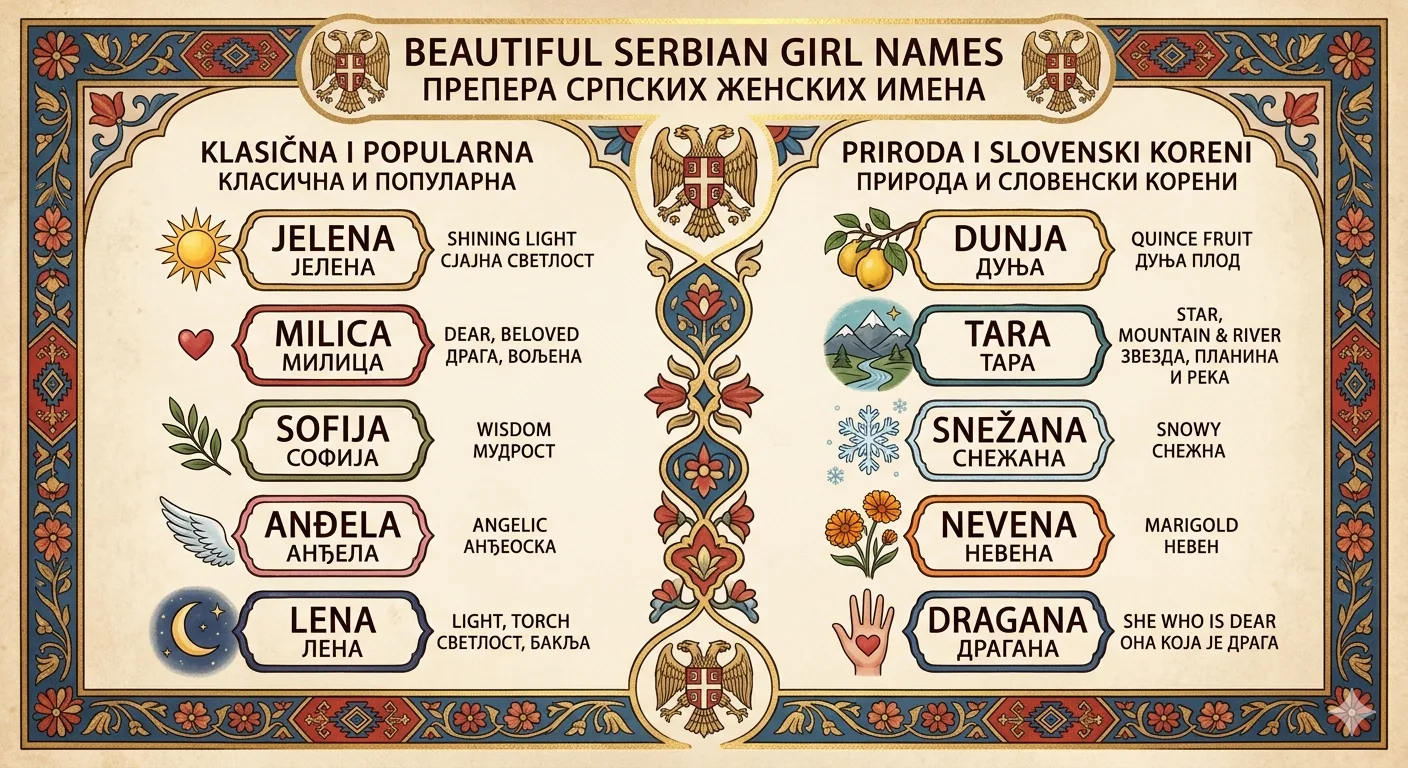
Traditional and Cultural Serbian Girl Names That Never Fade
Traditional Serbian girl names carry the weight of history, the beauty of Slavic linguistic heritage, and the comfort of names that have been passed through families across centuries. These classic Serbian names have been beloved across generations because they carry genuine cultural depth, beautiful sounds, and connections to the saints, queens, and heroines of Serbian national story.
|
Name |
Origin / Meaning |
Why It Endures |
|
Vesna |
Slavic, spring, messenger of spring |
Ancient Slavic goddess name, purely Serbian |
|
Biljana |
Slavic, herb, plant, medicinal plant |
Deeply Serbian, carries folk epic beauty |
|
Radmila |
Slavic, happy work, joyful labor |
Old Slavic compound, genuinely traditional |
|
Snezana |
Slavic, snow, white as snow |
Beloved Serbian Snow White name |
|
Slavica |
Slavic, glory, Slavic, fame |
Name of Slavic pride and national identity |
|
Gordana |
Serbian, proud, dignified |
Distinctly Serbian, noble and enduring |
|
Vojislava |
Slavic, warrior glory, army fame |
Ancient compound, rare and historic |
|
Danica |
Slavic, morning star, Venus |
Beautiful Slavic classic, always beloved |
|
Zora |
Slavic, dawn, morning light |
One of the most poetic Serbian names |
|
Milena |
Slavic, gracious, merciful, dear |
Soft and beautiful, timeless in Serbia |
|
Branislava |
Slavic, glory protector, armor fame |
Strong compound name, proudly Serbian |
|
Radojka |
Slavic, joy, glad, happiness |
Warm and joyful, traditional Serbian choice |
Vesna holds a particularly special place in Serbian cultural identity because it is one of the few surviving names directly connected to pre-Christian Slavic mythology. Vesna was the Slavic goddess of spring, a figure of warmth, renewal, and the return of life after the cold winter months. Choosing this name for a daughter is a connection to a layer of Serbian heritage that predates even the arrival of Christianity, reaching back to the ancient Slavic world from which the Serbian people emerged.
Danica, meaning morning star or the planet Venus, is one of the most poetically beautiful names in the Serbian tradition. The image of the morning star hanging in the sky before dawn, the brightest and most beautiful light in the predawn darkness, gives this name a luminous quality that Serbian families have always found deeply appealing. Snezana, literally meaning white as snow, carries the fairy-tale beauty of the Serbian Snow White story and has remained beloved in Serbian families for generations precisely because of its lyrical imagery and its connection to beloved folklore.
You can also use our Name Generator Tool to create unique names instantly. Kiribati Girl Names
Serbian Girl Names Rooted in Orthodox Christian Faith
The Serbian Orthodox Church has been one of the most powerful and enduring forces shaping Serbian culture, identity, and naming traditions for over eight hundred years. The tradition of celebrating a family's patron saint, known as the Slava, is one of the most distinctive features of Serbian culture, and the names of Orthodox saints have always been among the most beloved choices for baby girls across Serbia.
|
Name |
Saint or Biblical Meaning |
Religious Significance |
|
Paraskeva |
Greek, Friday, preparation day |
Beloved saint of Serbian Orthodox tradition |
|
Anastasija |
Greek, resurrection, rising again |
Resurrection theme, deeply Orthodox |
|
Varvara |
Greek, foreign woman, stranger |
Saint Barbara, celebrated in Orthodox calendar |
|
Magdalena |
Hebrew, from Magdala, tower |
Mary Magdalene, beloved New Testament figure |
|
Agata |
Greek, good, virtuous, kind |
Saint Agatha, early Christian martyr |
|
Filomena |
Greek, lover of strength, friend |
Saint Philomena, venerated in Orthodoxy |
|
Veronika |
Greek or Latin, true image |
Honored in Orthodox and Catholic tradition |
|
Natalija |
Latin, born on Christmas day |
Christmas name, deeply Orthodox meaning |
|
Vasilija |
Greek, royal, kingly, queenly |
Saint Basil related, noble and sacred |
|
Svetlana |
Slavic, light, holy light |
Slavic name meaning sacred light, deeply loved |
Paraskeva holds a uniquely honored position in Serbian Orthodox tradition. Saint Paraskeva of the Balkans, also known as Petka, is one of the most beloved saints in the entire Serbian Orthodox calendar, and her name remains a deeply meaningful choice for Serbian girls even today. The saint is associated with Friday, faithfulness, and compassion for the poor and suffering, and her feast day is celebrated with particular warmth throughout Serbia.
Anastasija, meaning resurrection, carries the most central theological concept of Orthodox Christianity directly in its sound. For deeply Orthodox Serbian families, giving a daughter this name is an expression of faith in the resurrection of Christ and in the hope of eternal life. Svetlana, though of Slavic rather than Greek origin, carries a meaning of holy light that makes it equally powerful as a name of Christian devotion, connecting Slavic roots with Orthodox spiritual values in one beautiful word.
Rare and Unique Serbian Girl Names That Truly Stand Out
For parents who want something genuinely distinctive, the Serbian naming tradition offers a wealth of rare and uncommon choices. These unique Serbian girl names are perfect for families who want their daughter to have a name that is memorable, deeply meaningful, and unlikely to be shared with many classmates. Serbia is rich enough in Slavic, Byzantine, and folk literary heritage to offer countless rare gems that deserve much wider recognition.
|
Name |
Origin / Meaning |
Why It Stands Out |
|
Desanka |
Slavic, right hand, dexterous |
Name of great Serbian poetess Desanka Maksimovic |
|
Kosara |
Serbian historical, dawn, Serbian princess |
Historic princess name, beautifully rare |
|
Jerina |
Greek form of Irina, peace, serene |
Medieval Serbian queen name, very rare |
|
Draga |
Slavic, dear, precious, loved one |
Old Serbian pet name turned given name |
|
Milunka |
Slavic, gracious, merciful diminutive |
Name of legendary Serbian war heroine |
|
Zorka |
Slavic, dawn, morning light, little dawn |
Poetic diminutive of Zora, rarely used |
|
Stojanka |
Slavic, standing firm, steadfast |
Traditional compound, genuinely rare |
|
Vasilka |
Greek, queen, royal, little queen |
Rare diminutive with royal meaning |
|
Nevena |
Slavic, marigold flower, calendula |
Floral name, purely Serbian, beautifully rare |
|
Radinka |
Slavic, joyful, glad, little joy |
Warm and rare, traditional diminutive form |
Desanka carries one of the most powerful literary associations in all of Serbian culture. Desanka Maksimovic was the greatest female poet in Serbian literary history, a figure of extraordinary warmth, compassion, and national significance whose poetry gave voice to the Serbian spirit across the darkest decades of the twentieth century. To name a daughter Desanka today is to connect her to this literary legacy and to the deep Serbian belief that poetry and beauty are essential to a fully human life.
Milunka honors one of the most astonishing figures in Serbian and indeed world military history. Milunka Savic was a Serbian woman who disguised herself as a man to fight in the Balkan Wars and First World War, eventually becoming the most decorated female combatant in the history of warfare. Her story of courage, resilience, and extraordinary humanity is one of the great untold stories of the twentieth century, and her name is a beautiful tribute to female strength of the most extraordinary kind.
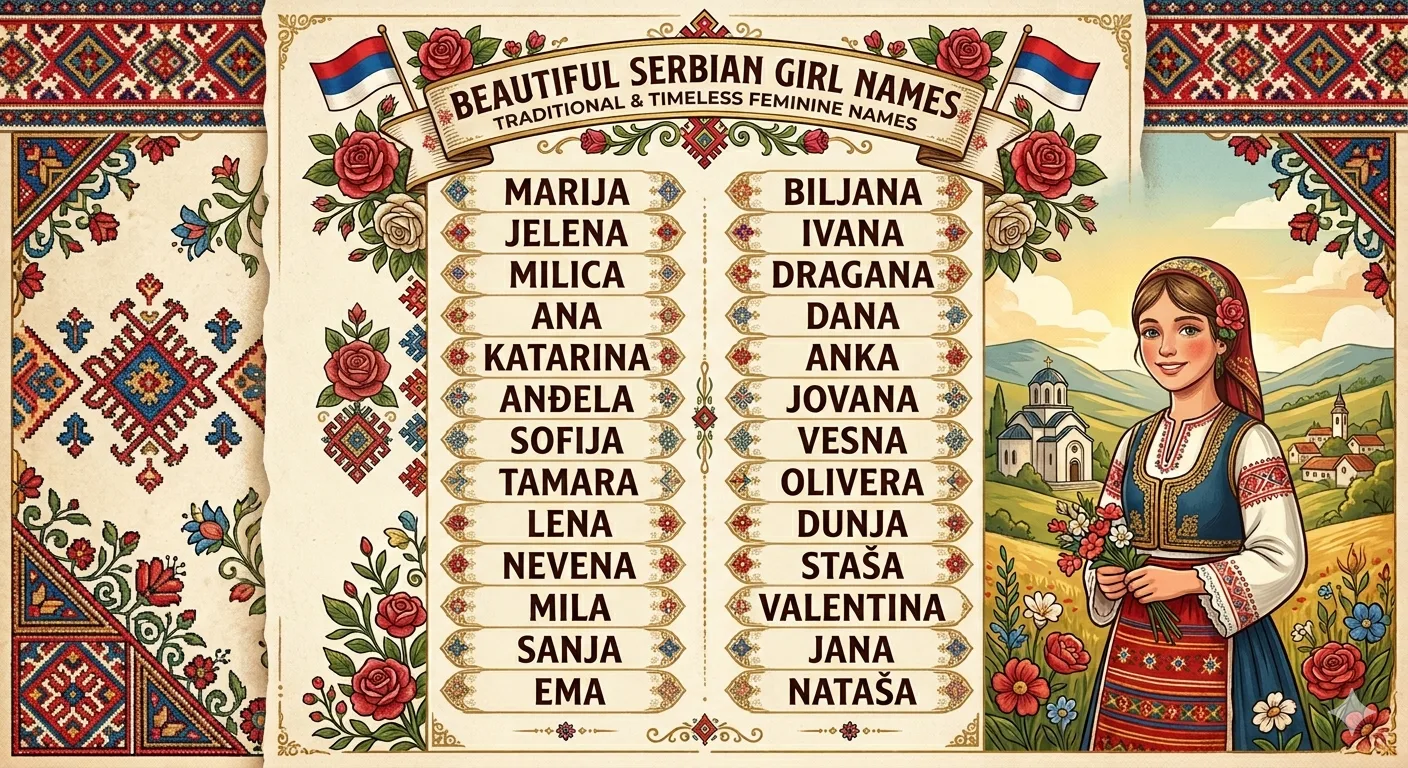
Nature-Inspired Serbian Girl Names Blooming with Beauty
Serbia's beautiful natural landscape, from the rolling hills and river valleys of Vojvodina to the dramatic mountains of eastern and southern Serbia, the gorges of the Drina, the forests of Fruska Gora, and the wild beauty of Tara National Park, has long inspired parents to choose names that honor the natural world. Nature-inspired girl names carry a poetic quality in Serbian that connects children to the living world around them.
|
Name |
Natural Connection |
Why It Is Beloved |
|
Nevena |
Marigold, calendula flower |
Purely Slavic, beautifully floral |
|
Ruza |
Rose, the queen of flowers |
Most beloved flower name in Serbia |
|
Jasna |
Slavic, clear, bright, sunny |
Natural brightness and clarity |
|
Zora |
Slavic, dawn, morning light |
Celestial and poetic, deeply Serbian |
|
Danica |
Slavic, morning star, Venus |
Celestial beauty, ancient Slavic name |
|
Breza |
Slavic, birch tree, silver birch |
Tree name, pure and silvery |
|
Jagoda |
Slavic, strawberry, wild berry |
Sweet and earthy, uniquely Serbian |
|
Roza |
Latin via Slavic, rose flower |
Classic floral beauty, widely loved |
|
Vanja |
Slavic, God is gracious, gift |
Soft and natural sounding, widely used |
|
Iskra |
Slavic, spark, flash of fire |
Brilliant natural image, very distinctive |
Danica, meaning morning star, is one of the oldest and most beautiful nature-inspired names in the entire Slavic tradition. The morning star has been a symbol of hope, beauty, and the promise of a new day since the earliest days of human civilization, and in Serbian culture this name carries all of that luminous symbolism. It is a name that speaks of light emerging from darkness, of beauty that appears at the threshold between night and morning, which makes it a profoundly meaningful choice for a new baby daughter.
Nevena, the Serbian name for the marigold flower, carries a special warmth in Serbian culture. The marigold is associated with the sun and with the warmth of late summer, and its deep orange and gold colors have made it a beloved symbol of vitality and cheerfulness. The name Nevena captures this warmth and carries a purely Slavic beauty that has no direct equivalent in other European languages, making it one of the most distinctly and proudly Serbian names a family could choose.
You can also use our Name Generator Tool to create unique names instantly. Kuwait Girl Names
How Names Are Chosen in Serbian Culture and Society
Understanding how Serbian families approach the naming process reveals a rich and complex cultural landscape shaped by religion, family tradition, regional identity, and the powerful pull of history and folk memory.
Family Heritage and Ancestral Pride
The tradition of naming children after beloved grandparents or other respected family members is enormously strong in Serbian culture. It is common practice for the firstborn son to be named after his paternal grandfather, and the same principle often extends to daughters, who may be named after grandmothers, aunts, or other important female figures in the family tree. This practice means that many traditional Serbian names are kept alive not because of their trendiness but because of their deep personal and familial significance.
The Slava Tradition and Orthodox Patron Saints
One of the most distinctive features of Serbian naming culture is the connection to the Slava, the celebration of a family's patron saint. Every Serbian Orthodox family observes a particular saint's day as its own feast day, a tradition passed from father to son across centuries. While the Slava does not directly determine a child's name, it creates a deep familiarity with the stories and qualities of Orthodox saints that naturally influences naming choices, making names like Paraskeva, Anastasija, Varvara, and Jovana particularly meaningful for families whose patron saints share those names.
Folk Epic Poetry and Literary Influence
Serbian folk epic poetry, collected and celebrated by Vuk Stefanovic Karadzic in the nineteenth century, has had an enormous and enduring influence on Serbian naming culture. Names that appear in the great Kosovo cycle of epics, names like Milica, Jerina, and Kosara, carry the romantic power of the ballad tradition and the deep national emotions associated with the stories of Serbian kings, queens, and heroes. For many Serbian families, choosing a name from the folk epic tradition is a way of connecting a child to the greatest expression of Serbian cultural identity.
Modern Urban and International Influences
Belgrade and other Serbian cities have become increasingly connected to European and global culture, and this connectivity has influenced naming trends significantly. Urban Serbian parents are increasingly drawn to names that feel international and stylish while still sounding natural in the Serbian language. Names like Sara, Lena, Nina, and Mia reflect this openness to global influence, chosen precisely because they carry a contemporary elegance that feels at home in both Serbian and broader European contexts.
You can also use our Name Generator Tool to create unique names instantly. Seychelles Girl Names
Latest Serbian Girl Name Trends Shaping 2026
Serbian baby girl naming trends in 2026 reflect a fascinating tension between deep cultural pride and modern openness, between the desire to honor a rich Slavic heritage and the excitement of participating in a shared European and global culture.
Traditional Slavic names are experiencing a meaningful revival among younger Serbian parents who feel a strong desire to reconnect with their cultural roots. Names like Vesna, Zorka, Danica, and Nevena that might have seemed old-fashioned to one generation are now being chosen by younger parents who see them as beautiful, distinctive, and authentically Serbian. This is part of a broader European trend toward celebrating indigenous naming traditions as a form of cultural identity.
Short and melodic names remain extremely popular in urban Serbia. One and two-syllable names like Ana, Mia, Nina, Lena, and Sara dominate the top of Serbian baby name charts because they combine ease of use with genuine beauty. These names work effortlessly in daily Serbian life while carrying enough international recognition to feel comfortable in a connected European society.
Nature and celestial inspired names are gaining momentum. Names like Zora, Danica, Iskra, Nevena, and Luna carry a natural poetry that appeals strongly to Serbian parents who want names rooted in the beauty of the living world and the night sky. This trend mirrors what is happening across Europe but in Serbia it is filtered through distinctly Slavic linguistic and cultural sensibilities that give these names a unique local flavor.
The revival of names connected to strong historical women is another important trend in 2026. Names like Milunka, Desanka, and Kosara are drawing renewed interest as Serbian society engages more deeply with questions of female identity, heritage, and historical contribution. Choosing a name that connects a daughter to one of Serbia's great historical or literary women is increasingly seen as a meaningful and proud act of cultural celebration.
Gender-neutral or cross-cultural names are a growing but still minority trend in Serbia. Names that work in multiple Slavic languages or that carry both Serbian and international recognition, names like Maja, Petra, Vanja, and Lara, are popular precisely because they feel rooted in Slavic tradition while also being recognizable across European borders. For Serbian families with connections to the diaspora or international professional lives, this kind of cross-cultural versatility in a name is genuinely valuable.
Expert Tips for Choosing the Perfect Serbian Girl Name
Start with meaning and cultural resonance. A name that carries a meaning you find genuinely beautiful or that connects to something important in your family's story and heritage will always feel more special than a name chosen only for its current trendiness. Serbian names are particularly rich in meaning because the Old Slavic roots of so many names translate directly into vivid, beautiful words. Knowing that Danica means morning star or that Zora means dawn gives the name an extra dimension of beauty every time you say it.
Consider the sound in Serbian everyday life. Think about how the name sounds in Serbian sentences, how it works with common Serbian diminutives and terms of endearment, and how it sounds when called across a schoolyard or spoken formally in a professional setting. Many Serbian names come with natural and beloved diminutive forms that become equally important in daily life. Milica becomes Milka or Mica in affectionate use. Jelena becomes Jeca. Aleksandra becomes Sandra or Saška. These diminutive forms are not just nicknames but genuinely important parts of the name's identity in Serbian culture.
Honor your Orthodox faith and family patron saint tradition. The Slava tradition creates a beautiful opportunity to choose a name connected to your family's patron saint, giving your daughter a name with personal religious significance as well as cultural depth. A name that links a child to the family's sacred heritage is a gift with a special kind of weight and beauty.
Think about how the name works in a wider world. Modern Serbian children will grow up in a Europe and a world where their name will be heard, read, and pronounced by people of many different linguistic backgrounds. A name like Ana, Sara, or Sofia works effortlessly across European languages. A name like Nevena or Snezana is more distinctly Serbian but carries a beauty that crosses language barriers even if it requires a little learning to pronounce correctly. Both are valid choices but worth thinking through honestly.
Trust the sound that feels right. After all the research and consideration, the right Serbian girl name is usually the one that feels warm and right when you say it aloud, the one that sounds like a beautiful piece of the Serbian language and like the beginning of your daughter's unique story at the same time. Serbian parents have always known that a name is a kind of song, and the best name is the one that sings most naturally in your heart.
Generate More Names: Girl Names Generator
Conclusion: Celebrating the Beautiful World of Serbian Girl Names
Serbian girl names are among the most musically beautiful, culturally layered, and historically rich in the entire Slavic world. They carry stories of princesses and saints, folk heroines and great poets, ancient Slavic goddesses and Byzantine queens. Whether you choose a timeless classic like Milica or Jelena, a modern favorite like Nina or Lena, a nature-inspired gem like Danica or Nevena, a faith-rooted choice like Anastasija or Paraskeva, or a rare and distinctive pick like Desanka or Milunka, you are giving your daughter a name with genuine beauty, depth, and connection to one of Europe's most distinctive and proud cultural traditions.
The most important thing about choosing a Serbian girl name in 2026 is choosing one that resonates with your heart, honors your family's unique story, and carries the values and beauty you hope your daughter will embrace throughout her life. A name is the first gift you give your child, and in the rich and endlessly inspiring world of Serbian naming tradition, there is a perfect name waiting for every girl born into this remarkable country.
We hope this complete guide to Serbian girl names has inspired you, informed you, and helped you discover beautiful possibilities rooted in one of the most distinctive naming cultures in the Balkans and the wider Slavic world. May your daughter grow up proud of her name, connected to her Serbian heritage, and ready to make her own unique and beautiful mark on the world.