 Russian Girl Name Generator
Discover beautiful Russian names with rich Slavic heritage
Guides & Articles
Russian Girl Names: A Complete Guide to Stylish, Popular and Meaningful Choices
Discover the most beautiful, trending, unique and culturally rich Russian girl names for 2026
Introduction: The Enchanting World of Russian Girl Names
Choosing a name for your baby girl is one of the most beautiful and significant decisions a parent can ever make. When it comes to Russian girl names, this decision carries an extraordinary depth of culture, history, literature, and emotional richness that few other naming traditions in the world can match. Russia is a land of remarkable stories, towering artistic achievement, ancient spiritual heritage, and an unbroken connection to a Slavic past that stretches back more than a thousand years. All of this pours into its naming traditions, making Russian girl names among the most meaningful, melodic, and memorable in the entire world.
Russian baby girl names are shaped by a fascinating combination of forces. Old Slavic tribal heritage gave the language some of its most ancient and powerful name forms. Orthodox Christianity brought a treasury of Greek, Hebrew, and Latin names that became deeply woven into Russian life over many centuries. Tsarist court culture elevated certain elegant names to symbols of aristocratic beauty. And the great writers of Russian literature, from Pushkin and Tolstoy to Chekhov and Dostoyevsky, immortalized names like Natasha, Anna, Tatiana, and Sonya in stories that have touched readers around the world.
In 2026, Russian girl names are experiencing a remarkable moment of global discovery. Parents across Europe, North America, Australia, and beyond are falling in love with the musical quality of Russian female names, their strong but graceful sounds, their rich meanings, and the cultural depth they carry. Whether you are of Russian heritage seeking to honor your roots, or simply a parent enchanted by the beauty of these names, this comprehensive guide covers everything you need to know about popular Russian girl names, modern trending choices, traditional and cultural names, rare and unique picks, and the deep naming traditions that make Russia such a remarkable source of inspiration.
Popular Russian Girl Names with Beautiful Meanings
Certain Russian girl names have proven themselves across generations, remaining consistently beloved by Russian families and increasingly admired by parents around the world. These popular Russian girl names combine the musical beauty of the Russian language with meanings that are deep, warm, and universally resonant. If you want a name that feels both genuinely Russian and warmly accessible to international ears, these beloved classics are the perfect place to begin your search.
|
Name |
Origin and Meaning |
Why It Stands Out |
|
Natasha |
Russian form of Natalia, birthday of Christ |
Iconic, melodic, beloved worldwide through literature |
|
Anna |
Hebrew, grace, God has favored me |
Timeless elegance, carried by tsarinas and literary heroines |
|
Tatiana |
Latin via Russian, fairy queen, from the Sabines |
Distinctly Russian, unforgettably beautiful sound |
|
Sofia |
Greek, wisdom and knowledge |
Top-ranked in Russia, universally loved worldwide |
|
Alexandra |
Greek, defender and protector of people |
Powerful and regal, deeply rooted in Russian royal history |
|
Elena |
Greek, shining light, bright and radiant |
Classic beauty, one of Russia's most enduring favorites |
|
Anastasia |
Greek, resurrection, one who will rise again |
Royal, legendary, universally romantic and stunning |
|
Maria |
Hebrew, beloved and wished for |
Russia's most historically important female name |
|
Ekaterina |
Greek, pure, one of great purity |
Russian form of Catherine, aristocratic and elegant |
|
Irina |
Greek, peace, one who brings peace |
Musical, soft, widely beloved across Russia and Europe |
|
Olga |
Norse via Russian, holy, blessed |
One of Russia's oldest and most sacred names |
|
Daria |
Persian via Russian, wealthy and powerful |
Modern feel with ancient roots, widely popular today |
Natasha holds a special place in the hearts of Russian families and international name lovers alike. Made immortal by Tolstoy's War and Peace, where Natasha Rostova became one of the most beloved heroines in world literature, this name combines the warmth of a nickname with genuine cultural depth. It is the diminutive of Natalia, itself derived from the Latin word for the birthday of Christ, giving it deep Orthodox Christian significance alongside its literary glamour.
Anastasia is perhaps the single most famous Russian girl name in the wider world, carrying the combined power of royal tragedy, Orthodox faith, and enduring romantic beauty. The meaning, resurrection or one who will rise again, comes from the Greek, and it was a name beloved by the Russian Imperial family. The legend of Grand Duchess Anastasia, the youngest daughter of Tsar Nicholas II, gave this name a mystique that has captivated the world's imagination for over a century.
Modern and Trending Russian Girl Names in 2026
Russian baby naming trends in 2026 show a fascinating and beautiful tension between tradition and modernity. Young Russian parents today are drawn to names that feel fresh and contemporary while still carrying authentic Russian identity. At the same time, international parents discovering Russian names for the first time tend to be drawn to names that are melodic, distinctive, and carry a clear cultural story. Here are the Russian girl names gaining the most momentum right now.
|
Name |
Meaning |
Why It Is Trending |
|
Mila |
Slavic, gracious, dear and beloved |
Short, warm, hugely fashionable internationally |
|
Sasha |
Greek via Russian, defender of humanity |
Gender-fluid charm, globally loved and recognized |
|
Vera |
Latin and Slavic, faith and truth |
Short and powerful, rising strongly across Europe |
|
Anya |
Hebrew via Russian, grace, God's gift |
Sweet diminutive, modern and universally appealing |
|
Lara |
Latin via Russian, protection, laurel |
Made famous by Doctor Zhivago, timelessly beautiful |
|
Zoya |
Greek via Russian, life, full of vitality |
Exotic but accessible, rising fast internationally |
|
Polina |
Latin via Russian, small, humble, devoted |
Fashionable in Russia today, elegant and musical |
|
Darya |
Persian via Russian, wealthy and sea-like |
Modern alternative to Daria, very popular now |
|
Vika |
Latin via Russian, victory, triumphant |
Energetic and confident, popular among young Russians |
|
Alina |
Slavic or Greek, bright, beautiful, noble |
Melodic and modern, crossing into global popularity |
|
Kira |
Persian via Russian, sun, throne, ruler |
Strong and stylish, gaining global recognition rapidly |
|
Sonya |
Greek via Russian, wisdom and cleverness |
Chekhov immortalized it, charming and deeply Russian |
Mila has become one of the most remarkable success stories in global baby naming in recent years. What began as a beloved Russian and Slavic diminutive name has swept across Europe and North America with remarkable speed, winning over parents who love its softness, its warmth, and its effortless international appeal. In Russia, Mila has always been understood as a name full of affection and tenderness, derived from the Slavic root meaning gracious and dear.
Kira is experiencing a particularly exciting moment in 2026. In Russia, it has deep roots as a form of the Persian name meaning sun or throne, and it carries an appealing combination of strength and elegance that modern parents love. Internationally, Kira has the advantage of being immediately pronounceable and beautifully distinctive without feeling difficult or unfamiliar. For parents seeking a Russian girl name that travels easily across cultural borders, Kira is an outstanding choice.
Lara remains one of the most cinematically romantic Russian girl names ever created, immortalized for the world by Boris Pasternak's Nobel Prize-winning novel Doctor Zhivago and the iconic 1965 film adaptation. The haunting melody of Lara's Theme has given this name an emotional resonance that goes far beyond its Latin roots in laurel and protection. Today, Lara is equally fashionable in Russia itself and in countries across Europe and beyond.
Traditional and Cultural Russian Girl Names That Carry History
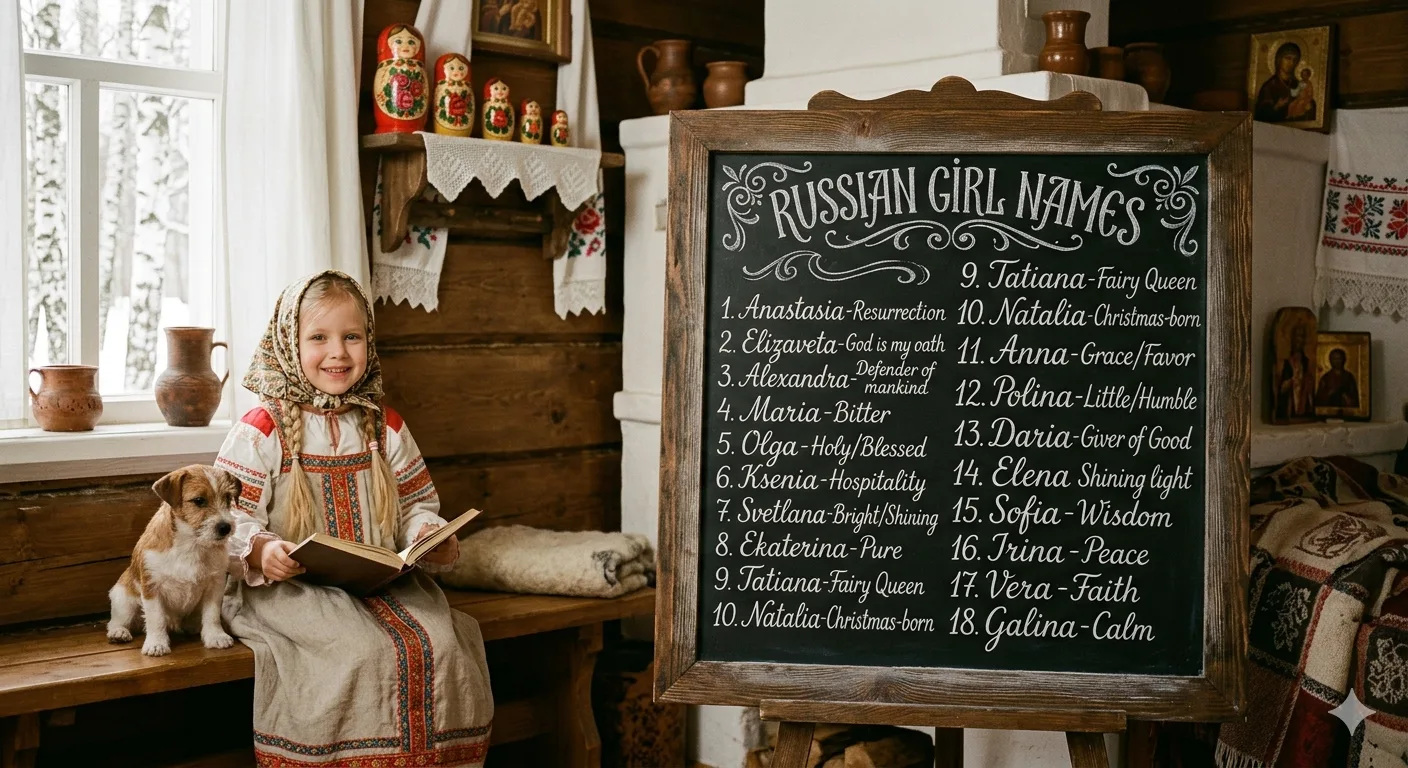
Traditional Russian girl names are windows into a thousand years of Slavic civilization. These are the names carried by saints, empresses, heroines of folk tales, and the mothers and grandmothers of countless Russian families. Choosing a traditional Russian name for your daughter is a way of connecting her to an ancient and magnificent cultural inheritance that spans the Orthodox Christian world, the Slavic heartland, and one of humanity's greatest literary and artistic traditions.
|
Name |
Origin and Meaning |
Why It Endures |
|
Olga |
Norse via Old Slavic, holy and blessed |
Russia's first Christian ruler bore this name |
|
Ludmila |
Slavic, grace of the people, beloved by all |
Ancient Slavic beauty, honored Saint Ludmila |
|
Nadezhda |
Slavic, hope, the virtue of hopeful expectation |
One of the great Russian virtue names |
|
Vera |
Slavic and Latin, faith, absolute truth |
Paired with Nadezhda and Lyubov as holy trinity |
|
Lyubov |
Slavic, love, deep and abiding affection |
Russia's beloved virtue name, deeply spiritual |
|
Vasilisa |
Greek via Russian, queenly, royal and noble |
Beloved heroine of Russian folk tales and myths |
|
Praskovya |
Greek via Russian, preparation, eve of feast |
Deeply traditional, carried by countless Russian women |
|
Xenia |
Greek via Russian, hospitality, welcoming stranger |
Ancient virtue name, beloved by Orthodox saints |
|
Zinaida |
Greek via Russian, of Zeus, divine and powerful |
Noble and rare, beautifully old-world Russian |
|
Agafya |
Greek via Russian, good, kind and virtuous |
Very traditional, deeply connected to Orthodox faith |
|
Feodora |
Greek via Russian, gift of God |
Russian form of Theodora, ancient and magnificent |
|
Pelageya |
Greek via Russian, of the sea, oceanic |
Old Russia name rarely heard now, strikingly beautiful |
Olga holds a position of extraordinary importance in Russian cultural and religious history. Saint Olga of Kiev was the first Russian ruler to convert to Orthodox Christianity, baptized in Constantinople in 957 AD and later canonized as Equal to the Apostles. Choosing Olga for a daughter today connects her to the very foundations of Russian Orthodox civilization and to one of the most important women in the entire history of the Slavic world.
Vasilisa is perhaps the most beloved name in Russian folk tale tradition. Vasilisa the Beautiful and Vasilisa the Wise are two of the most iconic heroines in Russian mythology, brave and clever young women who outwit Baba Yaga and triumph through virtue and intelligence. The name comes from the Greek for queenly and royal, and it carries a fairy-tale magic that no other Russian girl name quite matches.
Nadezhda, Vera, and Lyubov, meaning hope, faith, and love, form a triumvirate of Russian virtue names that hold deep significance in the Orthodox tradition. The three were venerated as sister martyrs in early Christianity, and their names together represent the theological virtues that Saint Paul described as the greatest qualities of the human soul. Using any of these names for a daughter connects her to a spiritual tradition of profound depth and beauty.
You can also use our Name Generator Tool to create unique names instantly. Cape Verdean Girl Names
Rare and Unique Russian Girl Names That Truly Stand Apart
For parents seeking something genuinely one of a kind, the Russian naming tradition offers an extraordinary wealth of rare and uncommon choices. These are names that have deep roots in Russian history, literature, or folk tradition but are rarely heard today even in Russia itself, making them truly distinctive options for parents who want their daughter to carry a name that is both authentically meaningful and memorably unusual.
|
Name |
Origin and Meaning |
Why It Is Special |
|
Svetlana |
Slavic, light, radiant brightness |
Poetic and rare outside Russia, deeply Slavic |
|
Rogneda |
Norse via Old Russian, pure Slavic royalty |
Name of an ancient Russian princess, extremely rare |
|
Yaroslava |
Slavic, glory of spring and fierce brightness |
Female form of legendary prince name, stunning |
|
Vseslava |
Slavic, glory to all, universal fame |
Ancient and extremely rare, powerfully beautiful |
|
Dobroslava |
Slavic, good glory, fame through goodness |
Old Slavic virtue name, incredibly rare today |
|
Miloslava |
Slavic, glory through grace and kindness |
Combines Mila and Slava, beautifully rare |
|
Radmila |
Slavic, joy and grace, caring for others |
Rare and warm, Slavic poetry in a single name |
|
Zlata |
Slavic, golden, made of gold |
Short and striking, golden meaning is enchanting |
|
Bronislava |
Slavic, glorious protector, defender of armor |
Ancient and fierce, rare and deeply meaningful |
|
Iskra |
Slavic, spark, a bright and vital flame |
Rare, poetic, full of energy and symbolism |
Svetlana carries one of the most beautifully simple meanings of any Russian girl name. From the Slavic root for light, it evokes radiance, clarity, and brightness in a way that feels both poetic and direct. Though deeply familiar in Russia and across the Slavic world, Svetlana remains genuinely rare internationally, making it an ideal choice for parents who want an authentic Russian name that will be truly distinctive in Western countries.
Zlata, meaning golden, is a name of remarkable simplicity and beauty. Short enough to be memorable and immediate, yet carrying a richness of meaning that gives it genuine depth, Zlata is used across several Slavic countries and has a warm, glowing quality that parents looking for something precious and rare will find irresistible. It is especially beautiful as a middle name paired with a longer given name.
The compound Slavic names like Miloslava, Yaroslava, and Bronislava represent the oldest layer of Russian female naming tradition, predating the adoption of Orthodox Christianity and reaching back to the pagan Slavic world of tribal identity and warrior culture. These names were built from meaningful elements, with slava meaning glory and various roots for grace, brightness, protection, and spring. Choosing such a name for a daughter today is a bold and beautiful act of cultural reclamation.
Russian Baby Girl Names That Are Perfect for 2026
Parents searching for the perfect Russian baby girl name in 2026 have an extraordinary range of choices available to them. From names that are immediately accessible to Western ears to names that carry the full musical complexity of the Russian language, the tradition offers something for every taste and every family story. Here is a curated collection of Russian baby girl names that are particularly well suited to the naming landscape of today.
|
Name |
Meaning |
Perfect For |
|
Masha |
Hebrew via Russian, beloved, wished for |
Parents who love warm diminutive nicknames |
|
Nika |
Greek via Russian, victory, triumphant one |
Short, powerful, globally accessible choice |
|
Lena |
Greek via Russian, bright shining light |
Elegant simplicity, works beautifully worldwide |
|
Katya |
Greek via Russian, pure and unspoiled |
Charming diminutive of Ekaterina, very loveable |
|
Tasha |
Latin via Russian, born at Christmas |
Friendly, warm, easy international alternative |
|
Oksana |
Hebrew via Ukrainian Russian, God's grace |
Distinctly Slavic, beautiful and rarely heard |
|
Varvara |
Greek via Russian, foreign, exotic stranger |
Russian form of Barbara, full of old-world charm |
|
Galina |
Greek via Russian, calm, serene and still |
Vintage Russian beauty ready for revival |
|
Tamara |
Hebrew via Russian, date palm tree, grace |
Exotic and warm, beloved across Soviet era |
|
Larisa |
Greek via Russian, cheerful, from Larissa |
Musical and graceful, wonderfully distinctive |
|
Rimma |
Hebrew via Russian, pomegranate, fertility |
Rare and beautiful, distinctive Russian gem |
|
Milena |
Slavic, gracious, favored and beloved |
International appeal with deep Slavic roots |
Milena represents a perfect bridge between authentic Slavic naming tradition and international accessibility. Derived from the same Slavic root as Mila, meaning gracious and beloved, Milena adds a musicality and fullness that makes it feel both deeply rooted and elegantly cosmopolitan. It is popular across Czech, Serbian, Bulgarian, and Russian naming cultures, and it has been gaining momentum internationally as parents discover its warm, flowing beauty.
Russian Naming Traditions and Cultural Naming Customs
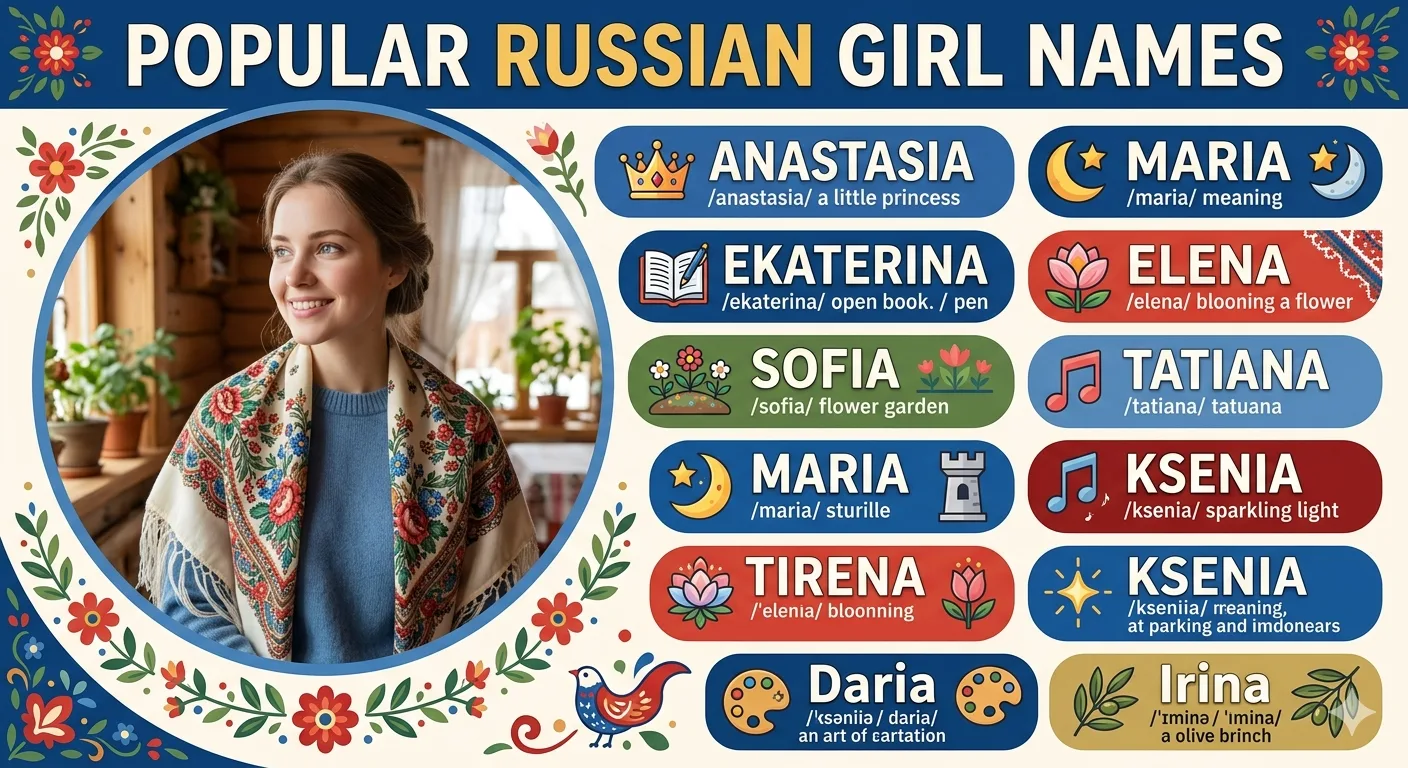
Understanding how names are chosen in Russian culture adds a richness of meaning to the naming process that goes far beyond simply selecting a word that sounds beautiful. Russian naming traditions are shaped by Orthodox Christianity, ancient Slavic customs, the complex history of the Soviet period, and a modern sensibility that balances cultural pride with global awareness.
The Russian Patronymic Tradition
One of the most distinctive and fascinating aspects of Russian naming culture is the patronymic system. In Russia, every person traditionally carries three names: a given name, a patronymic derived from their father's first name, and a family surname. A daughter of a man named Ivan would have the patronymic Ivanovna. A daughter of Aleksei would be called Alekseyevna. This system means that a Russian girl's full name is intimately connected to her father's identity, creating a linguistic bond between generations that is built into the very structure of every name.
The patronymic is used in formal address in Russia, giving the naming tradition a built-in formality and respect that shapes social interactions. When choosing a Russian girl name today, many families inside Russia and in Russian diaspora communities still consider how the name will sound paired with the patronymic form, ensuring a harmonious and beautiful combination.
You can also use our Name Generator Tool to create unique names instantly. Cambodian Girl Names
Orthodox Christian Influence on Russian Naming
The Russian Orthodox Church has been the single most powerful influence on Russian naming traditions for over a thousand years. After the adoption of Christianity in Kievan Rus in 988 AD, the church calendar of saints' days became the primary source of names for Russian children. Traditionally, a child might be named after the saint whose feast day fell on or near the date of their birth or baptism. This practice gave Russian families a direct spiritual connection between their child's name and the saints of the Orthodox faith.
Names like Tatiana honor Saint Tatiana, a Roman martyr beloved in the Orthodox tradition. Xenia honors Saint Xenia of Petersburg, one of Russia's most beloved fool-for-Christ saints and a patron of those seeking happiness in marriage. The deeply spiritual dimension of Russian naming means that choosing a traditional Russian girl name often means connecting a child to centuries of Orthodox Christian prayer, veneration, and community.
The Soviet Era and Its Influence on Names
The Soviet period from 1917 to 1991 had a profound and fascinating effect on Russian naming traditions. Early Soviet revolutionaries actively discouraged traditional Orthodox Christian names, viewing them as remnants of tsarist religious oppression. Some Soviet-era parents created entirely new names from revolutionary acronyms and ideological concepts. Names like Vladlena, combining Vladimir Lenin's name, or Ninel, Lenin spelled backwards, appeared during the most ideological phases of the Soviet period.
However, traditional names proved remarkably resilient even under Soviet pressure. Names like Anna, Natasha, Maria, Elena, and Tatiana never disappeared from use, partly because they were too deeply embedded in Russian family and cultural life to be uprooted. By the Brezhnev era, traditional names had largely reasserted themselves, and today's Russian parents are often consciously choosing names that reconnect their children to the pre-Soviet cultural heritage.
Modern Russian Naming Preferences
Contemporary Russian parents in 2026 show clear preferences that reflect both global trends and distinctly Russian cultural values. Short names of two or three syllables are particularly fashionable, echoing an international trend toward minimal, impactful naming. Names like Mila, Vera, Kira, Lena, and Nika all reflect this preference for elegant brevity. At the same time, there is a strong revival of interest in the beautiful compound Slavic names that predate the Orthodox Christian period, as young Russians rediscover their pre-Christian heritage with pride and curiosity.
Latest Russian Girl Name Trends to Watch in 2026
The Russian baby naming landscape in 2026 is shaped by several powerful and interconnected trends that reflect both the country's deep cultural identity and its engagement with global naming movements. Understanding these trends helps parents choose names that feel current and culturally alive while carrying genuine depth.
• Nature and light inspired names: Names meaning sun, light, dawn, and radiance are surging in popularity. Svetlana, Aurora in its Russian usage, Zara, and Zarya all reflect a desire to give daughters names connected to brightness and the natural world.
• Revival of Old Slavic names: Names like Yaroslava, Miloslava, and Zlata are being rediscovered by Russian parents interested in the pre-Christian Slavic heritage, creating a wave of authentically ancient names returning to modern use.
• Short and internationally accessible names: Mila, Kira, Vera, Lena, and Nika are all gaining popularity both inside Russia and internationally, reflecting a preference for names that sound beautiful in both Russian and other major world languages.
• Literary and artistic heritage names: Names connected to Russian literature, art, and music are experiencing a proud revival. Names like Natasha, Sonya, Anna, Tatiana, and Lara carry the combined weight of great Russian storytelling and remain perennially fashionable.
• Virtue and meaning-driven choices: Parents across Russia are returning to names that carry explicit and beautiful meanings, particularly virtue names like Vera, Nadezhda, and Lyubov, and names meaning wisdom, grace, and light.
• Diminutive forms as standalone names: Traditional Russian culture has always used affectionate diminutives, but modern parents are increasingly registering these shortened forms as official given names. Masha, Katya, Anya, and Sasha are being chosen as primary names rather than nicknames.
• Global diaspora influence: Russian families living in Europe, North America, Australia, and Israel are choosing names that honor their Russian heritage while working beautifully in their new home countries, driving demand for names like Alina, Lara, Mila, and Zoya that cross cultural borders with elegance.
You can also use our Name Generator Tool to create unique names instantly. Rwandan Girl Names
Tips for Choosing the Perfect Russian Girl Name
Selecting a Russian girl name is a deeply personal and meaningful process. Whether you have Russian roots or are simply enchanted by the beauty of these names, these practical and thoughtful guidelines will help you find the name that feels perfectly right for your daughter.
Consider How the Name Sounds in Both Russian and Your Language
If your family is bilingual or if you live outside Russia, think carefully about how a Russian girl name will sound and be received in the languages your daughter will grow up speaking. Names like Mila, Kira, Alina, Lara, and Vera travel beautifully across linguistic boundaries. Names like Nadezhda, Lyudmila, or Praskovya are deeply beautiful in Russian but may be more challenging in non-Slavic environments. Neither choice is wrong, but understanding the practical context will help you make the decision that serves your daughter best.
Explore the Meaning Behind the Name
Russian girl names are extraordinarily rich in meaning, and understanding what a name means adds a beautiful layer of intention to your choice. A name like Vera, meaning faith, or Nadezhda, meaning hope, carries an explicit prayer for your daughter's inner life. A name like Svetlana, meaning light, or Zoya, meaning life, expresses a hope for her vitality and radiance. Taking the time to learn the meaning of a name you love will deepen your connection to it and give your daughter a wonderful story to tell about her own name.
Think About the Full Name Combination
In Russian tradition, the combination of given name, patronymic, and surname creates a complete musical phrase that is considered as a whole. Even outside Russia, the way a first name flows with a middle name and surname matters enormously. Say the full name combination out loud many times and listen for rhythm, flow, and beauty. Russian names often have a natural musicality that works best when given room to breathe, so pairing a long Russian name with an equally long surname may create a combination that feels heavy, while pairing it with a shorter surname can be perfectly balanced.
Honor Family Heritage Through Naming
For families with Russian ancestry, choosing a traditional Russian girl name is a powerful act of cultural connection and family pride. Consider looking into your own family history for names that may have been carried by grandmothers, great-aunts, or other female ancestors. Reviving a family name that has been lost for a generation or two is one of the most meaningful ways to choose a name, creating a living bridge between past and present in your family's story.
Generate More Names: Girl Names Generator
Conclusion: The Timeless Beauty of Russian Girl Names
Russian girl names occupy a unique and magnificent place in the world's naming traditions. They carry the deep music of the Slavic language, the spiritual richness of a thousand years of Orthodox Christianity, the poetic brilliance of the world's greatest literary tradition, and the fierce beauty of a culture that has survived and flourished through extraordinary historical challenges. Whether ancient or modern, rare or beloved, each Russian girl name is a small piece of that vast and extraordinary heritage.
Choosing a Russian girl name for your daughter is an act of cultural celebration and deep intention. It connects her to Natasha Rostova dancing at her first ball, to Saint Olga bringing Christianity to the Russian lands, to the warmth and courage of countless Russian mothers and daughters across a thousand years of history. It gives her a name that is genuinely beautiful in sound, genuinely meaningful in depth, and genuinely distinctive in the wider world.
Whether you are drawn to the timeless elegance of Anna and Elena, the bold royal splendor of Anastasia and Alexandra, the modern freshness of Mila and Kira, the folk tale magic of Vasilisa, or the rare Slavic glory of Yaroslava and Zlata, you will find in Russian girl names a treasury of choices that is as deep and rich as Russia itself. Take your time, explore the meanings, feel the sounds, and trust your heart. The perfect Russian name for your daughter is waiting to be discovered.