 Portuguese Girl Name Generator
Discover elegant Portuguese names with Iberian heritage
Guides & Articles
Portuguese Girl Names: A Complete Guide to Stylish, Beautiful and Meaningful Choices
Discover the most popular, unique, traditional and trending Portuguese girl names for 2026
Introduction: The Enchanting World of Portuguese Girl Names
Choosing a name for your baby girl is one of the most tender and meaningful decisions a parent can ever make. In Portugal and across the Portuguese-speaking world, this decision carries layers of deep cultural pride, religious devotion, poetic beauty, and centuries of living tradition. Portuguese girl names are among the most lyrical and emotionally resonant in all of Europe, shaped by a language that poets have called the most musical in the Western world and a history that stretches from ancient Roman settlements through Moorish influence to the great Age of Exploration and beyond.
Portugal has always been a country with a profound sense of identity, and that identity lives very clearly in the names Portuguese families give their daughters. You will find names rooted in Latin Christianity sitting comfortably alongside names drawn from Arabic heritage, Germanic traditions, Greek mythology, Hebrew scripture, and the Celtic past. This extraordinary blend of influences makes Portuguese girl names uniquely rich, deeply layered, and endlessly beautiful for parents all over the world.
In 2026, Portuguese baby girl naming traditions are alive with both continuity and change. Traditional names that have been carried by generations of Portuguese women still hold deep pride of place in family choices, while modern parents increasingly look for names that feel fresh, global, and stylishly contemporary. Whether you are of Portuguese heritage searching for a name that honors your roots, a parent of any background simply drawn to the warmth and beauty of Portuguese names, or someone exploring baby girl names from the wider Lusophone world including Brazil, Angola, Mozambique, Cape Verde, and beyond, this complete guide is written for you.
This article explores the full landscape of Portuguese girl names, covering popular and beloved choices, modern trending names, traditional and classical names, rare and unique picks, names shaped by faith and culture, nature-inspired options, and the deep historical forces behind Portuguese naming traditions. You will also find expert tips for choosing the right Portuguese name and a comprehensive FAQ section addressing the questions parents most want answered.
Popular Portuguese Girl Names with Beautiful Meanings
Certain names have held a beloved place in Portuguese hearts and homes for many generations. These popular Portuguese girl names combine musical sound, powerful meaning, and enduring cultural resonance. If you want a name that feels warmly familiar across Portugal and the wider Lusophone world while carrying genuine depth and significance, these are the names to explore first.
|
Name |
Origin and Meaning |
Why It Stands Out |
|
Ana |
Hebrew, grace, God has favored |
Most timeless name in Portugal, pure simplicity |
|
Maria |
Hebrew, beloved, sea of bitterness |
Most sacred name in Portuguese Catholic tradition |
|
Sofia |
Greek, wisdom and knowledge |
Elegant classic, hugely popular across Portugal |
|
Beatriz |
Latin, she who brings happiness |
Royal Portuguese heritage, timeless elegance |
|
Inês |
Greek, pure and holy |
Medieval queen, deeply beloved in Portugal |
|
Mariana |
Hebrew-Latin blend, grace and sea |
Poetic, flowing, one of the most loved names |
|
Carolina |
Germanic, free woman, strong |
Stylish and graceful, widely adored |
|
Francisca |
Latin, free spirit, from France |
Honored by Saint Francis, classic and dignified |
|
Rita |
Sanskrit via Latin, pearl, brave |
Saint Rita beloved, short and powerfully sweet |
|
Madalena |
Hebrew, woman from Magdala |
Biblical elegance, unique Portuguese form |
|
Catarina |
Greek, pure and clear |
Classic Portuguese queenly name, forever loved |
|
Helena |
Greek, bright shining light |
Ancient beauty, quietly enduring in Portugal |
Maria holds a position of extraordinary reverence in Portuguese naming culture that goes beyond simple popularity. For most of Portuguese history, naming a daughter Maria was an act of deep religious devotion, a way of placing her under the protection of the Virgin Mary and connecting her to the most sacred figure in Portuguese Catholic life. Even today, Maria appears in compound names throughout Portugal, combined with other names to create beautiful double-barrel choices like Maria Ana, Maria Joao, Maria Beatriz, and Maria Ines. This tradition of Marian names reflects how profoundly faith has shaped Portuguese cultural identity across the centuries.
Beatriz carries a particularly royal Portuguese resonance. Several queens and princesses of Portugal have carried this name through the medieval and early modern periods, giving it an aristocratic elegance that modern Portuguese parents still find deeply appealing. Ines carries an equally powerful historical and literary legacy, honoring Ines de Castro, one of the most tragic and romantic figures in all of Portuguese history and literature, a woman whose love story has inspired poets and playwrights for seven centuries.
Modern and Trending Portuguese Girl Names in 2026
Portuguese parents in 2026 are drawn to girl names that feel contemporary, stylish, and forward-looking while still carrying the warmth and musicality that the Portuguese language naturally provides. Modern trending names in Portugal tend to have a fresh, vibrant quality that bridges the country's deep cultural heritage with the demands of a globally connected world. Here are the names gaining the most momentum across Portugal and the Lusophone world right now.
|
Name |
Meaning |
Why Trending |
|
Luna |
Latin, the moon, night sky |
Celestial beauty, rising fast across Portugal |
|
Matilde |
Germanic, mighty in battle |
Vintage revival, very fashionable in 2026 |
|
Leonor |
Greek, bright light, compassion |
Royal and elegant, hugely popular now |
|
Alice |
Germanic, noble, truth |
International appeal with Portuguese warmth |
|
Benedita |
Latin, blessed, well-spoken |
Saint Benedict tradition, elegantly revived |
|
Camila |
Latin, noble attendant in rituals |
Flowing beauty, rising fast in Portugal |
|
Lara |
Latin, cheerful and famous |
Short and stylish, very modern in Portugal |
|
Eva |
Hebrew, life, living |
Clean and beautiful, consistently strong |
|
Clara |
Latin, clear, bright, famous |
Luminous meaning, freshly fashionable |
|
Violeta |
Latin, purple flower |
Floral elegance with a Portuguese twist |
|
Isabel |
Hebrew, devoted to God |
Timeless Portuguese royal name, always loved |
|
Vera |
Latin, true and honest |
Short, strong, very much in fashion now |
Leonor is experiencing a remarkable surge in Portugal in 2026, driven in part by the prominence of Princess Leonor, heir to the Spanish throne and a figure with deep roots in both Iberian royal traditions. The name carries a luminous, regal quality that modern Portuguese parents find irresistible, combining historical depth with the clean, confident sound that contemporary naming preferences favor. Matilde is another name whose moment has clearly arrived, offering an antique beauty wrapped in a modern European sensibility.
The rise of Lara and Clara reflects the continuing Portuguese love for names that are short, crystal clear in sound, and full of bright meaning. These names feel right at home in Portuguese, where the natural musicality of the language gives even the simplest names a gentle lyrical quality. Eva has proven itself as one of those perennial names that never truly goes out of fashion in Portugal because its brevity, its biblical depth, and its absolute clarity of sound make it feel permanently right.
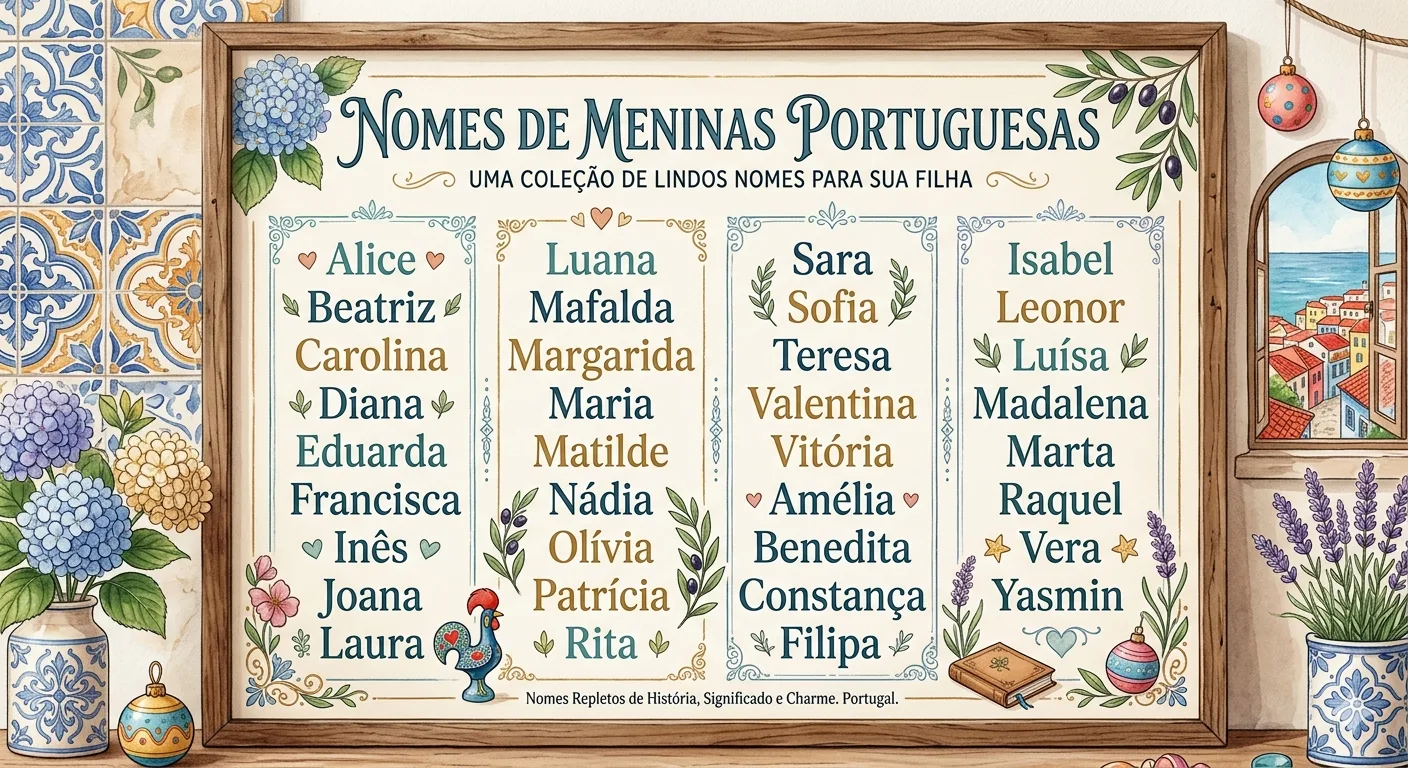
Traditional and Classical Portuguese Girl Names That Never Go Out of Style
Traditional Portuguese girl names carry the accumulated beauty of a thousand years of language, faith, art, and human experience. These classic names have been carried by generations of Portuguese women, from medieval noblewomen and Christian martyrs to fishermen's daughters and explorers' wives, and they continue to be chosen today because of their enduring elegance and the deep stories they tell.
|
Name |
Origin and Meaning |
Why It Endures |
|
Filipa |
Greek, lover of horses, noble |
Queen Philippa of Portugal, deeply historic |
|
Teresa |
Greek, to harvest, to reap |
Saint Teresa's legacy, forever beloved |
|
Joana |
Hebrew, God is gracious |
Portuguese royal tradition, enduring grace |
|
Constança |
Latin, constant and steadfast |
Medieval Portuguese queen, dignified |
|
Brites |
Celtic, strength and virtue |
Ancient Portuguese form of Brigit, rare |
|
Guiomar |
Germanic, famous in battle |
Medieval Portuguese nobility, distinctive |
|
Dulce |
Latin, sweet, gentle, kind |
Warmly traditional, beloved in Portugal |
|
Piedade |
Latin, piety, devotion, mercy |
Deeply religious, quintessentially Portuguese |
|
Leonarda |
Germanic, brave as a lion |
Classical strength, quietly enduring |
|
Ximena |
Hebrew, one who listens |
Medieval Iberian tradition, quietly noble |
|
Aldonça |
Germanic, noble, kind |
Old Portuguese form rarely heard today |
|
Mecia |
Latin, honorable and mighty |
Rare medieval Portuguese name, distinctive |
Filipa holds a place of particular honor in Portuguese history, associated most powerfully with Queen Philippa of Lancaster, the English-born queen who married King John I of Portugal and became one of the most beloved figures in Portuguese history. Her marriage to John I cemented the Anglo-Portuguese Alliance, the oldest surviving diplomatic alliance in the world, and her children included Prince Henry the Navigator, who launched the Age of Exploration that made Portugal one of the great maritime powers of history. Naming a daughter Filipa today connects her to this extraordinary chapter of Portugal's story.
Teresa carries the devotional legacy of two of Christianity's most admired saints, Saint Teresa of Avila and Saint Teresa of the Little Flower, both of whom have been deeply beloved in Portuguese Catholic tradition for centuries. The name has been carried by Portuguese queens and noblewomen throughout history and retains a warm, spiritual elegance that makes it feel timeless rather than merely old-fashioned.
You can also use our Name Generator Tool to create unique names instantly. Denmark Girl Names
Portuguese Girl Names Shaped by Faith and Religious Heritage
Portugal is one of the most deeply Catholic countries in Europe, and the influence of the Catholic Church on Portuguese naming traditions has been profound and lasting for over a thousand years. Religious names, Marian names, saints' names, and names with biblical roots form the backbone of traditional Portuguese naming culture and continue to be chosen with pride and devotion by Portuguese families today.
|
Name |
Faith Tradition and Meaning |
Cultural Significance |
|
Fatima |
Arabic, abstaining, shining one |
Site of Portugal's greatest Marian apparition |
|
Conceicao |
Latin, immaculate conception |
Most distinctly Catholic Portuguese name |
|
Graca |
Latin, grace of God |
Divine grace, timeless virtue name |
|
Assuncao |
Latin, assumption of Mary |
Marian feast day name, deeply traditional |
|
Piedade |
Latin, mercy, piety, devotion |
Quintessential expression of Portuguese faith |
|
Natividade |
Latin, nativity, birth of Christ |
Christmas connection, solemnly beautiful |
|
Cruz |
Latin, cross of Christ |
Rare but deeply symbolic Portuguese choice |
|
Serafina |
Hebrew, ardent and fiery |
Seraphic angels, sacred and beautiful |
|
Perpetua |
Latin, everlasting, eternal |
Early Christian martyr, powerful legacy |
|
Felicidade |
Latin, happiness, blessedness |
Joy and divine grace combined beautifully |
Fatima occupies a uniquely powerful place in Portuguese religious and cultural life because of the town of Fatima in central Portugal, where in 1917 three young shepherd children reported a series of apparitions of the Virgin Mary that attracted millions of Catholic pilgrims from across the world and made Fatima one of the most important Marian shrines on earth. Naming a daughter Fatima in Portugal carries this entire extraordinary weight of national religious experience and is considered by many Portuguese Catholic families one of the most blessed names a girl can carry.
Conceicao, honoring the doctrine of the Immaculate Conception of the Virgin Mary, is one of the most distinctly and recognizably Portuguese names in existence. It appears rarely outside the Portuguese-speaking world and carries within it the particular flavor of Portuguese Catholic devotion that has shaped the country's spiritual identity since the Age of Exploration, when Portuguese sailors carried the Marian faith to every corner of the globe. Choosing Conceicao for a daughter is a profound act of cultural and religious pride.
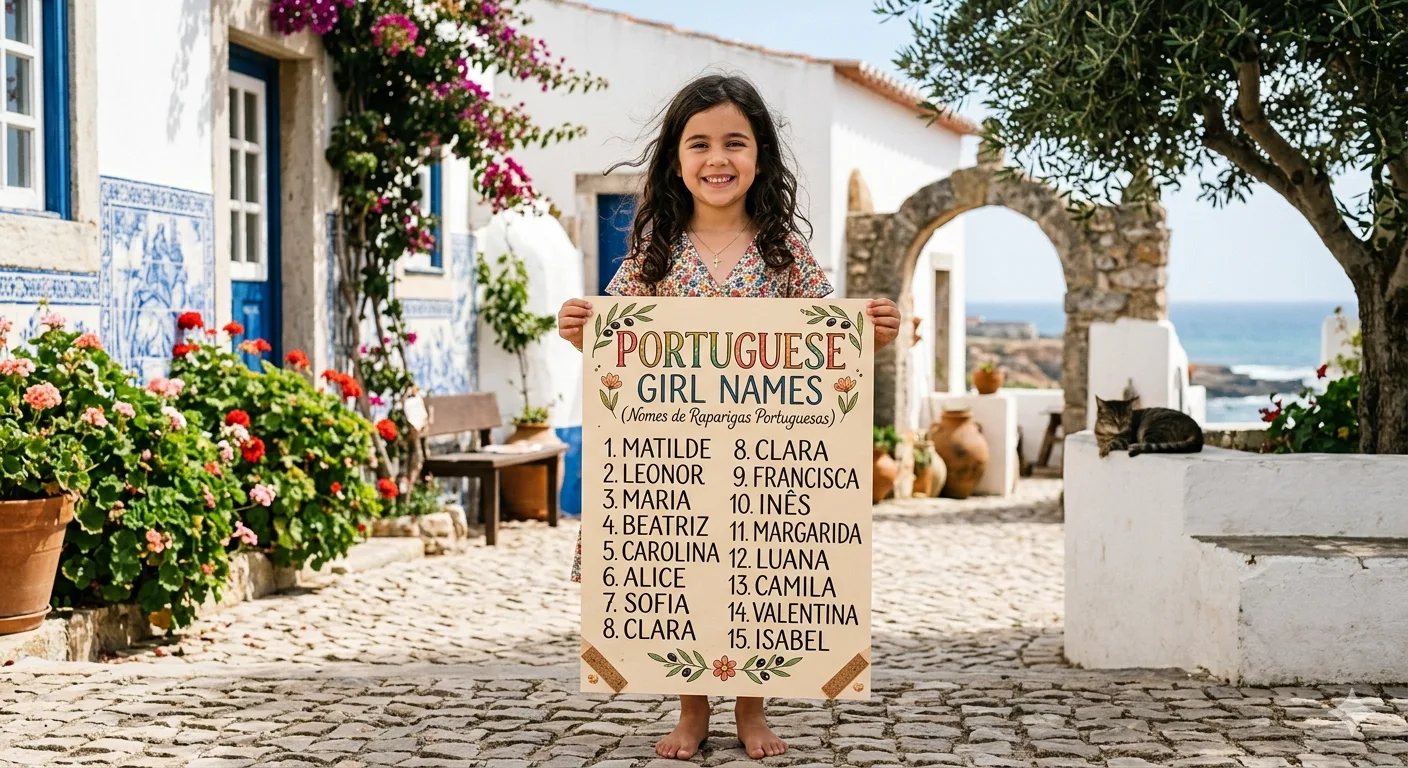
Rare and Unique Portuguese Girl Names That Truly Stand Out
For parents who want something genuinely distinctive, the Portuguese naming tradition offers a treasury of rare and uncommon choices that are virtually unheard of outside Portugal but carry extraordinary beauty, historical depth, and cultural richness. These unique Portuguese girl names are perfect for families who want their daughter to have a name that is genuinely one of a kind.
|
Name |
Origin and Meaning |
Why It Stands Out |
|
Aldara |
Germanic, noble guardian |
Extremely rare, hauntingly beautiful sound |
|
Branca |
Germanic, white, pure, radiant |
Medieval Portuguese gem, wonderfully rare |
|
Delfina |
Greek, from Delphi, dolphin |
Ancient and musical, almost never heard |
|
Eufrasia |
Greek, joy, good cheer |
Early Christian saint, exquisitely rare |
|
Florbela |
Latin-Portuguese, beautiful flower |
Beloved poet Florbela Espanca's name |
|
Genoveva |
Celtic, woman of the race |
Portuguese form of Genevieve, rare treasure |
|
Herminia |
Germanic, whole, universal |
Old Portuguese aristocratic name, elegant |
|
Lurdes |
Basque-French, place of Lourdes |
Marian pilgrimage site, rare and devotional |
|
Mafilde |
Germanic, mighty in battle |
Very old Portuguese variant, almost extinct |
|
Serenidade |
Latin, serenity and calm |
Poetic virtue name, breathtakingly rare |
|
Vitoria |
Latin, victory, triumphant |
Rare in everyday use, powerfully resonant |
|
Zelia |
Greek, jealous, zealous |
Saint Zelie Martin's name, rare and lovely |
Florbela carries the literary legacy of Florbela Espanca, one of the greatest and most beloved poets in Portuguese literary history, a woman whose intensely personal and passionately feminine poetry transformed Portuguese literature in the early twentieth century and whose name combines the Portuguese words for flower and beautiful into a single breathtaking creation. Choosing Florbela for a daughter today is both a tribute to this magnificent poet and a gift of one of the most genuinely beautiful compound names in any European language.
Branca, meaning white and radiant in medieval Portuguese, was a common name among Portuguese noblewomen of the medieval period and appears in several important historical and literary contexts. It carries a purity and clarity of meaning that feels both ancient and strangely fresh, and its rarity in modern use makes it an extraordinary choice for parents who want a name with genuine historical roots and deep Portuguese identity. The sound of Branca is simple, strong, and immediately appealing.
Nature-Inspired Portuguese Girl Names Blooming in 2026
Portugal's breathtaking natural landscape, from the dramatic Atlantic coastline and the cork forests of the Alentejo to the terraced vineyards of the Douro Valley, the volcanic islands of the Azores, and the subtropical gardens of Madeira, has always inspired a love of natural beauty in Portuguese culture. Nature-inspired girl names have a long and graceful history in Portuguese tradition and are experiencing a wonderful renaissance in 2026 as parents seek names that connect their daughters to the living world.
|
Name |
Natural Connection |
Why It Is Beloved |
|
Rosa |
Latin, the rose flower |
Timeless floral elegance, deeply traditional |
|
Violeta |
Latin, violet flower, purple |
Floral charm with poetic Portuguese flavor |
|
Iris |
Greek, rainbow, iris flower |
Luminous, mythological, beautifully simple |
|
Lirio |
Portuguese, lily flower |
Rare floral gem, purely Portuguese |
|
Aurora |
Latin, goddess of the dawn |
Celestial and romantic, rising rapidly |
|
Marina |
Latin, of the sea, ocean |
Perfectly suited to maritime Portugal |
|
Serena |
Latin, calm, serene, clear |
Peaceful and beautiful, perfectly lyrical |
|
Flor |
Latin-Portuguese, flower |
Simple, pure, classically beautiful |
|
Brisa |
Spanish-Portuguese, breeze |
Fresh air and freedom, poetically lovely |
|
Coral |
Latin, coral of the sea |
Ocean-inspired, colorful and beautiful |
|
Selene |
Greek, goddess of the moon |
Celestial beauty, quietly rising in use |
|
Primavera |
Latin-Portuguese, springtime |
Rare and poetic, season of renewal |
Marina holds a special resonance in Portugal that goes beyond its simply beautiful sound and meaning. As a seafaring nation whose history was shaped more profoundly by the ocean than perhaps any other European country, Portugal has always felt a deep emotional connection to the sea. Marina, meaning of the sea, is a name that carries within it the memory of all the Portuguese fishermen and their families, all the sailors who ventured into unknown waters during the Age of Discovery, and all the coastal communities whose lives have been shaped by the rhythm of the Atlantic. It is a name that is both deeply personal and profoundly national.
Aurora has been climbing steadily in popularity across Portugal and the broader Lusophone world in 2026, driven by its celestial beauty and its connection to the magical moment when darkness gives way to light at the start of each new day. The goddess Aurora holds a place in classical Roman mythology, and the name carries all of that ancient dignity alongside a freshness and luminosity that feels entirely contemporary. For a child born into the dawn of a new era, it is a name of extraordinary symbolic power.
You can also use our Name Generator Tool to create unique names instantly. Djibouti Girl Names
Beautiful Girl Names from the Broader Lusophone World
The Portuguese language is spoken by over 260 million people across the globe, from Portugal and Brazil to Angola, Mozambique, Cape Verde, Sao Tome and Principe, East Timor, and Macau. This vast Lusophone world has enriched Portuguese naming traditions enormously, with beautiful names from Brazilian Portuguese, African Portuguese, and other Lusophone communities adding new dimensions of beauty and meaning to the tradition.
|
Name |
Origin and Meaning |
Lusophone Region |
|
Ysadora |
Hebrew, gift of Isis, gifted |
Brazilian Portuguese, elegant variant |
|
Morena |
Latin, dark-haired, warm |
Brazil, celebrating dark beauty |
|
Yasmin |
Persian, jasmine flower |
Brazil and Angola, fragrant and beautiful |
|
Naledi |
Sotho, star in the sky |
Mozambique, luminous and rare |
|
Celeste |
Latin, heavenly, celestial |
Brazil and Portugal, spiritually beautiful |
|
Dandara |
Yoruba, warrior queen |
Brazil, honoring African Brazilian heritage |
|
Imaculada |
Latin, immaculate, spotless |
Angola, Mozambique, Marian devotion |
|
Isadora |
Greek, gift of Isis |
Brazil, made famous by Isadora Duncan |
|
Yara |
Indigenous Tupi, water lady |
Brazil, connecting to indigenous roots |
|
Zilda |
Germanic, battle heroine |
Brazil, uniquely Lusophone variant |
|
Neuza |
Hebrew, Naomi, pleasant one |
Brazil and Cape Verde, warmly beloved |
|
Amelinha |
Germanic, diminutive of Amelia |
Brazilian Portuguese, tender and sweet |
The Brazilian Portuguese naming tradition deserves special attention for the extraordinary creativity and beauty it has brought to the wider Lusophone world. Brazil is the largest Portuguese-speaking country on earth and its naming culture reflects the magnificent blend of indigenous Tupi, West African Yoruba, Portuguese colonial, and more recent immigrant influences that define Brazilian civilization. Names like Yara, drawn from Tupi indigenous mythology where Iara is the enchanting water spirit of the Amazon, represent a uniquely Brazilian bridge between the colonial Portuguese linguistic heritage and the indigenous cultures that predated European arrival.
Dandara carries a particularly powerful legacy in the Afro-Brazilian context, honoring the historical warrior queen and partner of the famous resistance leader Zumbi dos Palmares, whose quilombo of free Africans became the most powerful symbol of Black resistance to slavery in the Americas. Choosing Dandara is an act of cultural pride and historical remembrance that resonates deeply in Brazil and increasingly throughout the diaspora.
How Names Are Chosen in Portuguese Culture and Society
The Deep Catholic Tradition of Saints and Feast Days
For most of Portuguese history and continuing strongly today in many families, babies were named according to the Catholic liturgical calendar. A child born on or near the feast day of a particular saint would often be given that saint's name as a matter of both religious observance and cultural tradition. This practice created a beautiful rhythm between the sacred calendar and the naming of children, linking each person's birthday to a particular spiritual patron. The tradition of nome de batismo, the baptismal name, remains important in many Portuguese families even as it has loosened in urban modern settings.
Compound Names and the Maria Tradition
One of the most distinctively Portuguese naming traditions is the use of compound names, particularly those beginning or ending with Maria. Names like Maria Ana, Maria Joao, Maria Beatriz, Maria Teresa, Ana Maria, and Rosa Maria have been enormously popular throughout Portuguese history. This tradition reflects the central place of the Virgin Mary in Portuguese Catholic devotion and the belief that beginning a name with Maria places the child under Marian protection. Even today, many Portuguese women carry compound names of this type as their formal registered names while using a shorter version in everyday life.
Family and Ancestral Naming Patterns
Portuguese families have traditionally honored their ancestors by passing names down through generations. A daughter named for her grandmother or great-aunt carries not just a beautiful name but a living thread of family memory and continuity. This practice means that many traditional Portuguese names have survived the centuries not through mere fashion but through the deep bonds of family love. When a Portuguese family chooses to give their daughter the same name as a beloved grandmother or great-aunt, they are participating in one of the oldest and most emotionally powerful naming traditions in human culture.
Regional Naming Traditions Across Portugal
Portugal's different regions have historically maintained their own naming preferences and traditions. The north of Portugal, deeply conservative and agricultural, has traditionally favored the most deeply religious and classical names. The Alentejo region, with its Roman heritage, has shown a preference for Latin-rooted classical names. The coastal fishing communities have always had a particular love for names associated with the sea and with the Virgin Mary in her maritime aspects, such as Nossa Senhora do Mar, Our Lady of the Sea. The islands of the Azores and Madeira have developed their own subtly distinct naming cultures, shaped by relative isolation and the unique mix of Portuguese, Flemish, and other settler influences.
You can also use our Name Generator Tool to create unique names instantly. Eritrean Girl Names
Latest Portuguese Girl Name Trends Shaping 2026
Portuguese baby girl naming trends in 2026 reflect a fascinating conversation between deep tradition and contemporary global influence. Several clear patterns are defining the naming landscape across Portugal and the Lusophone world right now.
The royal revival is a powerful force. Following the increasing prominence of the Spanish royal family and the beloved figure of Princess Leonor, names with royal Portuguese and Iberian heritage such as Leonor, Beatriz, Catarina, Isabel, and Constança are all experiencing a significant surge in popularity. These names carry aristocratic elegance and historical depth while sounding perfectly stylish in the modern European context.
Short, melodic names are dominant. Portuguese parents in 2026 strongly favor names of two to three syllables with open vowel endings that exploit the natural musicality of the Portuguese language. Names like Lara, Luna, Eva, Clara, Vera, and Iris all fit this pattern perfectly, offering a clean, confident sound that works beautifully in both European Portuguese and Brazilian Portuguese.
Nature and celestial names are surging. Aurora, Luna, Marina, Iris, Violeta, and Serena are all rising rapidly in Portuguese popularity charts. This trend mirrors broader European and global patterns but feels especially natural in Portugal, where the stunning natural landscape and centuries of maritime connection to the wider natural world have always inspired a particular sensitivity to the beauty of the earth and sky.
International names with Portuguese warmth are growing. Names like Alice, Sofia, Emma, Olivia, and Clara have an international currency that appeals to cosmopolitan Portuguese parents while still sitting comfortably within the phonetic beauty of the Portuguese language. These names represent a confident Portuguese engagement with global naming culture without abandoning the country's own linguistic and cultural identity.
Vintage names are making a beautiful comeback. Names like Matilde, Filipa, Teresa, Benedita, and Herminia that might have seemed old-fashioned just a generation ago are now being chosen with conscious pride by younger Portuguese parents who appreciate their historical depth, their literary associations, and the sense of rootedness and character they provide.
Expert Tips for Choosing the Perfect Portuguese Girl Name
Let the sound guide you first. Portuguese is a language of extraordinary musical beauty, and the best Portuguese girl names exploit that musicality fully. Say any name you are considering aloud in Portuguese several times and listen to how it flows, how the vowels open and the consonants move. A name that sounds beautiful when spoken in Portuguese will carry that beauty throughout your daughter's life.
Consider the full name together. In Portugal, as in most of the Western world, a full name combines the first name with one or two family surnames. Think carefully about how the first name sounds in combination with your family name. Rhythm, flow, and the avoidance of unintended sound combinations all matter when the full name is spoken together.
Honor your heritage but follow your heart. Portuguese naming traditions are extraordinarily rich, and there is no shortage of beautiful names with deep historical, religious, or cultural resonance to choose from. But the most important thing is that the name you choose feels genuinely right to you, that it carries meaning you find truly beautiful, and that you can imagine calling your daughter by that name with love every single day of your life.
Think about the nickname landscape. Portuguese naming culture has a wonderful tradition of affectionate nicknames and diminutives. Ana becomes Aninha, Maria becomes Mariazinha, Rosa becomes Rosinha. Consider whether the natural nicknames that attach themselves to your chosen name are ones you love as much as the full version.
Respect the meaning without being enslaved to it. Name meanings are beautiful and worth knowing, but the most important quality of a name is the feelings it evokes and the person it comes to represent. Many of history's greatest Marias, Beatrizes, and Ines were not defined by the etymological meanings of their names but by the extraordinary lives they lived within those names.
Generate More Names: Girl Names Generator
Conclusion: Celebrating the Lyrical Beauty of Portuguese Girl Names
Portuguese girl names are among the most beautiful and culturally rich on earth. They carry within them the music of one of the world's great languages, the devotional warmth of centuries of Catholic faith, the adventurous spirit of a nation that once sailed to every corner of the world, the literary legacy of poets and writers who turned the Portuguese language into an instrument of extraordinary expressiveness, and the deep human love of beauty, meaning, and family connection that drives every naming decision regardless of culture or language.
Whether you choose a timeless classic like Maria or Beatriz, a modern favorite like Leonor or Luna, a nature-inspired gem like Aurora or Marina, a deeply religious choice like Fatima or Conceicao, a rare vintage treasure like Florbela or Branca, or a name from the broader Lusophone world like Yara or Dandara, you are giving your daughter a name with genuine depth, beauty, and the unique ability to carry her story forward into a future filled with possibility.
The most important thing about choosing a Portuguese girl name in 2026 is choosing one that resonates with your heart, honors what matters most to your family, and carries the warmth and musicality that make Portuguese names so extraordinary. A name is the first gift you give your daughter, and in the rich, lyrical, endlessly generous world of Portuguese naming tradition, there is a perfect name waiting for every girl born into this beautiful language.