 Croatian Girl Name Generator
Discover beautiful Croatian girl names from Slavic and Adriatic heritage
Guides & Articles
Croatia Girl Names: A Complete Guide to Stylish, Popular and Meaningful Choices
Discover the most beautiful, trending, unique and culturally rich Croatian girl names for 2026
Introduction: The Enchanting World of Croatian Girl Names
Choosing the perfect name for your baby girl is one of the most meaningful and memorable decisions any parent will ever make. In Croatia, a country of breathtaking natural beauty, ancient history, and deep cultural pride, this decision carries a special weight that goes far beyond simple aesthetics. Croatian girl names reflect the extraordinary story of a nation shaped by centuries of Mediterranean warmth, Central European elegance, Slavic heritage, and a coastal culture that has absorbed influences from the Adriatic Sea and the ancient civilizations that once flourished along its shores.
Croatia sits at a fascinating crossroads of European culture. This small but richly layered country on the eastern Adriatic coast has been home to Illyrians, Romans, Byzantines, Venetians, Ottomans, Austro-Hungarians, and finally the modern Croatian nation, each leaving a beautiful imprint on the language, culture, and naming traditions that Croatian families carry with them today. The result is a naming landscape that is uniquely rich, deeply rooted, and endlessly beautiful.
Croatian girl names draw on several powerful sources. There are the ancient Slavic names that predate Christianity and carry deep connections to nature, virtue, and the spiritual world of early Slavic peoples. There are the Catholic saint names that arrived with Christianity in the seventh and eighth centuries and have remained beloved for over a thousand years. There are the Mediterranean influences that give many Croatian names their musical, sun-warmed quality. And there are the modern international names that Croatian parents are increasingly embracing while still holding tightly to their remarkable cultural heritage.
In 2026, Croatian parents are navigating an exciting tension between honoring their beautiful naming traditions and embracing the fresh, global naming trends that connect their children to a wider European and international world. Whether you are searching for popular Croatian baby girl names, rare and unique Croatian names, traditional Dalmatian and coastal names, or modern and stylish choices inspired by Croatian culture, this complete guide covers everything you need to make a decision that feels both deeply personal and culturally meaningful.
This article explores the full landscape of Croatian girl names, from timeless classics and culturally significant traditional names to modern trending choices, rare gems, nature-inspired picks, and the deep cultural forces that continue to shape how Croatian families name their daughters today.
Popular Croatian Girl Names with Beautiful Meanings
Certain names have held a cherished place in Croatian hearts for generations, appearing consistently among the most loved choices for baby girls across Zagreb, Split, Dubrovnik, Rijeka, and every town and village in between. These popular Croatian girl names combine beautiful sounds, powerful meanings, and strong cultural resonance that connects them to the soul of Croatian identity. If you want a name that feels warmly familiar throughout Croatia while carrying genuine depth and significance, these are the names to explore first.
|
Name |
Origin and Meaning |
Why It Stands Out |
|
Ana |
Hebrew, grace, God has favored me |
The single most popular girl name in Croatian history |
|
Marija |
Hebrew via Latin, beloved, wished-for child |
Deeply Catholic, eternally beloved across Croatia |
|
Ivana |
Hebrew via Croatian, God is gracious |
Feminine form of Ivan, quintessentially Croatian |
|
Petra |
Greek, rock, stone, steady strength |
Strong and elegant, hugely popular for decades |
|
Nina |
Spanish and Slavic, little girl, grace |
Short, beautiful, consistently top-ranked in Croatia |
|
Lucija |
Latin, light, radiance, illumination |
Patron saint of light, especially beloved in Split |
|
Katarina |
Greek, pure, unsullied |
Classic dignity, rich nickname tradition in Croatia |
|
Maja |
Latin and Slavic, great, earth mother |
Soft and beautiful, one of Croatia's sweetest names |
|
Elena |
Greek, bright, shining light |
Timeless elegance, widely loved across Dalmatia |
|
Sara |
Hebrew, princess, noblewoman |
Biblical simplicity, warmly popular throughout Croatia |
|
Lara |
Latin, famous, cheerful, protection |
Modern classic, beautifully simple and strong |
|
Mia |
Scandinavian and Slavic, beloved, mine |
Short and stylish, rising fast in popularity |
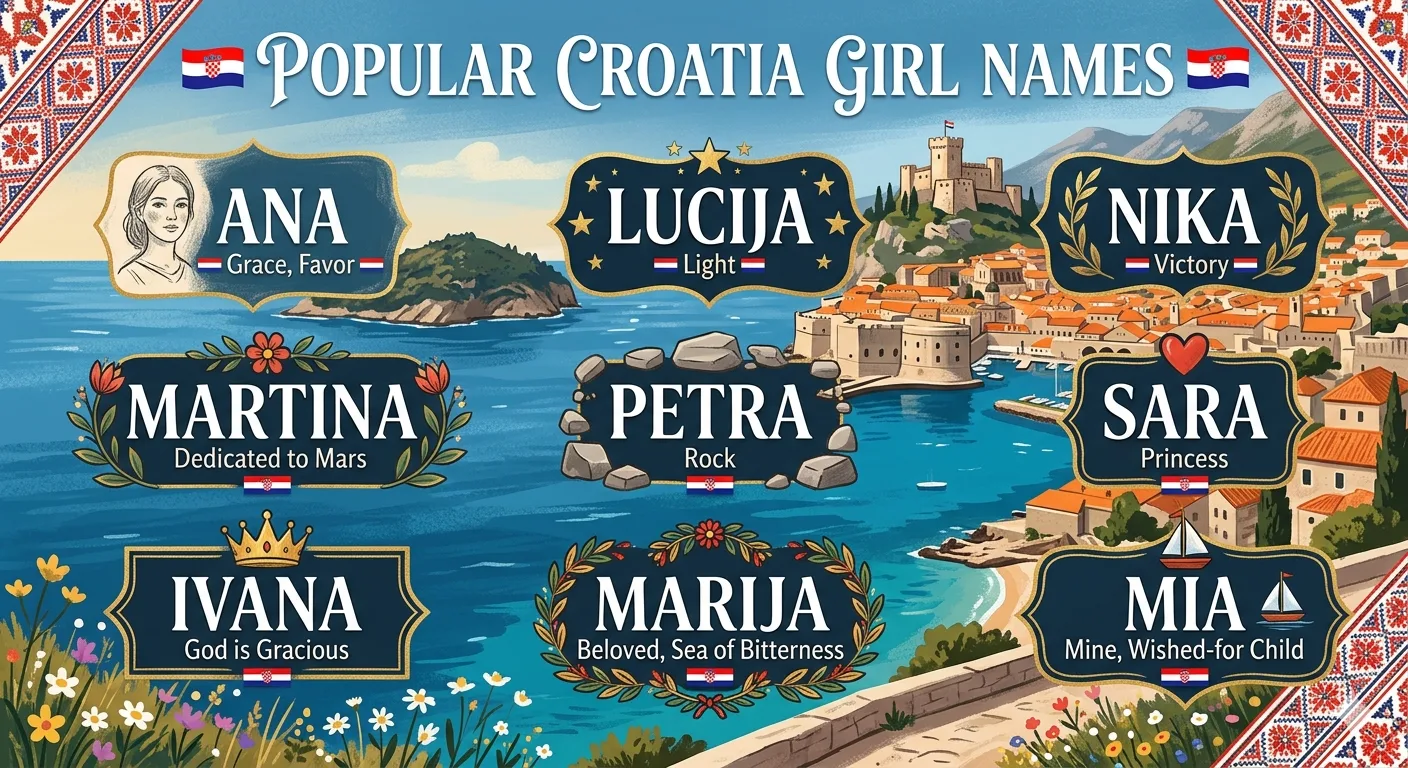
Ana stands in a category all by itself in Croatian naming history. The Croatian form of the Hebrew name Hannah, meaning grace or God has favored me, Ana has ranked among the very top names for Croatian girls for most of recorded naming history in the country. Its enduring appeal lies in its perfect simplicity, its deep Catholic resonance through Saint Anne, the mother of the Virgin Mary, and the way it sits effortlessly on the tongue in the Croatian language. Ana is a name that belongs to grandmothers and newborns alike, a name without age.
Marija, the Croatian form of Mary, carries the profound weight of Catholic devotion that runs through the heart of Croatian culture. Croatia is one of the most devoutly Catholic nations in Europe, and the Virgin Mary holds a special place in Croatian spiritual life that goes back more than thirteen centuries. Choosing Marija for a daughter is both an act of faith and an act of cultural pride, connecting a child to the deepest roots of Croatian identity in a single beautiful word.
Ivana represents one of Croatia's most characteristic naming traditions: the feminization of the beloved male name Ivan, itself the Croatian form of John. This practice of creating elegant feminine forms of traditional male names has given the Croatian naming tradition many of its most distinctive and beautiful girl names. Ivana carries strength, history, and a deeply Croatian character that makes it one of the most recognizable and beloved names in the country.
Modern and Trending Croatian Girl Names in 2026
Croatian parents in 2026 are drawn to girl names that feel contemporary, stylish, and connected to the wider European and global naming landscape while still honoring the beautiful sounds and cultural spirit of the Croatian language. Modern trending names in Croatia often have a fresh, clean quality that feels international while still sounding naturally beautiful when spoken in Croatian. Here are the names gaining the most momentum across Croatia right now.
|
Name |
Meaning |
Why Trending |
|
Lena |
Greek, shining light, bright one |
Clean, modern, works perfectly across European cultures |
|
Sofia |
Greek, wisdom, knowledge |
Rising rapidly, elegant and internationally fashionable |
|
Nika |
Greek, victory, triumphant |
Short and powerful, uniquely beautiful in Croatian |
|
Zara |
Arabic and Hebrew, flower, princess |
Stylish and multicultural, growing fast in Croatia |
|
Lea |
Hebrew, weary, delicate, wildflower |
Simple and beautiful, hugely fashionable in 2026 |
|
Ema |
Germanic, whole, universal |
Croatian form of Emma, rising to match European trends |
|
Hana |
Hebrew and Japanese, grace, flower |
Soft and multicultural, gaining real momentum |
|
Tena |
Shortened form of Kristina, anointed one |
Distinctively Croatian feel, stylish and modern |
|
Nora |
Irish and Latin, honor, light |
International charm meeting Croatian softness |
|
Klara |
Latin, bright, clear, famous |
Vintage revival with modern freshness in Croatia |
|
Iris |
Greek, rainbow, messenger of the gods |
Nature and mythology combined, very fashionable |
|
Luna |
Latin, the moon, celestial beauty |
Celestial trend reaching Croatian shores strongly |
One of the clearest patterns defining modern Croatian girl names in 2026 is the powerful pull of short, melodic names that work beautifully in both Croatian and other European languages. Croatia is a deeply European nation and an increasingly internationally connected one, and Croatian parents today are often conscious of choosing names that their daughters can carry comfortably whether they are living in Zagreb, studying in Vienna, or working in London. Names like Lena, Lea, Sofia, and Nika satisfy this desire for names that are authentically beautiful in Croatian while feeling completely at home across the wider European world.
The influence of global naming trends is increasingly visible in Croatian baby naming data. International names that have climbed rapidly in England, Germany, Scandinavia, and Italy are arriving on Croatian shores with growing speed, filtered through the distinctive sound preferences of the Croatian language. Luna, a name that has become enormously fashionable across all of Europe, is now rising quickly in Croatia as well, where its soft sounds and celestial romance translate perfectly into the Croatian aesthetic. Iris and Klara represent the vintage revival trend that is reshaping naming choices across Europe, with Croatian parents discovering the quiet elegance of names that carry classical beauty without feeling heavy or old-fashioned.
Traditional and Cultural Croatian Girl Names That Carry Deep Heritage
Traditional Croatian girl names are treasures of cultural memory, carrying the history, faith, and spirit of the Croatian people across centuries of extraordinary experience. These names have been given to daughters throughout Croatia's long history and continue to be chosen today by families who want to connect their children to something genuinely lasting. They are names rooted in Catholic tradition, ancient Slavic culture, and the distinctively Croatian way of seeing and celebrating the world.
|
Name |
Origin and Meaning |
Why It Endures |
|
Magdalena |
Hebrew, tower, elevated, from Magdala |
Saint Mary Magdalene, deeply beloved in Croatia |
|
Domagoja |
Croatian, homeland, protector of home |
Ancient Slavic-Croatian name, deeply patriotic |
|
Vjekoslava |
Croatian Slavic, eternal glory, fame |
Genuinely ancient Croatian name, rare beauty |
|
Zvonimira |
Slavic, sound of peace, bell of peace |
Feminine of historic Croatian king Zvonimir |
|
Dragica |
Croatian Slavic, dear one, precious |
Affectionate and distinctively Croatian |
|
Ruza |
Croatian, rose, beautiful flower |
Poetic and nature-rooted, classically Croatian |
|
Vjera |
Croatian, faith, belief, trust in God |
Virtue name deeply rooted in Croatian Catholic life |
|
Nevenka |
Croatian, marigold flower, sunshine |
Beautiful floral name, genuinely Croatian |
|
Dubravka |
Croatian Slavic, oak forest, strength |
Ancient Slavic heritage, deeply rooted in Croatia |
|
Gordana |
Croatian Slavic, proud, dignified woman |
Strong and characteristically Croatian |
|
Slavica |
Croatian Slavic, glory, Slavic people |
Heritage name connecting to Croatian Slavic roots |
|
Blanka |
Croatian, white, pure, bright |
Classic dignity, Venetian influenced, beloved in Dalmatia |
Zvonimira holds a special place in Croatian cultural memory because it is the feminine form of Zvonimir, one of the most celebrated kings in Croatian medieval history. King Dmitar Zvonimir ruled Croatia in the eleventh century during a period of Croatian independence and cultural flourishing that is remembered with great national pride. Choosing Zvonimira for a daughter today is both a beautiful aesthetic choice and a profound act of connection to the golden age of Croatian nationhood. The name carries the sounds of bells and peace within it, a deeply poetic combination that speaks to the Croatian soul.
Dubravka is one of the most beautifully Croatian names imaginable. Drawing on the ancient Slavic word for an oak forest or a sacred grove, Dubravka connects a daughter directly to the landscape and the pre-Christian spiritual life of the Slavic peoples who arrived in Croatia in the sixth and seventh centuries. It is also famous as the name of a celebrated medieval play set in Dubrovnik, making it a name with deep literary resonance in Croatian culture. Choosing Dubravka is choosing the deep roots of the Croatian forest itself.
Nevenka, meaning marigold in Croatian, represents the beautiful tradition of floral names that runs through Croatian culture. The marigold, called neven in Croatian, is a flower associated with warmth, healing, and the sun-bright colors of the Croatian coast. Nevenka carries all of this warmth within it and represents the distinctively Croatian ability to find beauty and meaning in the natural world that surrounds this extraordinarily lovely country.
You can also use our Name Generator Tool to create unique names instantly. Kyrgyzstan Girl Names
Dalmatian and Coastal Croatian Girl Names Inspired by the Adriatic
The Croatian coast is one of the most beautiful stretches of shoreline in the entire world. The Dalmatian coast, with its clear turquoise waters, ancient walled cities, fragrant pine forests, and centuries of Venetian and Mediterranean cultural influence, has produced a naming tradition that is subtly but distinctly different from the names of inland Croatia. Coastal and Dalmatian names often carry a warmer, more Mediterranean quality, reflecting the unique character of a region where Italian, Latin, and Croatian cultures have blended for centuries.
|
Name |
Origin and Meaning |
Coastal Connection |
|
Dujka |
Latin via Dalmatian, of Saint Domnius |
Patron saint of Split, profoundly Dalmatian |
|
Stana |
Croatian Slavic, she who stands firm |
Ancient Dalmatian heritage, strong and proud |
|
Antica |
Croatian, ancient one, of old |
Distinctively Dalmatian, rare and beautiful |
|
Marica |
Hebrew via Croatian, little Mary, beloved |
Affectionate diminutive, warmly Dalmatian |
|
Kornelija |
Latin, horn, strength, Cornelius family |
Roman heritage visible on the Dalmatian coast |
|
Viktorija |
Latin, victory, triumphant |
Croatian form of Victoria, popular along the coast |
|
Andrijana |
Greek, brave, manly strength |
Feminine of Andrija, beloved in coastal Croatia |
|
Jelka |
Croatian, fir tree, Christmas tree |
Nature-rooted, warmly beloved in coastal towns |
|
Ankica |
Hebrew via Croatian, little Ana, graceful |
Affectionate diminutive beloved in Dalmatia |
|
Vesna |
Slavic, spring, messenger of spring |
Ancient goddess of spring, beautiful and seasonal |
Vesna is one of the most poetic and culturally significant names in the entire Croatian tradition. In ancient Slavic mythology, Vesna was the goddess of spring, youth, and rebirth, a divine figure who represented the return of warmth and life after the cold of winter. Choosing Vesna for a daughter born in spring carries an extraordinary resonance that connects the child to one of the oldest spiritual traditions of the Slavic world. It is a name that belongs to blooming meadows, returning birds, and the first warmth of the Croatian spring sun on the Adriatic shore.
The Dalmatian coast has always been a place where different worlds met and mingled. Roman ruins stand alongside medieval Croatian fortresses, Venetian bell towers rise above Croatian fishing villages, and the Latin language has left deep marks on the local Croatian dialect. Names like Kornelija and Viktorija reflect this Latin heritage that is uniquely concentrated on the Dalmatian coast, where Roman civilization left some of its deepest marks anywhere in Europe. The ancient city of Diocletian in Split, built by the Roman emperor Diocletian himself, still stands as one of the best-preserved Roman monuments in the world, and the naming traditions of coastal Croatia carry that deep Roman imprint.
Rare and Unique Croatian Girl Names That Truly Stand Out
For parents searching for something genuinely distinctive, the Croatian naming tradition is a treasury of rare and uncommon choices that combine deep cultural roots with beautiful sounds. These rare Croatian girl names are perfect for families who want their daughter to have a name that is authentically rooted in Croatian heritage while being genuinely unusual and memorable. Croatia's rich history and its unique position at the crossroads of European cultures have produced countless rare gems waiting to be rediscovered.
|
Name |
Origin and Meaning |
Why It Is Special |
|
Cvijeta |
Croatian, flower, blossom |
Extremely rare, hauntingly beautiful Croatian original |
|
Biserka |
Croatian, little pearl, treasure of the sea |
Rare gem name connected to the Adriatic coast |
|
Miljenka |
Croatian Slavic, beloved, grace and mercy |
Deeply affectionate, rarely used today |
|
Suncanica |
Croatian, little ray of sunshine, warmth |
Poetic and rare, connecting to warmth and light |
|
Zlatica |
Croatian, golden one, precious as gold |
Rare and beautiful, meaning pure gold |
|
Jasna |
Croatian Slavic, clear, bright, luminous |
Rare today, deeply beautiful and distinctly Croatian |
|
Branka |
Croatian Slavic, protection, armor, defender |
Strong and rare, ancient Slavic warrior heritage |
|
Mirna |
Croatian Slavic, peaceful, calm as the sea |
Rare gem, peace and sea in one beautiful name |
|
Tiha |
Croatian, quiet, still, peaceful one |
Extremely rare, poetic and deeply Croatian |
|
Zdravka |
Croatian Slavic, healthy, sound, whole |
Ancient and rare, a wish for lifelong wellbeing |
Cvijeta is one of the rarest and most hauntingly beautiful names in the entire Croatian tradition. Meaning flower or blossom in Croatian, it was the name of Cvijeta Zuzoric, a sixteenth century Ragusan poet born in Dubrovnik who was celebrated across Renaissance Europe for her extraordinary beauty and intellectual brilliance. Choosing Cvijeta for a daughter today is choosing both a name of rare Croatian beauty and a connection to one of the most remarkable women in Croatian cultural history, a woman who sat at the center of European Renaissance intellectual life while remaining rooted in her Croatian Adriatic heritage.
Biserka connects a daughter to the sea in the most beautiful possible way. Meaning little pearl in Croatian, the name draws on the Adriatic itself, that extraordinary sea whose clear waters have shaped Croatian civilization for thousands of years. Pearls have been associated with the Adriatic coast since ancient times, and Biserka carries all of that maritime beauty within its few syllables. It is a name that feels like sunlight on sea water, rare, luminous, and unmistakably Croatian.
Mirna offers parents a name that is both rare and deeply meaningful. Meaning peaceful or calm as the sea in Croatian, Mirna carries within it the most beloved quality of the Croatian Adriatic, the extraordinary tranquility of those calm, clear, blue-green waters that have inspired poets and painters for centuries. A daughter named Mirna carries with her a wish for inner peace that is also a celebration of Croatia's most beautiful natural treasure.
Croatian Girl Names Rooted in Ancient Slavic Tradition
Before Christianity arrived in Croatia in the seventh and eighth centuries, the Croatian people carried a rich tradition of Slavic names that drew on nature, virtues, and the spiritual world of early Slavic culture. Many of these ancient Slavic names survive in the Croatian tradition today and carry a kind of deep, earthen beauty that connects modern Croatian girls to their most ancient roots. These names often combine two meaningful elements to create names that are essentially small poems about desired qualities or wishes for a child's life.
|
Name |
Slavic Meaning |
Cultural Significance |
|
Milica |
Slavic, gracious, dear, beloved one |
Royal medieval heritage, most beloved Slavic name |
|
Radmila |
Slavic, joyful work, happy and industrious |
Ancient two-element Slavic name, deeply rooted |
|
Bogdana |
Slavic, given by God, divine gift |
God and gift combined, ancient Slavic blessing |
|
Vladimira |
Slavic, rules the world, great ruler |
Feminine of Vladimir, powerful ancient name |
|
Dragomira |
Slavic, dear peace, precious and peaceful |
Two-element Slavic name of great beauty |
|
Stanislava |
Slavic, glory that stands firm |
Ancient name meaning glory and steadiness |
|
Snezana |
Slavic, snowy, white as snow, pure |
Winter name of extraordinary poetic beauty |
|
Radoslava |
Slavic, joyful glory, happy and glorious |
Ancient compound name of joy and honor |
|
Svetlana |
Slavic, bright light, luminous, radiant |
Beautiful light name, beloved across Slavic world |
|
Zivana |
Slavic, life, living, full of vitality |
Ancient goddess name, life itself personified |
Milica carries a royal medieval legacy that gives it a special weight in Croatian and broader South Slavic culture. In Serbian and Croatian medieval history, Milica was the name of Princess Milica, the wife of the Serbian Prince Lazar and a woman who became a symbol of grace, courage, and faithfulness in the face of historical tragedy. The name has been beloved across the South Slavic world for centuries because it combines one of the most affectionate Slavic roots, mil meaning dear or gracious, with a beautiful feminine ending that creates an elegantly flowing name.
Snezana is one of the most poetic names in the Croatian naming tradition. Meaning snowy or white as snow, it carries the pristine beauty of the Croatian winter mountains within it, the Dinaric Alps, the Velebit range, and the snow-covered landscapes that contrast so dramatically and beautifully with the warm blue Adriatic coast. Snezana is also the Croatian and South Slavic form of the Snow White fairy tale, connecting it to one of the oldest and most beloved stories in European culture.
You can also use our Name Generator Tool to create unique names instantly. Laos Girl Names
Creative Croatian Baby Girl Naming Ideas for Modern Parents
Modern Croatian parents have more naming possibilities available to them than any previous generation, and many families are finding creative ways to honor Croatian heritage while embracing contemporary naming sensibilities. Here are some inspired approaches to finding the perfect Croatian girl name for a baby born in 2026.
Combining Croatian Roots with International Appeal
Many of the most beautiful Croatian girl names have natural international equivalents or close cousins in other European languages, making them ideal choices for families who want a name that honors Croatian heritage while working beautifully in an international context. Lucija becomes Lucia in Italian and Spanish. Katarina becomes Katherine or Katarina in German and English. Elena is universally understood across European languages. Ana is simply and perfectly beautiful in any language. These names give daughters the best of both worlds, deep Croatian roots and easy international movement.
Choosing Names with Nature Meanings
Croatian nature names carry extraordinary beauty because Croatia itself is one of the most naturally spectacular countries in Europe. From the dramatic Plitvice Lakes to the Kornati island archipelago, from the Krka waterfalls to the wild Velebit mountains, Croatia's natural landscape is a source of endless inspiration. Names like Vesna for spring, Mirna for calm waters, Zlatka for gold, Nevenka for marigold, and Ruza for rose all draw on Croatia's natural world in the most direct and beautiful way possible.
Honoring Croatian Saints and Religious Figures
Croatia's deep Catholic faith has given the country a rich treasury of saint names that carry both spiritual meaning and deep cultural resonance. Saint names remain among the most respected and beloved choices for Croatian baby girls, connecting daughters to a living tradition of faith that is central to Croatian identity. Names like Lucija, connected to Saint Lucy whose feast day on December 13th is one of the most beautifully celebrated feast days in Croatia, or Katarina connected to Saint Catherine, or Magdalena connected to Mary Magdalene, carry centuries of Croatian devotional life within them.
Latest Croatian Girl Name Trends Shaping 2026
Croatian baby girl naming trends in 2026 reflect a fascinating and dynamic tension between deep cultural pride and enthusiastic engagement with wider European and global trends. Several clear patterns are defining the Croatian naming landscape right now, and understanding these trends can help parents navigate their choices with both cultural awareness and contemporary confidence.
Short and melodic names are dominant in Croatian naming charts. Croatian parents in 2026 have a strong preference for names of one to three syllables that carry maximum beauty with minimum complexity. Ana, Lea, Nika, Mia, Lena, and Tena are all riding this wave of preference for names that feel clean, modern, and instantly lovable. This trend reflects the Croatian aesthetic preference for names that flow naturally off the tongue and feel comfortable in casual everyday use as well as in formal contexts.
International European names are arriving in Croatia with growing speed. Names that are currently fashionable in Germany, France, the United Kingdom, Scandinavia, and Italy are appearing in Croatian naming statistics with increasing frequency, filtered through the phonetic sensibilities of the Croatian language. Sofia, Luna, Iris, Klara, and Elena are examples of this European crossover trend that connects Croatian naming to the broader continent without losing its distinctive character.
Vintage Croatian names are experiencing a meaningful revival. Just as vintage names are fashionable across Europe and North America, Croatian parents are rediscovering the beauty of names that their grandparents and great-grandparents carried. Names like Vesna, Jasna, Gordana, and Blanka, which had their peak popularity in the mid-twentieth century, are now being chosen by younger Croatian parents who appreciate their old-world elegance and distinctively Croatian character. This vintage revival is one of the most interesting and beautiful trends in Croatian naming right now.
Nature and the Adriatic are increasingly powerful naming inspirations. The extraordinary beauty of Croatia's natural environment, its coast, its islands, its rivers, its forests, and its mountains, is becoming a more conscious and explicit influence on Croatian naming choices. Names like Mirna meaning peaceful sea, Bisera meaning pearl, Zlatka meaning golden, and Nevenka meaning marigold all draw on the natural world in ways that feel deeply Croatian and deeply beautiful.
Catholic tradition remains the single most important cultural force in Croatian naming. Despite all the international trends and contemporary fashions, Croatian parents remain deeply connected to their Catholic naming tradition. Saint names, biblical names, and names associated with Croatian Catholic devotional life continue to dominate the naming charts and represent the stable, enduring core around which all other naming trends orbit. This is not nostalgia but living culture, the expression of a faith that is genuinely central to Croatian identity in 2026.
How Names Are Chosen in Croatian Culture and Society
Understanding how Croatian families approach the naming process reveals the rich cultural landscape that makes Croatian baby names so meaningful and distinctive. Croatian naming culture is shaped by several powerful forces that work together to create the unique naming tradition we see today.
The Catholic Feast Day Tradition
One of the most distinctive aspects of Croatian naming culture is the tradition of the imendan or name day, the feast day of the saint whose name you bear. In Croatia, name days are celebrated almost as enthusiastically as birthdays, and choosing a name with a Catholic saint behind it means giving a daughter a second birthday of sorts, a day of celebration that connects her to the spiritual community of those who have borne her name throughout history. This tradition makes the choice of a saint name feel not just religious but genuinely festive and communal.
Family and Generational Naming
Croatian families traditionally have a strong practice of naming children after grandparents, parents, or other beloved family members as a gesture of respect, love, and continuity. This practice of generational naming means that certain names recur across Croatian families with particular frequency, connecting children to their family stories in the most direct possible way. For many Croatian parents, the question of what to name a daughter begins with a careful conversation about which beloved family members deserve to have their name carried forward.
Regional Identity and Local Naming Traditions
Croatia is a country of genuinely distinct regional identities. The Dalmatian coast, Istria, Slavonia, Zagorje, Lika, and the other regions of Croatia each carry their own naming preferences and traditions. Dalmatian families may favor names with more pronounced Mediterranean and Venetian influences. Slavonian families from the flat agricultural east of Croatia may lean more toward traditional Slavic names. Istrian families carry the influence of the long Venetian and Italian presence in that peninsula. Understanding your family's regional roots can be a beautiful guide to finding names that carry genuine local resonance.
The Role of Godparents
In Croatian Catholic tradition, godparents play an important role in a child's naming and life. The practice of naming children after godparents or choosing names that godparents find meaningful is part of the broader web of community and spiritual responsibility that surrounds a Croatian child's entry into the world. Godparents in Croatia take their role seriously, and the relationship between a child and their kum or kuma, the Croatian words for godfather and godmother, is one of the most meaningful relationships in Croatian social life.
You can also use our Name Generator Tool to create unique names instantly. Cuba Girl Names
Expert Tips for Choosing the Perfect Stylish Croatian Girl Name
Begin with meaning and cultural resonance. A Croatian name that carries a meaning genuinely beautiful to you, or that connects to something important in your family's story or regional heritage, will always feel more special than a name chosen purely for its trendiness. The meaning of a Croatian name is a gift that grows more beautiful as your daughter grows into it.
Consider the sound of the full name in Croatian. Croatian is a phonetically rich language with strong consonant clusters and beautiful vowel sounds. Take time to say any candidate name out loud, in Croatian, multiple times, and consider how it flows with your family surname. Croatian surnames ending in ic, which is most of them, create a particular rhythmic pattern that some first names complement more beautifully than others.
Think about the name day and its celebrations. If you choose a name with a Catholic saint behind it, your daughter will have an imendan to celebrate every year. Some name days are among the most beautiful and festive in the Croatian calendar. Saint Lucy's day, the feast of Lucija, is celebrated with candles and processions in many Croatian cities. The feast of Kata, Katarina, on November 25th is another beloved celebration. The joy of a name day is a real and lasting gift.
Explore both the formal name and its diminutives. Croatian culture has an exceptionally rich tradition of affectionate diminutives, shortened and sweetened forms of names used in everyday warm conversation. Ana becomes Anica or Anka. Katarina becomes Kata or Kaja. Marija becomes Mara or Marica. Ivana becomes Iva or Ivanka. These diminutives are not less beautiful than the full name; they are part of the name's full character and something a Croatian girl will use and love throughout her life.
Honor your family's regional roots. Whether your family comes from Dalmatia, Istria, Slavonia, Zagorje, or anywhere else in this extraordinary country, exploring the particular naming traditions of your region can lead you to names that carry not just Croatian identity but the specific character of a particular landscape, history, and community. Regional naming pride is a beautiful and increasingly valued part of Croatian cultural life.
Trust your instincts and your love. After all the research and all the conversations, the right Croatian name for your daughter is ultimately the one that makes your heart feel certain and warm when you speak it. Croatian parents have always understood that a name is a form of love given before you even meet the person you are naming, and that love, when it is genuine, always finds the right words.
Generate More Names: Girl Names Generator
Conclusion: Celebrating the Rich Beauty of Croatian Girl Names
Croatian girl names are among the most culturally rich, historically layered, and genuinely beautiful names in the European tradition. They tell the story of a nation that has survived centuries of extraordinary challenge while holding tightly to its language, its faith, its natural beauty, and its deep sense of cultural identity. Whether you choose a timeless Catholic classic like Marija or Lucija, an ancient Slavic gem like Vesna or Dubravka, a rare coastal treasure like Cvijeta or Biserka, a modern and stylish choice like Sofia or Lena, or a vintage revival like Jasna or Blanka, you are giving your daughter a name rooted in one of Europe's most remarkable cultural stories.
The world of Croatian girl names rewards exploration. Every name in this tradition carries a story, a saint, a landscape, a historical figure, a spiritual meaning, or a wish for the future embedded in its beautiful syllables. Choosing a Croatian name for a daughter is not just a naming decision but an act of connection, to a people, to a place, to a faith, and to a cultural tradition that has endured and flourished against all odds across more than thirteen centuries of Croatian history.
We hope this complete guide to Croatian girl names has opened a door into a world of naming beauty that you may not have fully explored before. May your daughter grow up proud of her name, connected to the extraordinary heritage it carries, and ready to add her own chapter to the long and beautiful story of Croatia.