 Bolivian Boy Name Generator
Discover strong Bolivian boy names with Spanish and Andean heritage
Guides & Articles
Bolivian Boy Names: A Complete Guide to Stylish, Traditional and Modern Choices
Introduction: The Rich World of Bolivian Boy Names
Choosing a name for your baby boy is one of the most meaningful decisions any parent will ever make. In Bolivia, this decision carries extraordinary cultural depth because the country is home to an incredible blend of Indigenous Andean civilizations, Spanish colonial heritage, and modern Latin American influences. Bolivian boy names reflect all of this richness. Whether you are searching for a modern Bolivian name, a traditional Quechua or Aymara name rooted in ancient Andean culture, or a stylish Spanish-origin name that is trending across Latin America today, Bolivia offers one of the most diverse and beautiful naming traditions in the entire continent.
Bolivia is one of the most culturally diverse nations in South America. With a population that includes Quechua, Aymara, Guarani, and many other Indigenous peoples alongside Spanish-speaking mestizo communities, the country's naming traditions span thousands of years. The Andean civilizations that preceded and were absorbed by the Inca Empire left behind a legacy of powerful, nature-inspired, and spiritually significant names. The Spanish colonial period introduced Catholic saints' names, European given names, and a new linguistic layer that merged beautifully with what was already there. Today, Bolivian baby names for boys represent all of these histories at once.
This comprehensive guide covers popular Bolivian boy names, modern and trending choices for 2026, traditional Indigenous names from Quechua and Aymara cultures, rare and unique names that deserve more attention, and the cultural traditions that shape how Bolivian families choose names for their sons. Whether you are Bolivian yourself, have Bolivian heritage, or simply love the beauty of Andean and Latin American names, this article will give you everything you need.
Popular Bolivian Boy Names with Meanings
Some Bolivian names have been consistently beloved for generations. These popular names blend Spanish Catholic heritage with a distinctly Bolivian warmth and spirit. They are familiar across the country in cities like La Paz, Cochabamba, Santa Cruz, and Sucre, and have proven their staying power across decades.
|
Name |
Origin |
Meaning |
|
Santiago |
Spanish/Hebrew |
Supplanter; follower of Saint James |
|
Mateo |
Spanish/Hebrew |
Gift of God; beloved by Bolivian families |
|
Sebastian |
Latin/Greek |
Venerable, revered, highly respected |
|
Diego |
Spanish |
Supplanter; strong and spirited soul |
|
Juan |
Spanish/Hebrew |
God is gracious; classic and timeless |
|
Carlos |
Spanish/Germanic |
Free man; a name of strength and dignity |
|
Luis |
Spanish/Germanic |
Renowned warrior; bold and enduring |
|
Miguel |
Spanish/Hebrew |
Who is like God; deeply religious resonance |
|
Andres |
Spanish/Greek |
Manly and brave; a name of quiet courage |
|
Fernando |
Spanish/Germanic |
Bold journey; adventurous and free spirit |
|
Rodrigo |
Spanish/Germanic |
Famous ruler; associated with leadership |
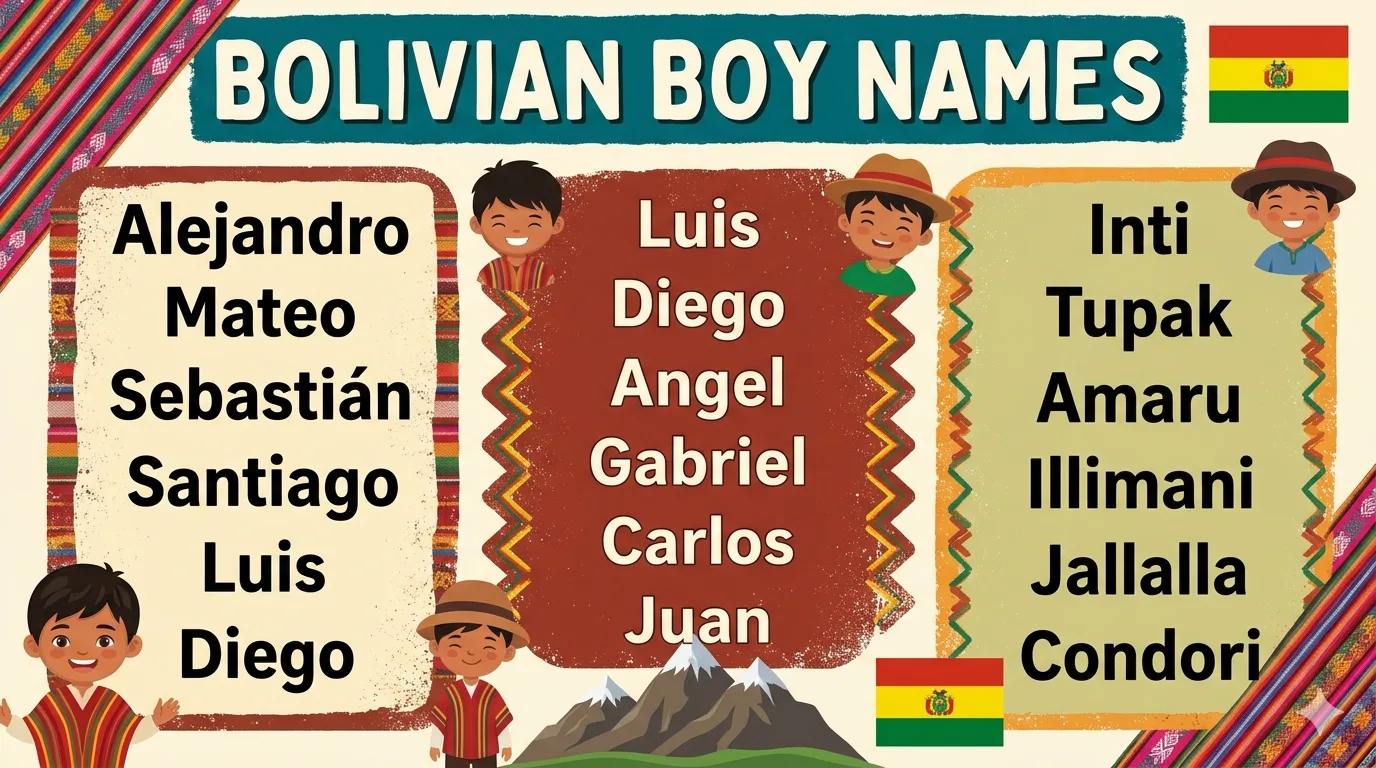
Names like Santiago, Mateo, and Miguel carry the deep Catholic faith that has shaped Bolivian culture since the 16th century. These popular baby names for Bolivian boys have been passed down through families for generations. When a Bolivian family names their son Juan or Carlos, they are continuing a naming tradition that connects their child to centuries of Latin American identity and Catholic devotion. Fernando and Rodrigo carry a sense of boldness that Bolivian parents have always admired.
Modern and Trending Bolivian Boy Names in 2026
Bolivian parents in 2026 are increasingly drawn to names that feel contemporary, globally aware, and stylish while still maintaining a connection to Latin culture. Modern Bolivian boy names tend to be shorter, smoother in sound, and carry meanings that reflect positive qualities like peace, strength, and divine favor. Social media, international music, global sports figures, and increased access to global culture have all shaped what names Bolivian families are choosing for their newborn sons today.
|
Name |
Pronunciation |
Meaning |
Why Trending |
|
Liam |
Lee-am |
Resolute protector |
Global influence, short and strong |
|
Emilio |
Eh-mee-lee-oh |
Industrious, hardworking |
Smooth sound, romantic feel |
|
Thiago |
Tee-ah-go |
Supplanter; modern Santiago |
Latin America wide, rising fast |
|
Ian |
Ee-an |
God is gracious |
Short, global, easy to pronounce |
|
Matias |
Mah-tee-as |
Gift of God |
Trendy across South America now |
|
Axel |
Ax-el |
Father of peace |
Urban, youthful, very popular |
|
Iker |
Ee-ker |
Visitation |
Basque origin, rising in Bolivia |
|
Joaquin |
Wah-keen |
Raised by God |
Classic yet fashionable revival |
|
Noah |
No-ah |
Rest, comfort, peace |
Biblical, globally beloved |
|
Bruno |
Broo-no |
Brown-haired; strong character |
Energetic, modern, cool sound |
The rise of names like Thiago, Matias, and Joaquin reflects a broader Latin American naming trend where parents are blending Spanish heritage with a fresh, modern sensibility. Axel and Bruno have arrived from European influence through media and music. Noah and Liam represent the global reach of streaming culture and international entertainment, which now deeply influences baby naming decisions across Bolivian cities. Emilio remains a timeless romantic choice that bridges the traditional and the stylish perfectly.
Traditional Bolivian Boy Names Rooted in Indigenous Heritage
Bolivia has one of the largest Indigenous populations in all of South America. Approximately 60 percent of Bolivians identify as Indigenous, and the naming traditions of the Quechua and Aymara peoples represent some of the oldest continuous naming cultures in the Western Hemisphere. Traditional Bolivian boy names from these cultures are deeply connected to nature, spirituality, the Andean cosmos, and the legacy of the great Inca Empire and pre-Inca Andean civilizations.
|
Name |
Cultural Root |
Meaning and Significance |
|
Tupac |
Quechua |
Royal, shining; name of Incan royalty |
|
Inti |
Quechua |
Sun god; light and divine energy |
|
Wayra |
Quechua/Aymara |
Wind; freedom and the breath of life |
|
Amaru |
Quechua |
Serpent; symbol of wisdom and power |
|
Cusi |
Quechua |
Happy, joyful; a name full of optimism |
|
Apu |
Quechua |
Mountain spirit; lord, great one |
|
Huascar |
Quechua |
Rope of gold; name of an Incan emperor |
|
Mallku |
Aymara |
Condor; chief or nobleman of the land |
|
Wara |
Aymara |
Star; light that guides in the darkness |
|
Pachakuti |
Quechua |
World-transformer; great Incan emperor |
Names like Tupac and Inti carry the royal prestige of the Inca Empire. Tupac Inca Yupanqui was one of the greatest Incan rulers, and his name remains a symbol of Indigenous pride and royal heritage across Bolivia and Peru. Inti, the sun god of the Incas, represents the very source of life and light in Andean cosmology. Wayra and Apu connect Bolivian boys to the natural world of the Andes, where wind and mountain spirits were revered as divine forces. These traditional Bolivian cultural names are increasingly being chosen by families who want to honor their Indigenous roots.
Rare and Unique Bolivian Boy Names That Stand Out
For families who want something truly extraordinary, Bolivia's rich linguistic and mythological traditions offer a treasury of rare and uncommon names. These unique Bolivian boy names are not widely used in everyday life, which makes them perfect for parents who want their son to carry a name that is both deeply meaningful and genuinely distinctive. Many of these names come from Quechua mythology, Aymara cosmology, or the ancient Andean spiritual world.
|
Name |
Rarity |
Meaning and Significance |
|
Urcaguary |
Very Rare |
Deity of precious metals in Bolivian mythology |
|
Kuntur |
Rare |
Condor; sacred Andean bird symbolizing power |
|
Sairi |
Very Rare |
Tobacco leaf; used in Andean spiritual ceremonies |
|
Rimaq |
Rare |
The one who speaks; eloquent and expressive |
|
Ocllo |
Very Rare |
Pure one; associated with Incan spiritual purity |
|
Misqui |
Rare |
Sweet; gentle, kind spirit beloved by all |
|
Illapa |
Uncommon |
Thunder and lightning; Andean deity of storms |
|
Hatun |
Uncommon |
Great one; used to signify nobility and honor |
|
Qori |
Rare |
Gold; rare Quechua name with shining meaning |
|
Supay |
Very Rare |
Spirit of the underworld; powerful and mysterious |
Names like Kuntur and Illapa are connected to the sacred animals and forces of the Andean world. The condor, represented by Kuntur, is considered the most powerful and sacred bird in Andean culture, a messenger between the human world and the divine realm of the sky. Illapa, the thunder deity, was one of the most important gods in the Inca pantheon. Choosing rare Bolivian names like these gives a child an identity that is truly unique, spiritually rich, and deeply rooted in one of the world's most ancient and fascinating cultures.
Bolivian Boy Names Inspired by the Natural World
Bolivia is one of the most ecologically diverse countries on earth. From the soaring peaks of the Andes and the mysterious highlands of the Altiplano to the tropical Amazon rainforest and the sweeping lowland plains of the Chaco, Bolivia's natural landscape is breathtaking. It should be no surprise that this incredible environment has long inspired the naming of Bolivian boys. Nature-inspired baby names in Bolivia carry a poetic, spiritual quality that resonates deeply with Andean worldview.
|
Name |
Nature Element |
Symbolic Meaning |
|
Inti |
Sun |
Warmth, divine light, life-giving energy |
|
Wayra |
Wind |
Freedom, movement, and spiritual breath |
|
Kuntur |
Condor / Eagle |
Sky power, vision, and sacred Andean spirit |
|
Apu |
Mountain |
Earthly strength, permanence, and the divine |
|
Qochamama |
Lake / Water |
Lake Titicaca spirit; depth and reflection |
|
Illapa |
Thunder |
Power of storms; force and dynamic energy |
|
Wara |
Star |
Celestial guidance and shining potential |
|
Pachamama |
Earth |
Sacred mother earth; rooted and life-giving |
The Andean worldview does not separate humanity from nature the way Western cultures often do. The mountains, the sun, the wind, and the stars are all living beings with spirits and personalities. When a Bolivian family names their son Inti or Wayra, they are not just choosing a poetic word. They are embedding their child in the cosmic fabric of the Andean universe, connecting him to forces that have been revered for thousands of years. Nature names for Bolivian boys are experiencing a revival among urban Bolivian families who want to reclaim Indigenous identity.
How Names Are Chosen in Bolivian Culture
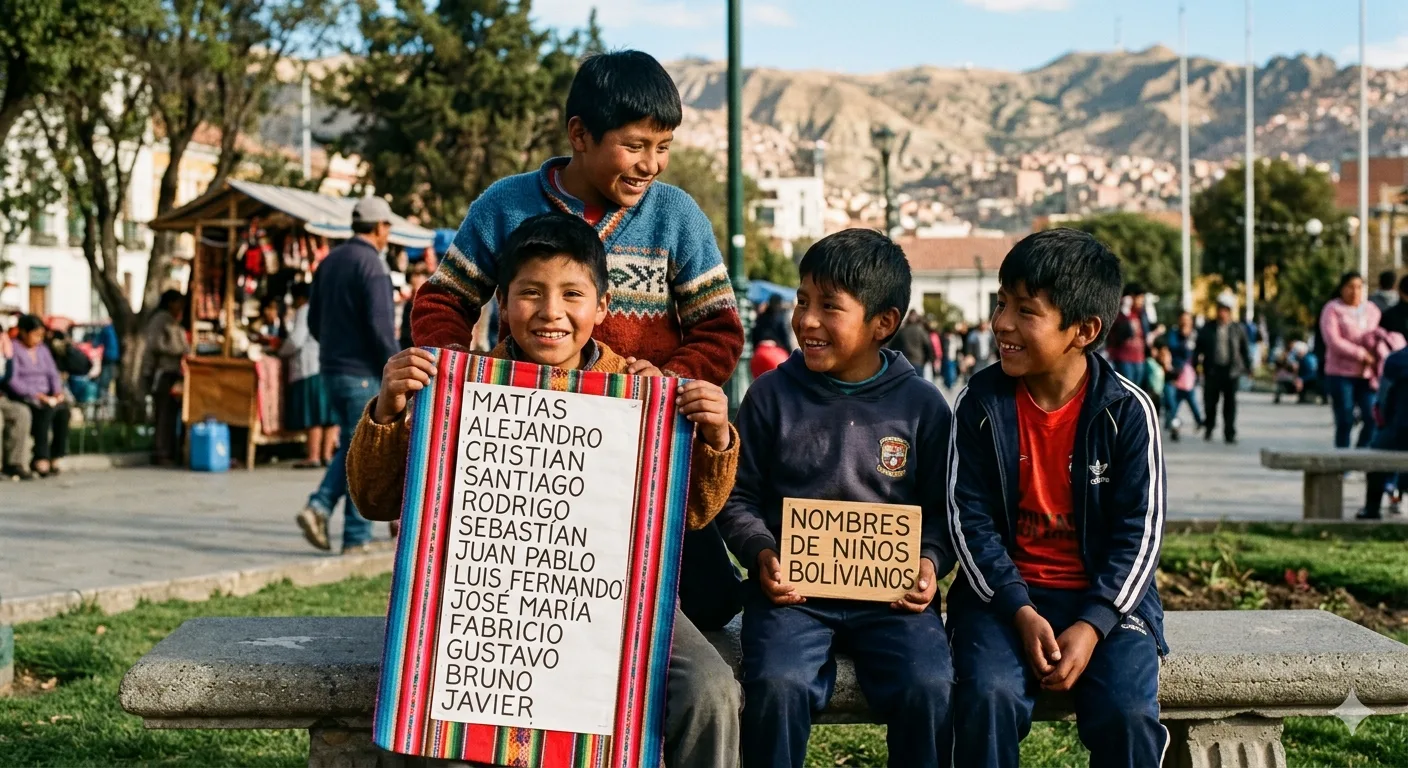
The process of choosing a name for a Bolivian boy reflects the country's unique blend of cultural traditions. Several key factors shape how Bolivian families approach baby naming, and understanding these traditions helps explain why certain names remain popular across generations while others rise and fall with the times.
Catholic Tradition and Religious Influence
For the majority of Bolivians who practice Catholicism, the Catholic calendar of saints plays an important role in naming decisions. Many Bolivian boys are named after the saint whose feast day falls on or near their birthday. This practice, known as the saint's day tradition, explains why names like Santiago, Juan, Miguel, Carlos, and Luis have remained so consistently popular for centuries. In many Bolivian families, a child's saint's day is celebrated with almost as much importance as their actual birthday.
Indigenous Heritage and Cultural Pride
Bolivia is the first country in South America to have enshrined the rights of its Indigenous peoples in a new constitution, which was adopted in 2009 under President Evo Morales. This political recognition of Indigenous culture has had a significant effect on naming practices. In the years since, there has been a meaningful revival of Quechua and Aymara names, particularly in highland regions like La Paz, Oruro, and Potosi. Families who might previously have chosen only Spanish names are now giving their sons traditional Andean names as a declaration of Indigenous pride.
Family Lineage and Generational Naming
In many Bolivian families, naming a son after his paternal grandfather is a deeply respected tradition. This generational naming practice creates a sense of continuity and family honor. It is very common in Bolivia to meet men whose first names are the same as their grandfather's, creating a living link between generations. Uncles, fathers, and respected family elders also frequently pass their names down to the next generation.
Modern Global Influences
Younger Bolivian parents in cities like Santa Cruz de la Sierra, Cochabamba, and La Paz are increasingly influenced by international media, sports stars, musicians, and global naming trends. Names that are popular across Latin America or that carry an international feel are gaining ground rapidly. The influence of Brazilian football, American entertainment, and European fashion has brought names like Thiago, Noah, Axel, and Matias into mainstream Bolivian use.
Read More: Bosnian Boy Name
Latest Naming Trends in Bolivia for 2026
Bolivian naming trends in 2026 reflect a fascinating tension between cultural pride and modern cosmopolitanism. Here is what is shaping the baby naming landscape across Bolivia right now.
The Revival of Indigenous Names
Perhaps the most significant trend in Bolivian baby naming today is the revival of Quechua and Aymara names. Driven by growing Indigenous pride, political recognition, and a broader cultural movement to reclaim pre-colonial identity, names like Tupac, Inti, Wayra, and Kuntur are being heard more often in Bolivian schools and communities than they have been in decades. This is especially visible in highland cities and among young urban professionals who identify strongly with their Andean heritage.
Short and Stylish Names Are Dominant
Across Bolivia, there is a clear preference among younger parents for names of two syllables that are easy to pronounce in both Spanish and Indigenous languages. Names like Ian, Noah, Axel, and Bruno fit this pattern perfectly. The preference for short, punchy names reflects global naming trends that have reached Bolivia through social media and international entertainment.
Blended Heritage Names
An interesting emerging trend is the choice of names that bridge Indigenous and Spanish worlds. Some Bolivian families are creating or reviving names that combine Quechua or Aymara roots with Spanish phonetics, resulting in names that feel both culturally authentic and accessible to a wide audience. This blending reflects the mestizo identity that many Bolivians hold, honoring both sides of their complex cultural heritage.
Football and Sports Culture
Bolivian football has a devoted following, and the names of famous players and sports figures regularly influence baby naming decisions. Brazilian names like Thiago and Neymar-inspired choices have filtered into Bolivia through the massive regional passion for South American football. The popularity of Matias and Axel is also partly driven by the association of these names with successful athletes in the regional sports world.
Names With Positive and Hopeful Meanings
There is a consistent preference among Bolivian parents for names that carry meanings of hope, joy, light, and blessing. Names that translate to golden day, gift of God, joyful, shining, or peaceful are disproportionately popular. This reflects a deeply optimistic spirit in Bolivian naming culture, where parents choose a name as a blessing and a hope for their child's future.
Tips for Choosing the Perfect Stylish Bolivian Name
• Consider the cultural roots of the name. Bolivia's naming landscape spans Spanish Catholic tradition and ancient Indigenous Andean culture. Understanding which tradition a name comes from will help you appreciate its full meaning and significance.
• Look at the meaning carefully. Bolivian names, both Spanish-origin and Indigenous, almost always carry a specific meaning. A name that means sun, gift of God, or free spirit is not just beautiful to say but beautiful in what it represents for your son's life.
• Think about how the name will function in daily Bolivian life as well as in any international context your family might move through. Names like Mateo, Santiago, and Emilio work equally well in Bolivia and abroad.
• Consider family traditions. In Bolivia, generational naming is deeply valued. If there is a beloved grandfather or uncle whose name you could honor, this creates a beautiful thread of continuity through your family's history.
• Say the full name aloud, including the family surname. Bolivian names often sound most beautiful when paired with a strong Spanish or Indigenous surname. The full name should flow naturally when spoken together.
• For Indigenous names, take time to learn the correct pronunciation and the cultural context. Names like Tupac, Kuntur, or Illapa carry deep spiritual significance in Andean culture, and knowing their background will add richness to your choice.
• If you want something rare and unique, explore Quechua and Aymara mythology. Bolivia's Indigenous naming traditions contain some of the most poetic and powerful names in the world, many of which are now extremely rare and waiting to be revived.
Generate More: Boy Names: Boy Names Generator
Conclusion: Celebrating the Beauty of Bolivian Boy Names
Bolivian boy names are among the most diverse, meaningful, and culturally rich in all of Latin America. They carry the stories of the Inca Empire and ancient Andean civilization, the devotion of four centuries of Catholic tradition, and the energy of a modern nation that is proud of every thread of its complex heritage. Whether you choose a beloved classic like Santiago or Miguel, a trending modern name like Matias or Thiago, a majestic Indigenous name like Tupac or Inti, or a rare gem like Kuntur or Illapa, you are giving your son a name rooted in something extraordinary.
Bolivia is a country of remarkable depth. Its naming traditions reflect its mountains, its sky, its faith, its history, and its enduring spirit. A Bolivian boy's name is never just a label. It is a story, a blessing, and a connection to one of the most fascinating cultures our world has produced. As Bolivia continues to evolve and as its Indigenous cultural revival gains strength, the names Bolivian parents choose for their sons will continue to be among the most meaningful and beautiful in the Spanish-speaking world.
We hope this guide to Bolivian boy names has given you inspiration, cultural insight, and perhaps a few names that made your heart beat a little faster. May your son grow up proud of the name and the remarkable nation and heritage it represents.