 Belarusian Boy Name Generator
Discover meaningful Belarusian boy names from Slavic and Eastern European heritage
Guides & Articles
Belarusian Boy Names: A Complete Guide to Stylish, Traditional and Modern Choices
Introduction: The Timeless World of Belarusian Boy Names
Choosing a name for your baby boy is one of the most meaningful decisions any parent will ever make. For Belarusian families, this choice goes far beyond personal preference. It is a bridge between generations, a symbol of cultural belonging, and a quiet declaration of identity. Belarusian boy names are celebrated for their deep Slavic roots, poetic sounds, and the rich meanings they carry. Whether you are searching for a popular Belarusian name, a modern and stylish choice, or a rare and unique gem from traditional Belarusian culture, this guide has everything you need.
Belarus is a landlocked country in Eastern Europe bordered by Russia, Ukraine, Poland, Lithuania, and Latvia. Its history, language, and culture have shaped one of the most distinctive naming traditions in the Slavic world. Belarusian names reflect centuries of Orthodox Christian faith, pagan heritage, Slavic mythology, and a profound love of nature. Today, as interest in Eastern European culture grows worldwide, Belarusian baby names are gaining attention far beyond the borders of the country itself.
This comprehensive article covers popular, unique, stylish, traditional, modern, and rare Belarusian boy names, along with their meanings, cultural context, and the latest naming trends for 2026. Whether you are of Belarusian heritage or simply drawn to the beauty of Eastern European names, this guide will inspire and inform your choice.
Popular Belarusian Boy Names with Meanings
Some Belarusian names have remained consistently beloved for generations because of their strong Slavic sounds and profound meanings. These names feel both familiar within Belarusian communities and appealing to a broader international audience. They represent the heart of Belarusian baby boy names and continue to rank among the most chosen names in the country year after year.
|
Name |
Origin |
Meaning |
|
Aleksandr |
Greek via Slavic |
Defender of men, protector of the people |
|
Dmitry |
Greek via Slavic |
Devoted to Demeter, earth goddess, harvest |
|
Ivan |
Hebrew via Slavic |
God is gracious, a gift of the Lord |
|
Maksim |
Latin via Slavic |
The greatest, the supreme one |
|
Artem |
Greek via Slavic |
Dedicated to Artemis, healthy and safe |
|
Nikita |
Greek via Slavic |
Victor, conqueror, unconquered |
|
Kirill |
Greek |
Master, lord, one who is lordly |
|
Mikhail |
Hebrew via Slavic |
Who is like God, divine strength |
|
Andrei |
Greek via Slavic |
Strong, brave, manly |
|
Sergei |
Latin via Slavic |
Servant, shepherd, caretaker |
|
Vladislav |
Slavic |
Glorious ruler, one who rules with glory |
|
Pavel |
Latin via Slavic |
Small, humble, the apostle Paul |
These popular Belarusian names have defined generations of men across Belarus and the wider Eastern European region. When you choose Ivan, Mikhail, or Aleksandr for your son, you connect him to a deep and proud tradition that stretches back many centuries. Each name carries a distinct virtue that Belarusian families have always held in the highest regard.
Modern and Trending Belarusian Boy Names in 2026
Belarusian parents today are increasingly drawn to names that feel fresh, contemporary, and globally accessible. Modern Belarusian boy names in 2026 tend to be shorter, easier to pronounce across languages, and carry meanings that emphasize positive qualities such as strength, brilliance, leadership, and grace. These trending Belarusian baby names for boys reflect a beautiful blend of cultural pride and forward-looking sensibility.
|
Name |
Pronunciation |
Meaning |
Why Trending |
|
Lev |
Lyev |
Lion, strength, courage |
Short, powerful, globally recognized |
|
Matvei |
Mat-vay |
Gift of God, divine blessing |
Biblical roots, modern Belarusian sound |
|
Timur |
Tee-moor |
Iron, timeless, unbreakable |
Strong and fashionable across Eastern Europe |
|
Egor |
Yeh-gor |
Farmer, earth-worker, grounded |
Stylish variation of George, very popular |
|
Daniil |
Dan-ee-il |
God is my judge, divine justice |
Contemporary spelling, widely trending |
|
Roman |
Ro-man |
Roman, strong like Rome |
International feel, smooth pronunciation |
|
Mark |
Mark |
Warrior of Mars, strong and bold |
Short, clean, internationally friendly |
|
Gleb |
Glyeb |
Heir of God, protected by God |
Distinctly Slavic, rising among young parents |
|
Yaroslav |
Yar-o-slav |
Fierce and glorious |
Ancient but powerfully on trend again |
|
Bohdan |
Boh-dan |
Gift of God, God-given |
Deeply Slavic, uniquely Belarusian |
One of the clearest patterns in modern Belarusian baby name choices is the preference for names with clean sounds, strong meanings, and cross-cultural appeal. Families in the Belarusian diaspora in Germany, Poland, and the United States particularly value names that require minimal adaptation in different linguistic settings while still sounding distinctly Eastern European and proud.
Traditional Belarusian Boy Names Rooted in History
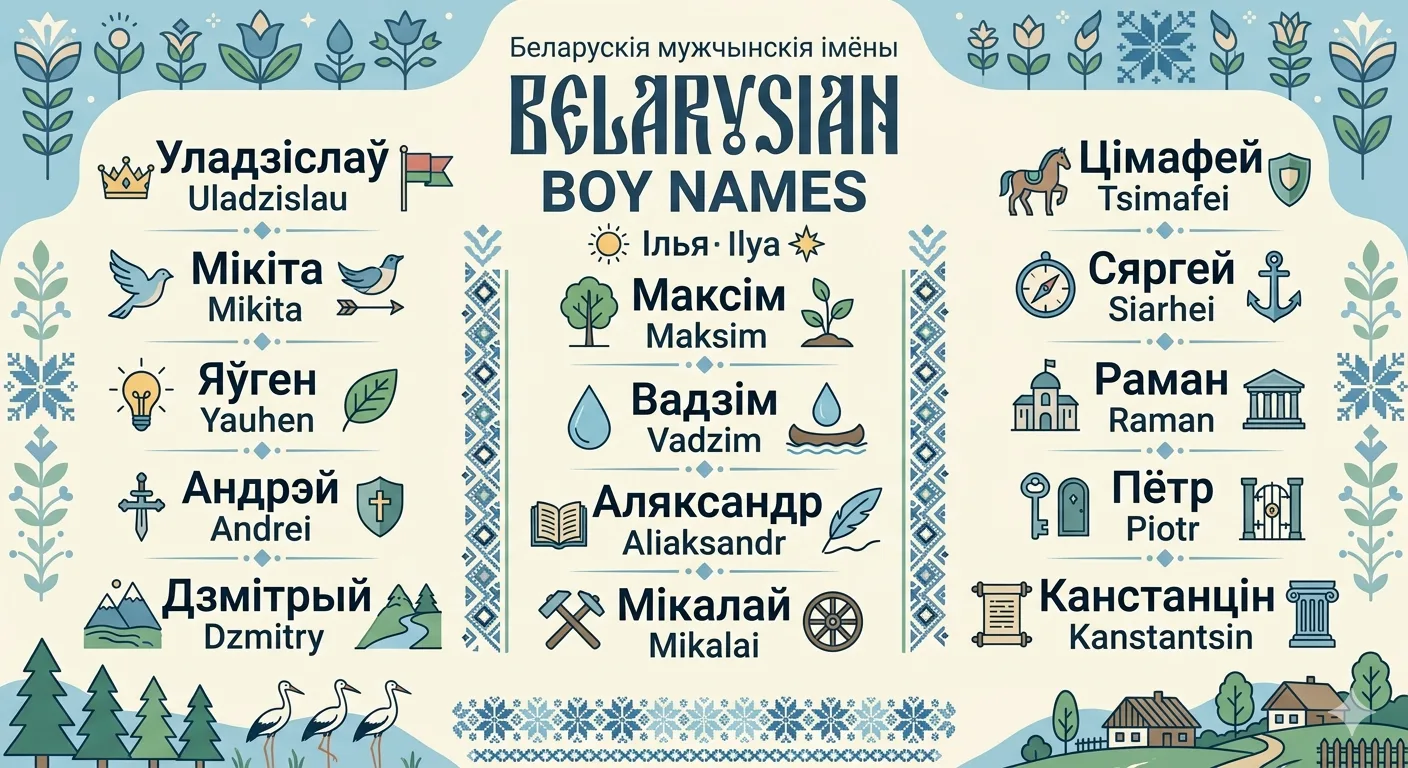
Traditional Belarusian names often trace their origins to Old Slavic roots, Orthodox Christian saints, and the ancient pagan heritage that predates Christianity in the region. These names carry the weight of history and are considered deeply honorable by many families across Belarus. Choosing a traditional Belarusian boy name is a way of honoring the country's rich past while giving your son a name with genuine cultural depth and meaning.
|
Name |
Meaning |
Cultural Significance |
|
Vyacheslav |
More glorious, ever greater in glory |
Old Slavic prince names, deep national history |
|
Stanislav |
One who achieves glory, stand in glory |
Royal Slavic name used across centuries of Belarusian nobility |
|
Bronislav |
Glorious armor, protector of glory |
Warrior name rooted in ancient Slavic tribal culture |
|
Miroslav |
Peace and glory combined |
Reflects the Belarusian ideal of harmonious strength |
|
Svyatoslav |
Holy and glorious, sacred fame |
Name of Slavic warriors and princes of early medieval history |
|
Borislav |
Fighter for glory, battle-glory |
Old Slavic hero name, deeply traditional and rare today |
|
Radoslav |
Happy and glorious, joyful fame |
Name rooted in Slavic values of joy and honor together |
|
Vsevolod |
Ruler of everything, all-powerful lord |
Ancient princely name from early East Slavic tradition |
|
Lyubomyr |
Loves peace, peaceful and loving |
Reflects Belarusian cultural values of peace and warmth |
|
Dobrynya |
Good, kind, virtuous by nature |
Legendary name from East Slavic folklore and mythology |
Names like Svyatoslav, Stanislav, and Vyacheslav carry royal connotations and are closely associated with great Slavic princes and rulers from early Belarusian and Kievan Rus history. Choosing one of these traditional names is a proud statement of heritage, cultural depth, and historical awareness.
Rare and Unique Belarusian Boy Names That Stand Out
For parents looking for something truly one of a kind, Belarusian language and culture offer a remarkable collection of rare and uncommon names. These unique Belarusian boy names are perfect for families who want their child to have a name that feels genuinely special, deeply meaningful, and unlikely to be shared with many others. These rare Belarusian baby names combine linguistic beauty with cultural significance.
|
Name |
Rarity |
Meaning and Significance |
|
Zmicer |
Very rare |
Belarusian form of Dmitry, uniquely tied to national Belarusian language identity |
|
Ales |
Rare |
Belarusian form of Aleksei or Alexander, carries the native language with pride |
|
Mikhas |
Rare |
Belarusian form of Mikhail, used by those who prefer the authentic native version |
|
Vasil |
Uncommon |
Belarusian form of Vasily meaning royal, kingly; gentle but powerful |
|
Syarhei |
Rare |
Belarusian spelling of Sergei, representing cultural authenticity and pride |
|
Radzim |
Very rare |
Legendary name from Slavic mythology, one who belongs to the homeland |
|
Lyavon |
Rare |
Belarusian form of Leon or Leonid, meaning lion, used by cultural preservationists |
|
Pilip |
Very rare |
Belarusian form of Philip meaning lover of horses, deeply native and uncommon |
|
Kastus |
Rare |
Belarusian form of Konstantin, associated with Kastus Kalinovsky, national hero |
|
Yazep |
Very rare |
Belarusian form of Joseph, used exclusively in native Belarusian-speaking families |
The trend of choosing authentic Belarusian language forms of names rather than their Russian equivalents is growing significantly among culturally conscious Belarusian families. Names like Zmicer, Ales, and Kastus are not just names but quiet acts of cultural preservation and national identity affirmation in a country navigating a complex relationship with its own linguistic heritage.
Belarusian Boy Names Inspired by Nature and the Homeland
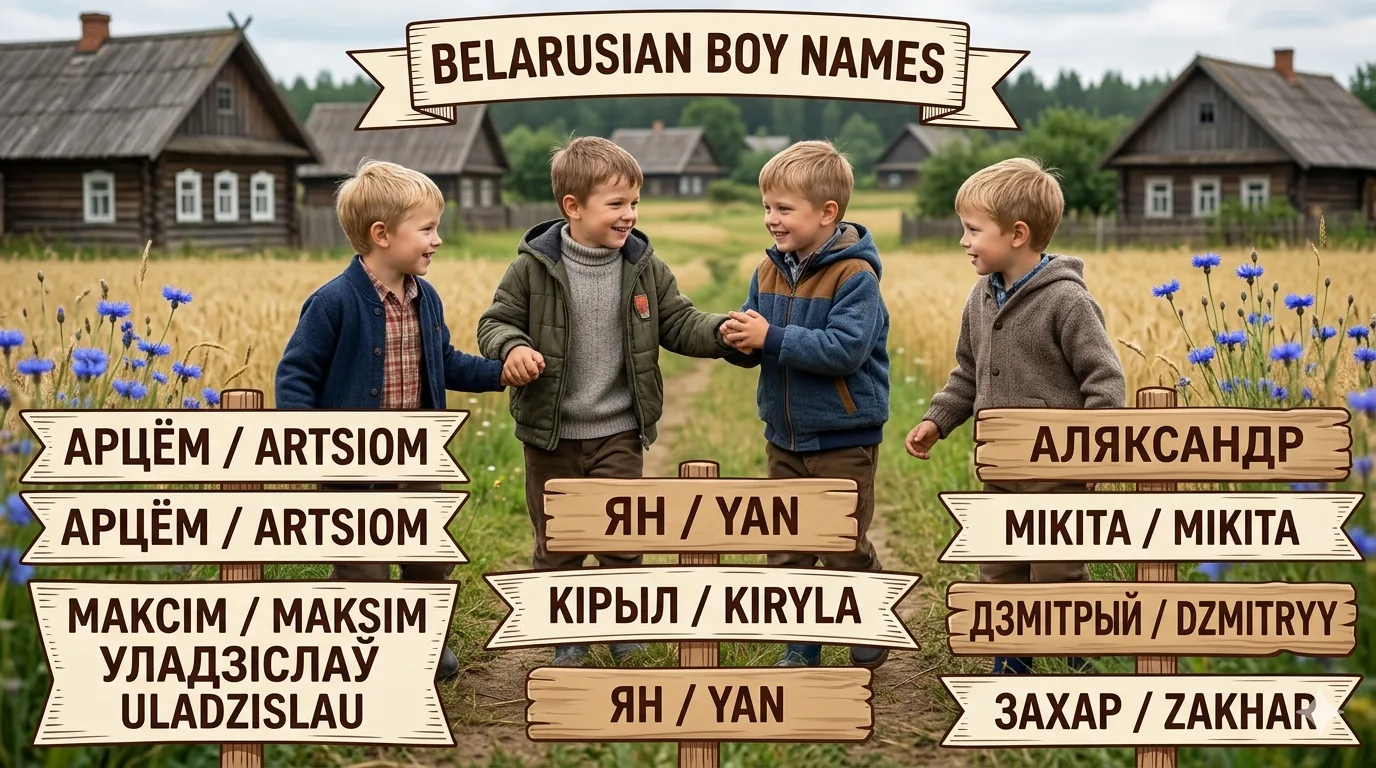
The Belarusian landscape is defined by vast forests, gentle rivers, wide plains, and a sky that stretches to the horizon. This deep connection to the natural world finds its way beautifully into Belarusian naming traditions. Nature-inspired Belarusian boy names carry a poetic, earthy quality that many modern parents find both grounding and deeply meaningful. These names connect a child to the land, seasons, and living world around him.
|
Name |
Nature Element |
Symbolic Meaning |
|
Yaraslau |
Spring sun and glory |
The fierce brightness of early spring light |
|
Zoryan |
Star, celestial light |
Guided by stars, a beacon of brightness |
|
Bor |
Pine forest, woodland |
Strength and permanence of ancient Belarusian forests |
|
Lyasny |
Forest dweller |
Born of the woods, connected to deep Slavic nature spirits |
|
Slavomir |
Peaceful glory of nature |
Harmony between strength and natural tranquility |
|
Volat |
Giant of nature, forest giant |
Legendary Belarusian folklore creature of great power |
|
Dubrouka |
Oak grove, sacred grove |
Named after a legendary Belarusian forest settlement |
|
Zoran |
Dawn, morning light |
The first light of a new day, hope and fresh beginnings |
Nature names are particularly meaningful among Belarusian families who feel a strong connection to their homeland and its natural beauty. Belarus is known as the lungs of Europe for its extraordinary forest cover, and names that reference trees, light, water, and the earth honor this deep relationship between the Belarusian people and their land.
How Names Are Chosen in Belarusian Culture
The process of naming a child in Belarus is a meaningful and often collective experience, shaped by family tradition, faith, history, and cultural values. Understanding how Belarusian families approach the naming process helps explain why certain names endure across centuries while others rise and fall with changing times.
Family and Generational Legacy: In many Belarusian families, it is common to honor a grandfather or deceased relative by naming a newborn after them. This practice creates a living link between generations and keeps the memory of loved ones alive through the child's identity.
Orthodox Christian Influence: The majority of Belarusian families belong to the Eastern Orthodox Christian tradition, and saint names have long been central to the naming culture. Names like Mikhail, Pavel, Ivan, and Andrei come directly from the Orthodox Christian calendar of saints and carry deep spiritual significance.
National and Historical Pride: Belarus has a proud if complex national history, and names associated with Belarusian historical heroes and cultural figures carry particular weight. Kastus, for example, honors Kastus Kalinovsky, a beloved nineteenth century national hero who fought for Belarusian identity and freedom.
The Belarusian Language Movement: In recent years, there has been a growing cultural movement to use authentic Belarusian language forms of names rather than their Russian equivalents. This reflects a broader effort to protect and celebrate the Belarusian language, which has been under pressure for much of the twentieth and twenty-first century.
Modern Global Influence: Younger Belarusian parents are also influenced by international media, sports, literature, and global culture. Names that sound strong and stylish in both Belarusian and European contexts are increasingly popular among urban families.
Read More: Belgian Boy Names
Latest Naming Trends Among Belarusian Families in 2026
Belarusian naming trends in 2026 reflect a fascinating and sometimes surprising mix of cultural revival, international awareness, and a return to Slavic roots. Here is a detailed look at what is currently shaping the naming landscape for Belarusian baby boys.
Return to Native Belarusian Forms: One of the most significant trends of recent years is the growing preference for authentic Belarusian language versions of names. Ales instead of Aleksei, Mikhas instead of Mikhail, and Zmicer instead of Dmitry are being chosen by families who want to make a statement about their cultural identity through their child's name.
Short and Strong Names Are Winning: One and two syllable names like Lev, Mark, Gleb, and Egor are dominating the modern Belarusian naming landscape. Parents love names that are easy to pronounce, remember, and carry across languages without losing their essence.
Revival of Ancient Slavic Names: Old Slavic compound names like Yaroslav, Miroslav, and Stanislav are being rediscovered by Belarusian millennials and Gen Z parents who want to reconnect with their pre-Soviet, pre-Christian Slavic heritage. These names feel simultaneously ancient and refreshingly distinctive.
Names That Work Internationally: With growing Belarusian communities in Poland, Germany, Lithuania, and beyond, there is increasing demand for names that work seamlessly across European languages. Roman, Mark, and Artem check this box perfectly.
Folklore and Mythology Names: Names drawn from East Slavic folklore such as Dobrynya and Volat are attracting attention from parents who want something genuinely unique and deeply rooted in the mythological imagination of their ancestors.
Faith-Inspired and Meaningful Choices: There remains a strong current of religious naming in Belarusian culture, with Orthodox saint names continuing to hold steady popularity. Names with clear spiritual meanings like Bohdan and Daniil are consistently loved for their faith-centered symbolism.
Understanding the Difference Between Belarusian and Russian Names
Many people unfamiliar with Eastern European naming traditions assume Belarusian and Russian names are identical. In reality, there are meaningful differences that reflect the distinct linguistic and cultural identity of Belarus.
The Belarusian language, while related to Russian, has its own phonology, grammar, and vocabulary. This means that many names have uniquely Belarusian forms that differ in sound and spelling from their Russian equivalents. For example, the Russian name Mikhail becomes Mikhas or Mikhail in Belarusian. Dmitry becomes Zmicer. Aleksei becomes Ales. These are not simply different spellings but different linguistic expressions of cultural identity.
Choosing the authentic Belarusian form of a name is increasingly seen as an act of cultural pride and linguistic preservation. As Belarus continues to navigate questions of national identity, language, and sovereignty, the choice of a name can carry quiet but profound meaning for a family.
Tips for Choosing the Perfect Stylish Belarusian Boy Name
• Consider the meaning first. Belarusian names almost always carry a beautiful and specific meaning, and knowing what a name means will deepen your connection to it and help your child understand their own identity.
• Think about how the name sounds in both Belarusian and any other language your family uses daily. A name that works smoothly in multiple linguistic contexts is a great practical choice for diaspora families.
• Check family naming traditions. In many Belarusian families, naming patterns are cherished across generations. Honoring a grandparent's name can create a beautiful and meaningful thread connecting your child to family history.
• Consider whether you want the authentic Belarusian language form or the more internationally recognized version. Both are valid choices but carry different cultural messages and identities.
• Avoid overly complicated spellings that might cause your child difficulties on official documents in different countries, especially if your family lives abroad.
• Say the full name out loud several times including the family surname to ensure the combination sounds harmonious, balanced, and pleasing to the ear.
• Look for a name with personal resonance, whether it connects to Belarusian history, reflects a virtue you admire, honors a family member, or simply carries a sound and meaning that feels right.
• Research the saint's name day associated with your chosen name if your family follows Orthodox Christian traditions, as this can add another layer of significance and celebration throughout your child's life.
Generate More Boy Names: Boy Names Genetator
Conclusion: Celebrating the Beauty of Belarusian Boy Names
Belarusian boy names are among the most distinctive, meaningful, and beautifully crafted in the Slavic world. They carry the stories of an ancient people, the spirituality of the Orthodox Christian tradition, the quiet resistance of a language that has survived tremendous pressure, and the poetic beauty of a land defined by its forests, rivers, and wide open skies.
Whether you choose a popular name like Ivan or Maksim, a traditional powerhouse like Stanislav or Yaroslav, a rare and culturally proud choice like Ales or Zmicer, or a modern favorite like Lev or Daniil, you are giving your son a name rooted in something genuinely extraordinary. Each Belarusian name carries within it a history, a landscape, a faith, and a culture that is entirely its own.
The beauty of Belarusian naming culture is that it continues to evolve while remaining anchored to its deep Slavic roots. As Belarusian communities grow and thrive both at home and across the world, these names travel with them, carrying language, identity, and pride to every corner of the globe.
We hope this comprehensive guide to Belarusian boy names has given you inspiration, insight, and perhaps a few names to fall deeply in love with. May your son grow up proud of his name, proud of his heritage, and proud of the remarkable culture that gave that name its beauty and meaning.