 Austrian Boy Name Generator
Discover meaningful Austrian boy names from Alpine Central European heritage
Guides & Articles
Austrian Boy Names Popular, Modern, Traditional, Unique and Trending Names with Meanings
The Timeless Appeal of Austrian Boy Names in 2026
Austria is a nation that wears its cultural richness like a crown. Nestled in the heart of Central Europe and bordered by eight countries, Austria has long been a crossroads of languages, traditions, and histories. This geographic and cultural position has shaped one of the most elegant and diverse naming traditions on the continent. Austrian boy names in 2026 carry the weight of an imperial past, the warmth of Alpine village life, the spiritual depth of Catholic tradition, and the clean sophistication of a modern European nation that remains deeply proud of its roots.
The German language forms the foundation of Austrian naming culture, but Austrian names are never simply German names in disguise. The Austrian character, shaped by centuries of Habsburg rule, by the music of Mozart and Schubert, by the coffeehouse philosophy of Vienna, and by the folk traditions of Tyrol, Salzburg, and Styria, gives its names a distinct flavor that sets them apart. An Austrian boy name carries elegance without arrogance, strength without harshness, and tradition without stiffness.
In 2026, Austrian parents are making naming decisions that reflect both a deep respect for heritage and a sophisticated awareness of contemporary European trends. The revival of classical names alongside the rise of minimalist modern choices creates a naming landscape that is genuinely exciting to explore. Whether you are searching for popular Austrian baby names, rare and unique Austrian names, traditional names rooted in German and Catholic heritage, or modern stylish names that feel current and cosmopolitan, this complete guide covers every dimension of naming for boys in Austria today.
Understanding Austrian boy names is also an entry point into Austrian identity itself. A name is never just a sound. In Austria, it is a small act of cultural belonging, a nod to a saint, an ancestor, a valley, a musical tradition, or a centuries-long conversation between past and present. This guide will help you find the Austrian boy name that speaks most clearly to the qualities and connections you want your son to carry through his life.
Popular Austrian Boy Names That Have Stood the Test of Time
Popular Austrian boy names earn their place through cultural staying power rather than fleeting fashion. These are the names heard in school classrooms across Vienna, in the Alpine villages of Vorarlberg, and in the baroque squares of Salzburg and Graz. They are rooted in German linguistic heritage, Catholic saint tradition, and the enduring influence of the Habsburg dynasty that once made Vienna the capital of a great empire. These names are beloved because they carry sound, meaning, and history in equal measure.
|
Name |
Origin |
Meaning |
|
Lukas |
Latin/German |
Bringer of light; the illuminating one |
|
Maximilian |
Latin/German |
The greatest; one who excels above all |
|
Florian |
Latin/German |
Flowering; prosperous and flourishing |
|
Sebastian |
Greek/German |
Venerable; worthy of great reverence |
|
Tobias |
Hebrew/German |
God is good; the divine is my treasure |
|
Fabian |
Latin/German |
Bean grower; one who cultivates life |
|
Felix |
Latin |
Happy, fortunate, and blessed |
|
Matthias |
Hebrew/German |
Gift of God; divinely bestowed |
|
Dominik |
Latin/German |
Belonging to the Lord; devoted soul |
|
Stefan |
Greek/German |
Crown; garland of victory |
|
Andreas |
Greek/German |
Strong and manly; courageous by nature |
|
Christoph |
Greek/German |
Bearer of Christ; one who carries the divine |
|
Michael |
Hebrew/German |
Who is like God; incomparable strength |
|
Johannes |
Hebrew/German |
God is gracious; the Lord has shown favor |
|
Alexander |
Greek/German |
Defender of mankind; protector of all |
These names represent the soul of Austrian naming tradition. When a family in Innsbruck names their son Florian or when a Viennese family chooses Maximilian, they are connecting their child to centuries of Austrian cultural identity. Florian, for example, is the patron saint of Upper Austria and of fire brigades across the country, making his name one of the most culturally rooted choices an Austrian family can make. Maximilian carries the legacy of the great Habsburg emperor who shaped the Golden Age of Austria. These names are popular because they deserve to be.
Modern and Stylish Austrian Boy Names Trending in 2026
The modern Austrian parent navigates a world of choices that would have astonished previous generations. Thanks to greater access to international naming trends, a more mobile population, and a cultural openness shaped by Austria's membership in the European Union, the landscape of modern Austrian boy names is more diverse and exciting than ever. The stylish Austrian baby names gaining momentum in 2026 tend to be shorter, phonetically clean, meaningful, and able to cross language borders with ease.
|
Name |
Pronunciation |
Meaning |
Why Trending |
|
Luca |
Loo-kah |
Bringer of light |
Cross-European appeal, warm and modern |
|
Leon |
Leh-on |
Lion; brave and regal |
Strong meaning, clean sound, rising fast |
|
Elias |
Eh-lee-as |
My God is the Lord |
Biblical depth with modern Austrian feel |
|
Noah |
No-ah |
Rest and comfort; peace |
Globally loved, elegantly simple |
|
Emil |
Eh-mil |
Industrious; striving forward |
Short, classic, very Austrian heritage |
|
Ben |
Ben |
Son; a blessing |
Minimal and strong, growing quickly |
|
Finn |
Fin |
Fair; bright and white |
Nordic freshness, popular in Alpine regions |
|
Jonas |
Yo-nas |
Dove; bringer of peace |
Biblical and beautiful, consistently loved |
|
Paul |
Powl |
Small; humble and great |
Classic simplicity, timeless energy |
|
Oskar |
Os-kar |
Divine spear; champion |
Strong Austrian heritage, stylishly vintage |
The clearest pattern among modern Austrian baby names in 2026 is the preference for names that are short, open-ended, and easy to pronounce across German, English, and other European languages. Austrian families live in an increasingly interconnected world where their children may study in London, work in Zurich, or travel regularly across Europe. A name that works effortlessly across borders is not just stylish but practical. Names like Luca, Leon, and Emil achieve this beautifully, carrying Austrian elegance without the regional specificity that might make them harder to use internationally.
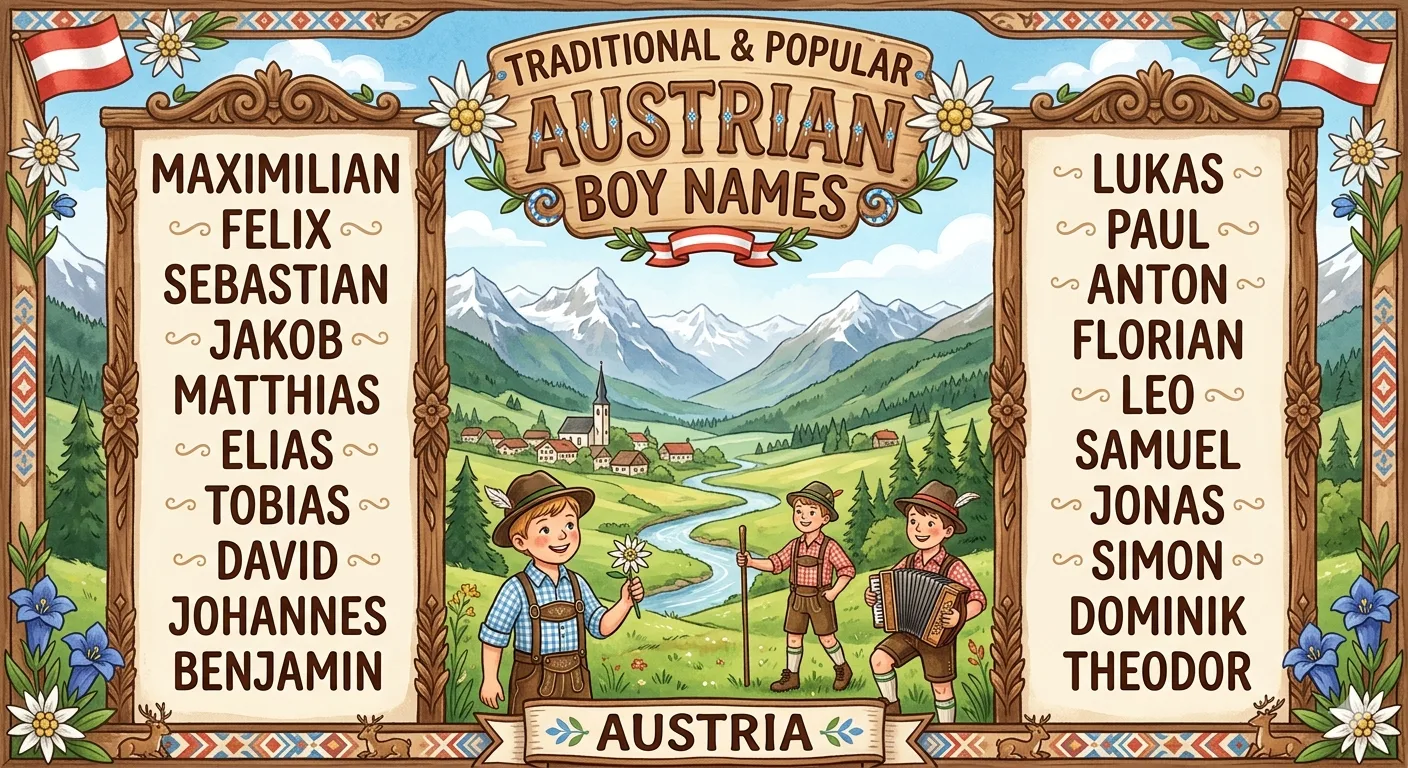
Traditional Austrian Boy Names Rooted in History and Heritage
Austria has one of the richest traditions of historical naming in Europe. The Habsburg dynasty, which ruled the Austrian Empire for over six centuries, left a profound imprint on Austrian naming culture. Emperors, archdukes, saints, composers, and alpine folk heroes all contributed names to the Austrian pool that carry tremendous cultural significance to this day. Traditional Austrian names are not simply old names. They are living connections to a history that Austrians genuinely cherish and take pride in.
Names of the Habsburg Legacy
The Habsburg dynasty produced some of the most powerful rulers in European history, and their names have filtered deeply into Austrian consciousness. These names carry imperial dignity, historical weight, and an unmistakably Austrian character that no other naming tradition can replicate.
|
Name |
Meaning |
Historical Significance |
|
Friedrich |
Peaceful ruler; defender of peace |
Name of many Habsburg emperors and archduke figures |
|
Leopold |
Bold people; brave leader of the nation |
Patron saint of Austria; deeply embedded in Habsburg history |
|
Rudolf |
Famous wolf; legendary protector |
Name of Rudolf I, founder of the Habsburg dynasty |
|
Karl |
Free man; strong and manly |
Name of Emperor Karl I, last ruler of Austria-Hungary |
|
Franz |
Free man; one who belongs to all |
Name of Emperor Franz Joseph, the great Austrian sovereign |
|
Otto |
Wealth and fortune; noble power |
Beloved Habsburg name; name of Archduke Otto von Habsburg |
|
Ernst |
Serious, earnest; one of great sincerity |
Classic Habsburg name of dignity and depth |
|
Heinrich |
Ruler of the home; home king |
Ancient Germanic name long favored by Austrian nobility |
Names of Austrian Saints and Catholic Tradition
Roman Catholicism is woven into the fabric of Austrian culture, and the feast days of saints continue to influence naming choices across the country. Austria celebrates saint name days with the same warmth as birthdays in many traditional families, and this living connection to the liturgical calendar has kept saint names vital and relevant across generations.
|
Name |
Meaning |
Religious Significance |
|
Rupert |
Bright fame; shining reputation |
Patron saint of Salzburg; enormously important in Austrian Catholicism |
|
Wolfgang |
Traveling wolf; bold wanderer |
Patron saint of Regensburg; beloved across Austria |
|
Virgil |
Staff bearer; one who guides |
Irish-born saint revered as Bishop of Salzburg |
|
Markus |
Of Mars; dedicated warrior |
Apostle and evangelist; feast day celebrated across Austria |
|
Georg |
Farmer; one who works the earth |
Patron saint of many Alpine communities |
|
Nikolaus |
Victory of the people; champion |
Beloved saint; St Nicholas tradition central to Austrian culture |
|
Benedikt |
Blessed; one upon whom God has smiled |
Founder of Western monasticism; deeply loved in Austria |
|
Augustin |
Great and venerable; magnificent |
Dear Augustin of Viennese folklore fame; beloved cultural figure |
Rare and Unique Austrian Boy Names Worth Discovering
As many popular names become increasingly common across Central Europe, a growing number of Austrian families are diving deeper into their naming heritage to find truly distinctive choices. Rare Austrian boy names draw from medieval German linguistic roots, Alpine folk traditions, forgotten saints of the Germanic church, and the vast archives of Habsburg-era baptismal records. These names are often more beautiful and meaningful than their popular counterparts and simply await rediscovery.
|
Name |
Rarity |
Meaning and Significance |
|
Liutpold |
Very Rare |
People's power; ancient form of Leopold with remarkable historical depth |
|
Hadmar |
Very Rare |
Strife famous; ancient Austrian noble name from the Kuenring dynasty |
|
Eberhard |
Rare |
Brave as a boar; strong and courageous protector of the forest |
|
Gottfried |
Uncommon |
God's peace; one who brings divine tranquility and harmony |
|
Walther |
Rare |
Ruler of the army; powerful leader and guardian of his people |
|
Anselm |
Rare |
Helmet of God; divinely protected warrior of great courage |
|
Berthold |
Rare |
Bright ruler; one who governs with intelligence and luminous wisdom |
|
Dietmar |
Very Rare |
Famous among the people; celebrated by all who know him |
|
Gebhard |
Very Rare |
Generous gift; one who gives freely and with an open heart |
|
Hartmann |
Rare |
Hard man; one of enduring strength and steadfast character |
|
Konrad |
Uncommon |
Bold counsel; brave advisor who speaks truth with confidence |
|
Siegbert |
Very Rare |
Bright victory; one whose triumphs shine brilliantly for all to see |
Choosing a rare Austrian name for your son gives him a genuinely unique identity while honoring the deepest layers of Germanic and Austrian heritage. Names like Gottfried and Walther carry the poetry of medieval German literature. Names like Hadmar and Liutpold connect a child directly to the ancient noble families who shaped the Austrian landscape before the Habsburgs rose to prominence. These names are waiting to be rediscovered by families who value depth and distinction over familiarity.
Baby Naming Ideas for Austrian Boys Across Every Theme
Austria offers an unusually rich pool of naming inspiration because it sits at the intersection of so many great cultural traditions. Germanic, Alpine, Catholic, imperial, musical, and folk influences all converge in the Austrian naming landscape. Here are thoughtfully organized baby name ideas drawn from different aspects of Austrian heritage and culture.
Music-Inspired Austrian Boy Names
Austria is the birthplace of some of the greatest composers in human history. Vienna's musical tradition, from the Classical to the Romantic era, has given the world names that carry both cultural prestige and beautiful sound. Honoring this heritage through a name is one of the most distinctly Austrian choices a family can make.
|
Name |
Musical Connection |
Meaning |
|
Wolfgang |
Wolfgang Amadeus Mozart, Austria's greatest composer |
Traveling wolf; bold wanderer through the world |
|
Franz |
Franz Schubert, master of the Lied and romantic melody |
Free man; one who belongs to no borders |
|
Gustav |
Gustav Mahler, symphonic genius of Vienna's golden age |
Staff of the gods; divine support and guidance |
|
Anton |
Anton Bruckner, Austria's cathedral in sound |
Praiseworthy; priceless and worthy of all honor |
|
Joseph |
Joseph Haydn, father of the symphony and string quartet |
God will increase; abundance and divine blessing |
|
Johann |
Johann Strauss, king of the Viennese waltz tradition |
God is gracious; the Lord has shown great favor |
Alpine and Nature-Inspired Austrian Boy Names
The dramatic Alpine landscape of Austria, with its towering peaks, deep valleys, turquoise lakes, and ancient forests, has inspired a tradition of names that reflect the natural world. These names carry a fresh, grounded quality that feels both timeless and deeply Austrian.
|
Name |
Meaning |
Natural Connection |
|
Berg |
Mountain; the great elevation |
The towering Alps that define Austrian identity |
|
Forst |
Forest; ancient woodland guardian |
The dense pine forests of Styria and Carinthia |
|
Stein |
Stone; solid and enduring |
The granite peaks and limestone cliffs of the Austrian Alps |
|
Lenz |
Spring; season of renewal and light |
The Alpine spring that transforms the mountain valleys |
|
Silvan |
Of the forest; woodland spirit |
The forested slopes that surround every Austrian valley |
|
Valentin |
Strong and healthy; full of vitality |
The robust health that the Alpine air and life inspire |
Short and Powerful Austrian Boy Names
Short names have a particular strength in German, and many of the most stylish modern Austrian baby names are those that deliver great meaning in just a few letters. These concise names are easy to call, memorable, and carry confident energy well suited to a boy growing into his own identity.
|
Name |
Letters |
Meaning |
|
Ben |
3 |
Son; blessed offspring; divine gift |
|
Leo |
3 |
Lion; courageous and regal in spirit |
|
Ivo |
3 |
Yew wood; strength, longevity, and nature |
|
Til |
3 |
People's power; strong among his community |
|
Jan |
3 |
God is gracious; simple and deeply meaningful |
|
Paul |
4 |
Small and humble; the great in a modest form |
|
Emil |
4 |
Industrious; one who always strives forward |
|
Kurt |
4 |
Bold counsel; brave and honest advisor |
|
Bert |
4 |
Bright; radiant and distinguished by nature |
Latest Naming Trends for Austrian Boys in 2026
Austrian baby naming trends in 2026 reflect the country's unique position as a Central European nation with a profoundly rich imperial heritage and a thoroughly modern, globally connected identity. Several distinct currents define how Austrian families are naming their sons today, and understanding these trends reveals as much about Austria's cultural moment as it does about the individual names themselves.
Reaed More: Azerbaijan Boy Names
The Grand Revival of Habsburg Era Names
Perhaps the most distinctive trend in Austrian baby naming right now is the revival of names associated with the Habsburg dynasty and its imperial legacy. Names like Franz, Rudolf, Leopold, Karl, and Otto, which might have seemed overly formal or old-fashioned just a generation ago, are experiencing a genuine and enthusiastic comeback. Young Austrian parents are rediscovering these names as expressions of cultural pride and historical identity rather than dusty relics. This is partly driven by a broader European trend toward vintage names, but in Austria it carries a specifically national dimension that makes it particularly meaningful.
Minimalist Names with Maximum Impact
Across Austria, parents are gravitating toward names that are short, phonetically clean, and uncluttered by elaborate spelling or pronunciation requirements. Names like Leon, Emil, Ben, Paul, and Finn are thriving because they feel simultaneously modern and timeless. In a world of growing complexity, the quiet confidence of a short, well-chosen name resonates deeply with contemporary Austrian parents who want something elegant rather than showy.
International Names Find a Home in Austria
Austria's position at the heart of Europe, its thriving tourism industry, and the presence of many international families and diplomats in Vienna have made the Austrian naming landscape more internationally diverse than ever before. Names like Luca, Noah, Elias, and Jonas work beautifully in German while also being recognized across dozens of other languages. These names appeal to Austrian families who want a name with European breadth while still feeling right at home in a Viennese kindergarten.
Musical and Cultural Heritage Names
A small but growing movement among Austria's most culturally engaged families involves choosing names that honor Austria's extraordinary musical and artistic heritage. Wolfgang, after Mozart, Gustav after Mahler, Franz after Schubert, and even less obvious choices like Anton after Bruckner are appearing with new frequency among families who feel strongly about this dimension of Austrian identity. These names carry a cultural prestige that is uniquely Austrian.
|
Name |
Trend Status |
Meaning |
|
Leon |
Top Rising Name 2026 |
Lion; brave and regal |
|
Elias |
Consistently Top 5 |
My God is the Lord |
|
Lukas |
Stable Long-Term Favorite |
Bringer of light |
|
Leopold |
Habsburg Revival |
Bold leader of the people |
|
Emil |
Vintage Comeback |
Industrious and striving |
|
Noah |
International Favorite |
Rest and comfort; peace |
|
Florian |
Cultural Pride Pick |
Flowering and flourishing |
|
Oskar |
Stylishly Vintage |
Divine spear; champion |
|
Finn |
Nordic Influence Rising |
Fair, bright, and clear |
|
Wolfgang |
Musical Heritage Choice |
Traveling wolf; bold wanderer |
How Austrian Families Choose a Name for Their Son
The process of naming a child in Austria blends several centuries of tradition with the very contemporary influences of a modern European society. Understanding how Austrian names are chosen illuminates why certain names carry such enduring power and why the Austrian naming tradition remains one of the most coherent and meaningful in Europe.
The Role of Catholic Baptism and Saint Name Days
Austria is a predominantly Roman Catholic nation, and baptism has historically played the central role in formally naming a child. Many Austrian families, particularly those with strong regional and rural roots, still maintain the tradition of choosing a name connected to the feast day of a saint near the date of the child's birth. The feast of Saint Florian on May 4th, Saint Leopold on November 15th, and Saint Rupert on September 24th are among the many days that have traditionally influenced Austrian naming choices. This connection between name and liturgical calendar gives Austrian names a sacred and communal quality that goes beyond individual preference.
Family Continuity and Ancestral Names
Like most Central European cultures, Austrian families place enormous value on naming traditions within the family. Naming a son after his paternal grandfather, his godfather, or a beloved great-uncle is a common and deeply meaningful practice that creates continuity across generations. In the village communities of Tyrol, Salzburg, and Burgenland, these family naming traditions have sometimes persisted for six or seven generations, creating a thread of identity that ties living children directly to their ancestors.
Regional Identity and the Austrian Provinces
Austria is a federal republic of nine distinct provinces, each with its own cultural character, dialect tradition, and regional identity. A family from Tyrol may favor different names than a family from Burgenland or Vienna. Tyrolean families often favor names with Alpine folk resonance, while Viennese families may lean toward the more cosmopolitan and imperial end of the Austrian naming tradition. This regional diversity enriches the overall Austrian naming landscape enormously and means that popular Austrian boy names can vary noticeably from one part of the country to another.
Modern Parents and the European Naming Landscape
Today's Austrian parents are more connected than ever to the broader European naming conversation through social media, parenting websites, streaming culture, and the simple experience of traveling and working across EU borders. This connectivity means that naming trends from neighboring Germany, Switzerland, Italy, and further afield influence Austrian choices in real time. The result is a naming culture that remains distinctly Austrian in its preferences while absorbing the best of what contemporary European naming has to offer.
Cultural and Religious Influences on Austrian Boy Names
Austria's naming culture is shaped by a constellation of forces that have operated for over a thousand years and continue to influence parents today. The Roman Catholic Church, the Habsburg dynasty, the German language and its medieval literary tradition, the distinct Alpine folk cultures of the various provinces, and Austria's centuries-long position as a meeting point of Germanic, Slavic, Hungarian, and Italian influences have all contributed to one of the most layered naming traditions in Europe.
The Catholic Church has been the single most powerful force in Austrian naming history. For centuries, Austrian law required that children receive the name of a saint at baptism, and this practice shaped the entire naming vocabulary available to Austrian families. Even today, when these formal religious requirements no longer apply, the weight of Catholic tradition remains strong in Austrian naming choices. Saints like Florian, Rupert, Wolfgang, and Leopold are not merely religious figures but genuinely beloved Austrian cultural icons whose names carry enormous national as well as spiritual significance.
The Habsburg dynasty added a specifically imperial layer to Austrian naming culture that no other European nation shares in quite the same way. Names like Franz, Rudolf, Karl, Leopold, and Otto carry not just family history but the weight of an entire civilization that once stretched from Madrid to Budapest. Austrians who choose these names are not merely honoring family ancestors but participating in a conversation with one of the great dynastic traditions of European history.
The German language itself contributes a phonetic and semantic richness to Austrian naming that is unique. German names tend to carry strong, clear meanings rooted in nature, warfare, nobility, and Christian virtue, and these meanings are deeply understood by Austrian families in a way that makes the choice of a name feel genuinely significant rather than merely aesthetic. To name a son Friedrich meaning peaceful ruler or Gottfried meaning God's peace is to make a statement about the values and hopes with which you send that child into the world.
Tips for Choosing the Perfect Austrian Boy Name
Whether you are an Austrian family choosing from a tradition that has been passed down through generations or an international family drawn to the elegance and depth of Austrian naming culture, these thoughtful tips will guide you toward a choice you and your son will love for a lifetime.
• Research the historical and cultural background of any name you are seriously considering. Austrian names carry rich stories connected to saints, emperors, composers, and folk heroes that add tremendous depth to a simple first impression.
• Say the full name, including your family surname, aloud several times and in different situations. Ensure the rhythm and sound of the complete name flows naturally and pleasantly in both formal and everyday contexts.
• Consider how the name will work across the languages your son may use. Austria is a multilingual environment where German, English, and often one or two other European languages are part of daily life for many people.
• Learn the proper German or Austrian pronunciation of any name you choose. Some names look very different on paper than they sound when spoken correctly, and the spoken version is the one that will define your son's daily experience of his own name.
• Honor family tradition by discussing your choice with grandparents and other family elders. Their knowledge of family naming patterns can reveal meaningful connections and prevent accidental duplication that might cause confusion within an extended family.
• Consider the nickname forms that naturally emerge from the name. Austrian culture has a warm tradition of affectionate diminutives and nicknames, and knowing what your son will likely be called informally ensures that the short form is also something you love.
• Think about the meaning of the name in terms of the qualities, values, and hopes you carry for your son. Austrian names rooted in virtues like peace, courage, light, and devotion carry a subtle but real blessing through a person's life.
• If choosing a rare or historical Austrian name, verify that its spelling and pronunciation are accessible enough for your son to use comfortably throughout his life without requiring constant explanation, particularly if he will spend significant time outside German-speaking countries.
• Trust the names that move you emotionally. A name that gives you a sense of warmth, pride, and rightness when you say it will continue to feel that way for the rest of your life. That emotional resonance is as important as any cultural or historical consideration.
Generate More Boy Names: Boy Names Generator
Conclusion: The Enduring Gift of an Austrian Boy Name
An Austrian boy name is far more than a word spoken at birth. It is a thread connecting your son to one of the most remarkable cultural traditions in European history. It is a link to the great emperors of the Habsburg dynasty who shaped the destiny of an entire continent. It is a bow made to a saint whose virtue has been celebrated in these same Alpine valleys for fifteen centuries. It is a note in a musical tradition that gave the world Mozart, Schubert, Haydn, and Mahler. It is the sound of a language that has sung folk songs through mountain winters and debated philosophy in Viennese coffeehouses for hundreds of years.
Whether you choose the imperial grandeur of Maximilian or Leopold, the saintly resonance of Florian or Wolfgang, the modern elegance of Leon or Luca, the poetic depth of Gottfried or Walther, or the rare distinction of Hadmar or Berthold, you are giving your son something enduring. Austrian names draw from a culture that has survived the rise and fall of empires, the catastrophes of two world wars, and the sweeping changes of the modern age while keeping its language, its faith, its musical soul, and its mountain spirit magnificently intact.
Take your time with this decision. Speak the name aloud in the kitchen and in the quiet of the evening. Say it in the way you will call it across a garden and in the way you will say it with pride at a graduation. Consult your family, reflect on the meaning, research the history, and trust your instincts. The right Austrian boy name will carry your son from the first morning of his life to wherever his path takes him with grace, strength, and a quiet pride in where he comes from.